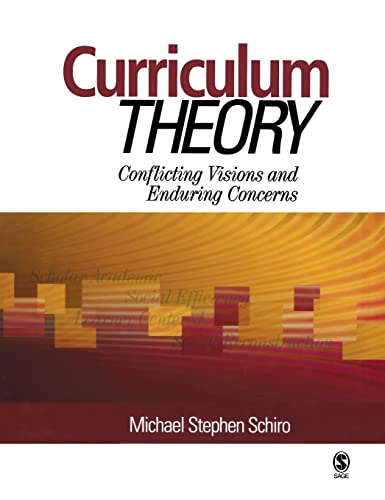

Curriculum theory : conflicting visions and enduring concerns / Michael S. Schiro.
Detalles de publicación: Los Angeles, Calif. : Sage Publications, c2008.Descripción: xvii, 237 p. : ill. ; 24 cmISBN:- 9781412953153 (cloth : alk. paper)
- 9781412953160 (pbk. alk. paper)
| Imagen de cubierta | Tipo de ítem | Biblioteca actual | Biblioteca de origen | Colección | Ubicación en estantería | Signatura topográfica | Materiales especificados | Info Vol | URL | Copia número | Estado | Notas | Fecha de vencimiento | Código de barras | Reserva de ítems | Prioridad de la cola de reserva de ejemplar | Reservas para cursos | |
|---|---|---|---|---|---|---|---|---|---|---|---|---|---|---|---|---|---|---|
| Libro | Biblioteca Mons. Iñaki Mallona (Arecibo) Colección General ab | 375.001 S337c (Navegar estantería(Abre debajo)) | Disponible | 60000010115662 |
Descripciones mejoradas de Syndetics:
"Schiro (Boston College) has written a text that examines curriculum theory for experience and pre-service educators with the purpose of understanding educational philosohpies or ideologies that they are likely to encounter in their teaching."--H.B. Arnold, CHOICE"The book provides readers with a clear, sympathetic and unbiased understanding of the four conflicting visions of curriculum that will enable them to more productively interact with educators who might hold different beliefs. The book stimulates readers to better understand their own beliefs and also to provide them with an understanding of alternate ways of thinking about the fundamental goals of education" --SIRREADALOT.ORG"A much needed, insightful view of alternative curriculum orientations. This is an exceptionally written book that will be useful to teachers, curriculum workers, and school administrators."--Marc Mahlios, University of Kansas
" Curriculum Theory: Conflicting Visions and Enduring Concerns is a thought provoking text that invites self-analysis."--Lars J. Helgeson, University of North Dakota
Curriculum Theory: Conflicting Visions and Enduring Concerns presents a clear, unbiased, and rigorous description of the major curriculum philosophies that have influenced educators and schooling over the last century. Author Michael Stephen Schiro analyzes four educational visions--Scholar Academic, Social Efficiency, Learner Centered, and Social Reconstruction--to enable readers to reflect on their own educational beliefs and allow them to more productively interact with educators who might hold different beliefs.
Key Features
Provides a historical perspective on the origins of curriculum ideologies: The book places our current educational debates and issues in a historical context of enduring concerns. Offers a model of how educational movements can be critically analyzed: Using a post-structuralist perspective, this model enables readers to more effectively contribute to the public debate about educational issues. Pays careful attention to the way language is used by educators to give meaning to frequently unspoken assumptions: The text′s examination helps readers better understand curricular disagreements that occur in schools. Highlights the complexities of curriculum work in a social context: With an understanding of the ideological pressures exerted on them by society and colleagues, readers can put these pressures in perspective and maintain their own values, beliefs, and practices.Intended Audience
This book is designed as a supplemental text for advanced undergraduate and graduate courses such as Curriculum Theory, Introduction to Curriculum and Instruction, Curriculum Philosophy, and Curriculum Theory and Practice in the department of education.
Includes bibliographical references and index.
Tabla de contenidos provista por Syndetics
- Preface
- 1 Introduction to Curriculum Ideologies
- Your Beliefs About Curriculum
- The Curriculum Ideologies
- Curriculum Workers
- The Nature of the Curriculum Ideologies
- 2 Scholar Academic Ideology
- Scholar Academic Curricula
- Curriculum and the Disciplines
- The Academic Disciplines
- Curriculum Issues
- Historical Context
- Aims
- Knowledge
- The Child
- Learning
- Teaching
- Evaluation
- Concluding Perspective
- 3 Social Efficiency Ideology
- A Scientific Technique of Curriculum Making
- Programmed Curriculum and the Behavioral Engineer
- The Analogy
- Social Orientation
- Objectives
- Historical Context
- Aims
- Knowledge
- Learning
- The Child
- Teaching
- Evaluation
- Concluding Perspective
- 4 Learner Centered Ideology
- The Ideal School
- Learners
- The Growing Individual
- The Learning Person
- The Curriculum: Unit of Work Versus School Subject
- Historical Context
- Aims
- The Child
- Learning
- Teaching
- Knowledge
- Evaluation
- Concluding Perspective
- 5 Social Reconstruction Ideology
- Highlander
- Sixth-Grade Social Reconstruction Mathematics
- Society and Reconstruction
- Reconstruction Through Education
- Historical Context
- Aims
- The Child
- Learning
- Teaching
- Knowledge
- Evaluation
- Concluding Perspective
- 6 A Comparative Overview of Curriculum Ideologies
- Comparative Summary
- Other Parameters
- Concluding Perspective
- 7 Individual Perspectives on Curriculum Ideologies
- Curriculum Life Histories
- Can People Believe in More Than One Ideology?
- Why Do Educators Change Ideologies?
- Concluding Perspective
- Appendix: Curriculum Ideologies Inventory
- References
- Index
- About the Author
- Why Do Educators Change Ideologies?
- Concluding Perspective
- Appendix
- Curriculum Ideologies Inventory
- Instructions for Graphing the Results of the Inventory
- Curriculum Ideologies Inventory Graphing Sheet
- Instructions for Interpreting the Results of the Inventory
- Example of a Completed Graph for the Curriculum Ideologies Inventory
- References
- Index
- About the Author
Reseñas proporcionadas por Syndetics
CHOICE Review
Schiro (Boston College) has written a text that examines curriculum theory for experienced and pre-service educators with the purpose of understanding educational philosophies or ideologies that they are likely to encounter in their teaching. The publication is organized around an introductory chapter and four main chapters that examine each of the major curriculum ideologies: Scholar Academic, Social Efficiency, Learner Centered, and Social Reconstruction. Chapters 2, 3, 4, and 5 provide an explanation of and historical perspective on each of the ideologies. In chapter 6 the author examines knowledge, learning, the child, teaching, and evaluation with the use of comparative tables. The tables are easy to use and ask key questions for the reader while providing a focus on the ideologies that have been presented in earlier chapters. The final chapter is focused on individual perspectives. The appendix provides a Curriculum Ideologies Inventory that will be useful in pre-service courses and professional development seminars. Summing Up: Recommended. All undergraduates through professionals. H. B. Arnold University of the PacificNotas de autor provistas por Syndetics
Michael Stephen Schiro has taught at the elementary, middle, and high school levels. He received his bachelorate from Tufts University and his doctorate from Harvard University. In the 1960's he worked for school desegregation n North Carolina. In the 1970's he worked to improve urban education in Lowell, Massachusetts. He was chair of the Department of Teacher Education and School Administration at Boston College in the 1980's. He specializes in mathematics education and curriculum theory, and taught courses in mathematics education, curriculum theory, computer education, literacy, and multicultural education at Boston College from 1974 to 2009, when he retired. He published eleven books with such diverse titles as Integrating Children′s Literature and Mathematics in the Classroom, Oral Story Telling and Teaching Mathematics, Mega-Fun Math Games, Curriculum for Better Schools: The Great Ideological Debate, and Tan and the Shape Changer.