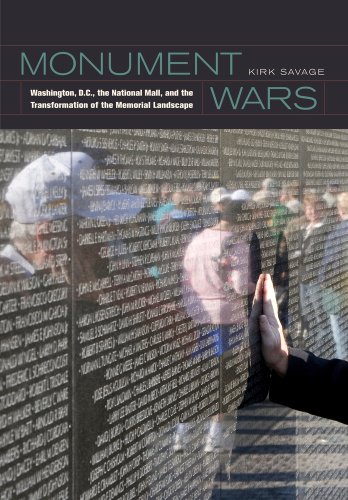
Imagen de portada de Amazon
Imagen de Amazon.com
Imagen de cubierta Syndetics
Portada de Syndetics
Imagen de OpenLibrary

Monument wars Washington, D.C., the National Mall, and the transformation of the memorial landscape Kirk Savage. txt

Por: United States of America University of California Press 2009Descripción: x, 390 p. ill., maps 27 cmTipo de contenido:
  • text
Tipo de medio:
  • unmediaded
Tipo de soporte:
  • volume
ISBN:
  • 9780520256545
Tema(s): Clasificación CDD:
  • 725/.9409753 22
Clasificación LoC:
  • F203.5.M2  S38 2009
Contenidos:
Introduction -- A monument to a deceased project -- Covering ground -- The mechanic monster -- Inventing public space -- The monument transformed -- The conscience of the nation -- An end to war, an end to monuments?
Valoración
    Valoración media: 0.0 (0 votos)
Existencias
Imagen de cubierta Tipo de ítem Biblioteca actual Biblioteca de origen Colección Ubicación en estantería Signatura topográfica Materiales especificados Info Vol URL Copia número Estado Notas Fecha de vencimiento Código de barras Reserva de ítems Prioridad de la cola de reserva de ejemplar Reservas para cursos
Libro CARIBET Biblioteca Arquitectura Colección General CARIBET General F203.5.M2 S38 2009 (Navegar estantería(Abre debajo)) 1 Disponible 91000000037796
Total de reservas: 0

Descripciones mejoradas de Syndetics:

The National Mall in Washington, D.C., is "a great public space, as essential a part of the American landscape as the Grand Canyon," according to architecture critic Paul Goldberger, but few realize how recent, fragile, and contested this achievement is. In Monument Wars , Kirk Savage tells the Mall's engrossing story--its historic plan, the structures that populate its corridors, and the sea change it reveals regarding national representation. Central to this narrative is a dramatic shift from the nineteenth-century concept of a decentralized landscape, or "ground"-heroic statues spread out in traffic circles and picturesque parks-to the twentieth-century ideal of "space," in which authority is concentrated in an intensified center, and the monument is transformed from an object of reverence to a space of experience. Savage's lively and intelligent analysis traces the refocusing of the monuments themselves, from that of a single man, often on horseback, to commemorations of common soldiers or citizens; and from monuments that celebrate victory and heroism to memorials honoring victims. An indispensable guide to the National Mall, Monument Wars provides a fresh and fascinating perspective on over two hundred years of American history.

Include index.

Includes bibliographical reference.

Introduction -- A monument to a deceased project -- Covering ground -- The mechanic monster -- Inventing public space -- The monument transformed -- The conscience of the nation -- An end to war, an end to monuments?

Reseñas proporcionadas por Syndetics

CHOICE Review

Savage (art and architecture, Univ. of Pittsburgh) deviates from a strictly chronological account to provide a meticulous, well-researched narrative that acknowledges and questions the role of the monument while tracing a shift or "spatial turn" away from the 19th-century notion of public "grounds" to the modern conception of "space." Tracing the aesthetic, social, and cultural transformation of Washington, DC, from Pierre Charles L'Enfant's 18th-century plan for dispersing monuments and hubs across the city to the unified landscape core of the 20th century, Savage offers an acute study of the National Mall, its memorials and monuments, and the allocation and designation of space in the nation's capital. The author's critical stance moves beyond descriptive or historical studies to offer theoretical grounding that adds to recent scholarship by James M. Goode (Washington Sculpture, CH, Aug'09, 46-6541) and Cynthia Field et al. (Paris on the Potomac, CH, Sep'08, 46-0091). Moreover, Monument Wars deepens understanding of Washington's monuments and how they engage the interstices of the local and national, past and present, patron and viewer. Endnotes and bibliography of archival and database references and more than 300 print sources from a range of disciplines (history, art history, design, landscape aesthetics, philosophy, and psychology) richly annotate the book. Invaluable for courses in US history, American studies, art history, visual culture, and public art. Summing Up: Essential. All readers/libraries. J. Decker Georgetown College

Notas de autor provistas por Syndetics

Kirk Savage is Associate Professor and Chair of the Department of Art and Architecture at the University of Pittsburgh. He is the author of Standing Soldiers, Kneeling Slaves: Race, War, and Monument in Nineteenth-Century America.
Compartir
logopucpr-y-vive

Contáctanos

¡Queremos saber de ti!

Tel. 787.841.2000 Ext. 1801

bibliotecavaldes@pucpr.edu

⁣Búscanos en las redes

© 2026 Desarrollado por Ignite Online • All Rights Reserved • Powered by Koha.