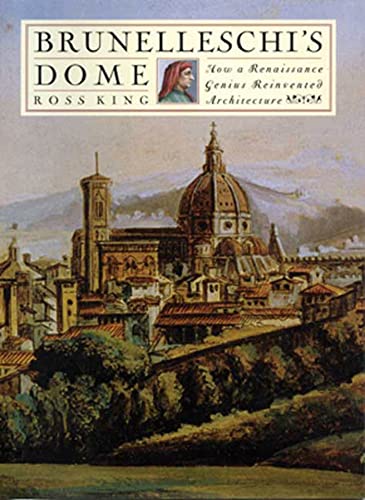

Brunelleschi's dome : how a Renaissance genius reinvented architecture / King, Ross txt
New York : Walker & company , 2000Descripción: 194 pag. ill. 25 cmTipo de contenido:- text
- unmediaded
- volume
- 9780802713667
- 0802713661
- 726.6
- NA5621.F7 k56 2000
| Imagen de cubierta | Tipo de ítem | Biblioteca actual | Biblioteca de origen | Colección | Ubicación en estantería | Signatura topográfica | Materiales especificados | Info Vol | URL | Copia número | Estado | Notas | Fecha de vencimiento | Código de barras | Reserva de ítems | Prioridad de la cola de reserva de ejemplar | Reservas para cursos | |
|---|---|---|---|---|---|---|---|---|---|---|---|---|---|---|---|---|---|---|
| Libro | CARIBET Biblioteca Arquitectura Colección General CARIBET | General NA5621.F7 k56 2000 (Navegar estantería(Abre debajo)) | 1 | Disponible | 91000000033365 |
Descripciones mejoradas de Syndetics:
Anyone alive in Florence on August 19, 1418, would have understood the significance of the competition announced that day concerning the city's magnificent new cathedral, Santa Maria del Fiore, already under construction for more than a century. "Whoever desires to make any model or design for the vaulting of the main Dome...shall do so before the end of the month of September." The proposed dome was regarded far and wide as all but impossible to build: not only would it be enormous, but its original and sacrosanct design eschewed (shunned) the flying buttresses that supported cathedrals all over Europe. The dome would literally need to be erected over thin air.
Of the many plans submitted, one stood out--a daring and unorthodox solution to vaulting what is still the largest dome (143 feet in diameter) in the world. It was offered not by a master mason or carpenter, but by a goldsmith and clock maker named Filippo Brunelleschi, then 41, who would dedicate the next 28 years to solving the puzzles of the dome's construction. In the process, he did nothing less than reinvent the field of architecture.
Brunelleschi's Dome is the story of how a Renaissance genius bent men, materials, and the very forces of nature to build an architectural wonder we continue to marvel at today. Denounced at first as a madman, Brunelleschi was celebrated at the end as a genius. He engineered the perfect placement of brick and stone, built ingenious hoists and cranes (some among the most renowned machines of the Renaissance) to carry an estimated 70 million pounds hundreds of feet into the air, and designed the workers' platforms and routines so carefully that only one man died during the decades of construction--all the while defying those who said the dome would surely collapse and personal obstacles that at times threatened to overwhelm him. This drama was played out amidst plagues, wars, political feuds, and the intellectual ferments of Renaissance Florence--events Ross King weaves into the story to great effect, from Brunelleschi's bitter, ongoing rivalry with the sculptor Lorenzo Ghiberti to the near capture of Florence by the Duke of Milan. King also offers a wealth of fascinating detail that opens windows onto fifteenth-century life: the celebrated traditions of the brickmaker's art, the daily routine of the artisans laboring hundreds of feet above the ground as the dome grew ever higher, the problems of transportation, the power of the guilds.
Even today, in an age of soaring skyscrapers, the cathedral dome of Santa Maria del Fiore retains a rare power to astonish. In telling the story of the greatest engineering puzzle of the Renaissance and one of the world's architectural marvels, Ross King brings its creation to life in a fifteenth-century chronicle with twenty-first-century resonance.
includes index
includes bibliography pg.177
Tabla de contenidos provista por Syndetics
- List of Illustrations(p. ix)
- Acknowledgments(p. xi)
- 1 A More Beautiful and Honourable Temple(p. 1)
- 2 The Goldsmith of San Giovanni(p. 12)
- 3 The Treasure Hunters(p. 21)
- 4 An Ass and a Babbler(p. 32)
- 5 The Rivals(p. 43)
- 6 Men without Name or Family(p. 49)
- 7 Some Unheard-of Machine(p. 56)
- 8 The Chain of Stone(p. 70)
- 9 The Tale of the Fat Carpenter(p. 76)
- 10 The Pointed Fifth(p. 82)
- 11 Bricks and Mortar(p. 91)
- 12 Circle by Circle(p. 100)
- 13 The Monster of the Arno(p. 108)
- 14 Debacle at Lucca(p. 118)
- 15 From Bad to Worse(p. 128)
- 16 Consecration(p. 137)
- 17 The Lantern(p. 141)
- 18 Ingenii Viri Philippi Brunelleschi(p. 153)
- 19 The Nest of Delights(p. 160)
- Notes(p. 169)
- Select Bibliography(p. 177)
- Index(p. 179)
Reseñas proporcionadas por Syndetics
Library Journal Review
British historical novelist King (Domino, Minerva; Ex Libris) brings his talent for colorful period re-creation to the story of the world's largest masonry dome, that of the cathedral in Florence, Italy. Filippo Brunelleschi's ingenious solution for erecting the enormous dome ranks among the outstanding accomplishments of the early Renaissance, stimulating among his contemporaries a new appreciation of classical architecture as well as inspiring a spirit of innovation. For King, the dome's story is a tumultuous saga of rich and poor, geniuses and journeymen, soldiers and ecclesiastics, all of whom bring to life the vivid tapestry of daily life in the first half of the 1400s. King has done his research, but where the historical record is vague he doesn't hesitate to deploy the speculative imagination of the novelist. Regarding the cathedral itself, he dwells on engineering minutiae, paying scant attention to design and aesthetics. Omitted is mention of Filippo's important designs for the cathedral's exedrae, perhaps because this episode lacks drama. For reference, public libraries need Peter Murray's Architecture of the Italian Renaissance (1975, o.p.) or Ludwig Heydenreich's Architecture in Italy, 1400-1500 (Yale Univ., 1995). Those that are looking for a simple "good read" in the mold of Dava Sobel's Longitude (LJ 8/96) would do well to acquire this page turner.DDavid Soltsz, Cuyahoga Cty. P.L., Parma, OH (c) Copyright 2010. Library Journals LLC, a wholly owned subsidiary of Media Source, Inc. No redistribution permitted.Publishers Weekly Review
Walker was the hardcover publisher of Dava Sobel's sleeper smash, Longitude, and Mark Kurlansky's steady-seller Cod: A Biography of the Fish that Changed the World. This brief, secondary source-based account is clearly aimed at the same lay science-cum-adventure readership. British novelist King (previously unpublished in the U.S.) compiles an elementary introduction to the story of how and why Renaissance Italian architect Filippo Brunelleschi (1377-1446) designed and oversaw the construction of the enormous dome of Florence's Santa Maria del Fiore cathedralÄdesigning its curves so that they needed no supporting framework during construction: a major Renaissance architectural innovation. Illustrated with 26 b&w period prints, the book contains 19 chapters, some very brief. Although the result is fast moving and accessible, King overdoes the simplicity to the point that the book appears unwittingly as if it was intended for young adults. (Donatello, Leonardo and Michelangelo, for example, "took a dim view of marriage and women.") This book feels miles away from its actual characters, lacking the kind of dramatic flourish that would bring it fully to life. Despite direct quotes from letters and period accounts, the "would have," "may have" and "must have" sentences pile up. Still, the focus on the dome, its attendant social and architectural problems, and the solutions improvised by Brunelleschi provide enough inherent tension to carry readers along. (Oct. 23) (c) Copyright PWxyz, LLC. All rights reservedCHOICE Review
British novelist King has written a remarkably readable book with a well-designed format on what could be a tediously technical subject: the construction of the dome of Santa Maria del Fiore in Florence. The reader is treated to a chronicle of Filippo Brunelleschi's life in 19 chapters that include such fascinating details as the daily routine of the workers, the technology of brick making and quarrying of marble, the amazing machines invented by Brunelleschi for raising 70 million pounds of stone to the highest levels of the dome, and the rhyme and reason for his ingenious patterning of bricks. This detailed history of the building process is illustrated with useful diagrams and drawings and includes comprehensive notes and bibliography. Using primary sources as well as the literature of decades of scholarship, the author delights the reader with his enticing narrative, which unfolds like a mystery tale. Any prospective reader will ask one important question: does the author really explain comprehensibly exactly how Brunelleschi constructed the dome? He does. But more than that, a window is opened onto life in 15th-century Florence, with a telescope on the genius who solved "the greatest architectural puzzle of the age." General readers; undergraduates through faculty. S. C. Scott Pennsylvania State University, University Park CampusBooklist Review
Like the poetry of Petrarch or the artistry of Giotto, the architecture of Filippo Brunelleschi radiates the talent of a Renaissance genius. King illuminates the mysterious sources of inspiration and the secretive methods of this architectural genius in a fascinating chronicle of the building of his masterwork, the dome of Santa Maria del Fiore. Unsurpassed by St. Peter's in Rome or St. Paul's in London, Filippo's sublime dome required an imaginative leap in its conception and a stubborn relentlessness in its execution. King details how Filippo waged and won his 28-year battle to raise the magnificent structure, surmounting every technical, political, and artistic obstacle. And just as his dome created a visual focus for the city of Florence, his exploits in building it wove together numerous strands of municipal history--war, disease, intrigue, commerce--making one glorious narrative cord. King demonstrates a remarkable range, explaining everything from how Filippo engineered the hoists for raising stone to why the masons working on the dome drank diluted wine, but he always brings us back to the one incandescent mind performing the one matchless feat that would forever transform architecture from a mechanical craft into a creative art. --Bryce ChristensenNotas de autor provistas por Syndetics
Born and raised in Canada, Ross King has lived in England since 1992. In 2002--03, two books of his were published in the United States, Domino , about the world of masquerades and opera in 18th century London and the New York Times bestselling Michelangelo and the Pope's Ceiling .
Nominated for a National Book Critics Circle Award in 2003 in the category of critisicm, in Michelangelo and the Pope's Ceiling King tells the story of the four years--1508-1512.--Michelangelo spent painting the ceiling of the newly restored Sistine chapel. In this extraordinary book, he presents a magnificent tapestry of day-to-day life of the ingenious Sistine scaffolding and outside in the upheaval of early 16th century Rome.
King's highly acclaimed Brunelleschi's Dome: How a Renaissance Genius Reinvented Architecture , was an instant hit in the U.S., landing on the New York Times , Boston Globe and San Francisco Chronicle bestseller lists and becoming a handselling favorite among booksellers. Brunelleschi's Dome was chosen "The 2000 Book Sense Nonfiction Book of the Year" and a Book Sense 76 top ten selection.
Anyone familiar with Ross King's writing knows that he has an astonishing knowledge of European cultural history. He originally planned a career in academia, earning his Ph.D. in English Literature and moving to England to assume a research position at the University of London.
King lives near Oxford, England, in the historic town of Woodstock, the site of Blenheim Palace. He is a devoted cyclist and hikes regularly in both the Pyrenees and the Canadian Rockies.