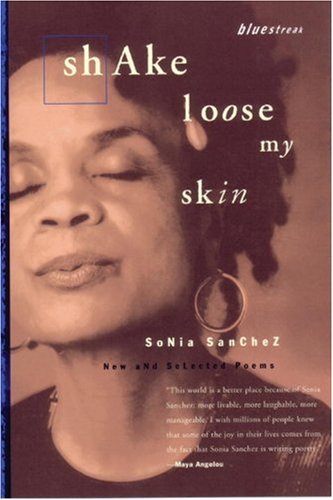
Covering over thirty years of work, Shake Loose My Skin is a stunning testament to the literary, sensual, and political powers of the award-winning Sonia Sanchez. "This world is a better place because of Sonia Sanchez: more livable, more laughable, more manageable. I wish millions of people knew that some of the joy in their lives comes from the fact that Sonia Sanchez is writing poetry." -Maya Angelou
Extracto provisto por Syndetics
Excerpt Homecoming i have been a way so long once after college i returned tourist style to watch all the niggers killing themselves with three-for-oners with needles that cd not support their stutters. now woman i have returned leaving behind me all those hide and seek faces peeling with freudian dreams. this is for real. black niggers my beauty. baby. i have learned it ain't like they say in the newspapers. Poem at Thirty it is midnight no magical bewitching hour for me i know only that i am here waiting remembering that once as a child i walked two miles in my sleep. did i know then where i was going? traveling, i'm always traveling. i want to tell you about me about nights on a brown couch when i wrapped my bones in lint and refused to move. no one touches me anymore. father do not send me out among strangers. you you black man stretching scraping the mold from your body. here is my hand. i am not afraid of the night. Malcolm do not speak to me of martydom of men who die to be remembered on some parish day. i don't believe in dying though i too shall die and violets like castanets will echo me. yet this man this dreamer, thick-lipped with words will never speak again and in each winter when the cold air cracks with frost, i'll breathe his breath and mourn my gun-filled nights. he was the sun that tagged the western sky and melted tiger-scholars while they searched for stripes. he said, "fuck you white man. we have been curled too long. nothing is sacred now. not your white face nor any land that separates until some voices squat with spasms." do not speak to me of living. life is obscene with crowds of white on black. death is my pulse. what might have been is not for him/or me but what could have been floods the womb until i drown. Personal Letter No. 2 i speak skimpily to you about apartments i no longer dwell in and children who chant their dis obedience in choruses. if i were young i wd stretch you with my wild words while our nights run soft with hands. but i am what i am. woman. alone amid all this noise. A Poem far My Father how sad it must be to love so many women to need so many black perfumed bodies weeping underneath you. when i remember all those nights i filled my mind with long wars between short sighted trojans & greeks while you slapped some wide hips about in your pvt dungeon, when i remember your deformity i want to do something about your makeshift manhood. i guess that is why on meeting your sixth wife, i cross myself with her confessionals. Poem No. 3 i gather up each sound you left behind and stretch them on our bed. each nite i breathe you and become high. Blues in the night in my half hour negro dreams i hear voices knocking at the door i see walls dripping screams up and down the halls won't someone open the door for me? won't some one schedule my sleep and don't ask no questions? noise. like when he took me to his home away from home place and i died the long sought after death he'd planned for me. Yeah, bessie he put in the bacon and it overflowed the pot. and two days later when i was talking i started to grin. as everyone knows i am still grinning. Haiku did ya ever cry Black man, did ya ever cry til you knocked all over? Sequences 1. today I am tired of sabbaths. I seek a river of sticks scratching the spine. O I have laughed the clown's air now my breath dries in paint. 2. what is this profusion? the sun does not burn a cure, but hoards while I stretch upward. I hear, turning in my shrug a blaze of horns. O I had forgotten parades belabored with dreams. 3. in my father's time I fished in ponds without fishes. arching my throat, I gargled amid nerves and sang of redeemers. (o where have you been sweet redeemer, sharp redeemer, o where have you been baroque shimmer? i have been in coventry where ghosts danced in my veins i have heard you in all refrains.) 4. ah the lull of a yellow voice that does not whine with roots. I have touched breasts and buildings answered. I have breathed moth-shaped men without seeds. (O indiscriminate sleeves) (once upon an afternoon i became still-life i carried a balloon and a long black knife.) 5. love comes with pink eyes with movements that run green then blue again. my thighs burn in crystal. Haiku if i had known, if i had known you, i would have left my love at home. Poem No. 8 i've been a woman with my legs stretched by the wind rushing the day thinking i heard your voice while it was only the nite moving over making room for the dawn. Copyright (c) 1999 Sonia Sanchez. All rights reserved.
Reseñas proporcionadas por Syndetics
Library Journal Review
In this anthology, which include a tribute to her father, love poems, and notes to graduating seniors, African American poet and lecturer Sanchez brings together selections from her previous works (including the National Book Critics Circle nominee, Does Your House Have Lions?). (c) Copyright 2010. Library Journals LLC, a wholly owned subsidiary of Media Source, Inc. No redistribution permitted.
Publishers Weekly Review
Mapping out an education that starts with a "Homecoming""I have been a/ way so long/ once after college/ I returned tourist/ style to watch all/ the niggers killing/ themselves"and arrives at a "Love Poem" that asks, "where are the fathers/ strutting their furlined/ intellect bowing their/ faces in the crotch/ of academia," Sanchez avoids many of the poetic pitfalls that an explicit political agenda can entail. This gathering, including work from six previous collections, highlights Sanchez's range: prose poems investigate disenfranchised lives, from a lover strung out on dope to a hate-crime victim whose home has been spray-painted with the predictably horrifying epithets, while lyrics move down the page in sinewy lines that seem to pluck living speech from air. But it is love, or the lack therof, that is at the heart of the book. Sanchez's language is restless in seeking it out, shuttling back and forth from a gritty black vernacular in "Towhomitmayconcern" ("git yo/ self fattened up man/ you gon be doing battle with me/ ima gonna stake you out") to the jazzy nomenclature of "This Is not a Small Voice" ("This is the voice of La Tanya./ Kadesha. Shaniqua. This/ is the voice of Antoine./ Darryl. Shaquille.") Such polyvocal lyrics celebrate the breadth of black culture, and probe the silences of bigotry. Like June Jordan, Sanchez is at her best when enacting power struggles rather than merely rallying political support in easy battlecries, as some of these poems do. This collection should draw wide attention to the consistency of Sanchez's achievement, and to the success of her formal adaptations, like the recent "Blues Haikus": "am I yo philly/ outpost? man when you sail in/ to my house, you docked." (Feb.) (c) Copyright PWxyz, LLC. All rights reserved
Booklist Review
Ai's name is as terse as an element in the periodic table, and a symbol for a complex amalgam that is part African American, Japanese (Ai means love in that language), Choctaw, and Dutch, but this braided heritage rarely surfaces in her famously jolting poems. Ai prefers to write "fictions," dramatic, sometimes surreal monologues delivered by invented characters or headline icons. This form dominates her new work as well as the selections from her first four books, Cruelty, Killing Floor, Sin, and Fate. In the past, Ai has given voice to such figures as Jimmy Hoffa, J. Edgar Hoover, and Lenny Bruce. In her new poems, she scours today's news and writes about rapists, the paparazzi, Jon-Benet Ramsey, and a president embroiled in a sex scandal. Whatever one may think of Ai's poetics, her bold and searing performances constitute a key facet in the literature of cultural dissection. Dove is a far more lyric poet, and her poems are to be savored. She, too, is a storyteller, but for her the real action is on the inside, and her psychological portraits of mothers, fathers, and children are gently illuminating and arrestingly beautiful. In "Cameos," she traces the emotional fissures that run beneath the modest facade of a blue-collar family. The theme of self-betterment and a passion for learning runs through many poems, particularly those in a sequence titled "Freedom: A Bird's Eye View." Music animates Dove's supple lines as she praises Rosa Parks and all the unnamed heroines and heroes who calmly and firmly say no to what can and must be changed, and yes to what cannot. Sanchez, like Ai, has always been an outspoken and unflinching poet, innovative in her improvisations on meter and form. She moves from harmless-looking, short-lined stanzas that pack a wallop to jazzy prose-poems, giving shape and sound to every shade of mood, from blue to sensual, violent to celebratory. More than three decades of her work appear in this new retrospective volume, including concise early works from I've Been a Woman to prosy offerings from Homegirls and Handgrenades, and on up through four subsequent volumes, ending finally with four new poems. --Donna Seaman
Notas de autor provistas por Syndetics
Born in Alabama, educated in New York City, Sanchez is a leading poet of the Black Arts Movement, whose poetry is written from political, economic, and social concerns as well as literary ones. Although her literary focus has been primarily to express her experience as an African American woman, Sanchez claims, "if you write from a black experience, you're writing from a universal experience as well." Sanchez's poems are direct, colloquial, and often militant. Many of her works are for children, such as her "poems for young brothas and sistuhs," as she puts it in It's a New Day (1971). Yet she also writes with tenderness about love. As academic interest in the voices of women and African Americans has intensified, critical interest in and acceptance of Sanchez's work has increased. (Bowker Author Biography)
Shake loose my skin
APA
Sanchez S., . (1999). Shake loose my skin: new and selected poems. Boston: Beacon Press.
Chicago
Sanchez Sonia, . 1999. Shake loose my skin: new and selected poems. Boston: Beacon Press.
Harvard
Sanchez S., . (1999). Shake loose my skin: new and selected poems. Boston: Beacon Press.
MLA
Sanchez Sonia, . Shake loose my skin: new and selected poems. Boston: Beacon Press. 1999.