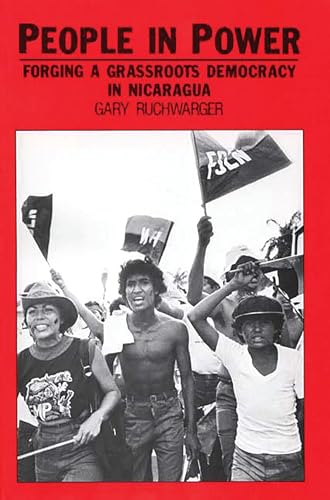
Imagen de portada de Amazon
Imagen de Amazon.com
Imagen de cubierta Syndetics
Portada de Syndetics
Imagen de OpenLibrary

People in power forging a grassroots democracy in Nicaragua Gary Ruchwarger.

Por: Detalles de publicación: South Hadley, Mass. Bergin & Garvey Publishers 1987.Descripción: xi, 340 p. map 24 cmISBN:
  • 0897891295 (alk. paper)
  • 0897891309 (pbk. : alk. paper)
Tema(s): Clasificación CDD:
  • 324/.097285 19
Clasificación LoC:
  • JL1616 .R82 1987
Valoración
    Valoración media: 0.0 (0 votos)
Existencias
Imagen de cubierta Tipo de ítem Biblioteca actual Biblioteca de origen Colección Ubicación en estantería Signatura topográfica Materiales especificados Info Vol URL Copia número Estado Notas Fecha de vencimiento Código de barras Reserva de ítems Prioridad de la cola de reserva de ejemplar Reservas para cursos
Libro Biblioteca Encarnación Valdés Colección General bev 324.097285 R899p (Navegar estantería(Abre debajo)) Disponible 80000000325939
Total de reservas: 0

Descripciones mejoradas de Syndetics:

In one of the best social and economic histories to date of the post-1960 upheavals, Ruchwarger emphasizes that these [mass-based] groups played a long, crucial and independent role in shaping the revolution that destroyed Somoza.
The Times Literary Supplement

A wealth of useful data. . . . There is value in much of the information and the organizational structures of participation are clearly outlined. Choice

Includes index.

Bibliography: p. 328-334.

Reseñas proporcionadas por Syndetics

Library Journal Review

This useful book focuses on the essential political issue in Nicaragua: To what extent does authentic popular control exist? Instead of concentrating on the top down, Ruchwarger analyzes the operations and influence of grassroots organizations. Although sympathetic to the Sandinistas, he arrives at several important critical conclusions, among them that the local organizations for the most part operate with participatory democracy, but they have not exerted influence in higher government levels. This work provides support for the view that the Sandinistas have pursued an eclectic revolutionary approach. Recommended for academic libraries. Roderic A. Camp, Latin American Studies Dept., Central Coll., Pella, Ia . (c) Copyright 2010. Library Journals LLC, a wholly owned subsidiary of Media Source, Inc. No redistribution permitted.

CHOICE Review

The participatory characteristics of the Nicaraguan revolution are described in detail. Both before and after the July 1979 ouster of the Somoza family dynasty, the role of grass-roots activities is depicted as central to the methods of the revolutionaries. The author relies substantially on interviews and observation during 16 months' research conducted from 1983 to 1986. The result is a wealth of useful data concerning Sandinista mass organizations and their efforts to shape policy and popular attitudes. Ruchwarger is avowedly sympathetic to the revolution, and judgments are not always based on an unbiased perspective. Furthermore, the rush of events is eclipsing the conditions described here. A better-balanced and broader treatment is John Booth's The End and the Beginning: The Nicaraguan Revolution (2nd ed., 1986; 1st ed., CH, Feb '83). However, there is value in much of the information, and the organizational structures of participation are clearly outlined. The book is extensively footnoted, and includes a select bibliography. Upper-division undergraduates.-J.D. Martz, Pennsylvania State University, University Park Campus
Compartir
logopucpr-y-vive

Contáctanos

¡Queremos saber de ti!

Tel. 787.841.2000 Ext. 1801

bibliotecavaldes@pucpr.edu

⁣Búscanos en las redes

© 2026 Desarrollado por Ignite Online • All Rights Reserved • Powered by Koha.