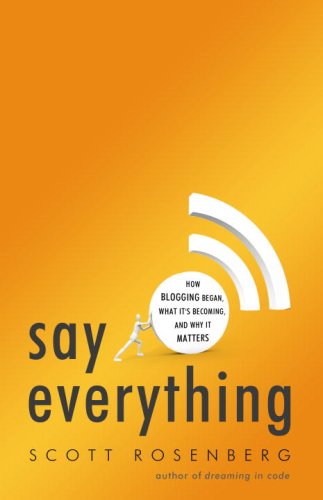

Say everything how blogging began, what it<U+2019>s becoming, and why it matters Scott Rosenberg.
Detalles de publicación: New York Crown c2009.Descripción: 404 p. 25 cmISBN:- 9780307451361
| Imagen de cubierta | Tipo de ítem | Biblioteca actual | Biblioteca de origen | Colección | Ubicación en estantería | Signatura topográfica | Materiales especificados | Info Vol | URL | Copia número | Estado | Notas | Fecha de vencimiento | Código de barras | Reserva de ítems | Prioridad de la cola de reserva de ejemplar | Reservas para cursos | |
|---|---|---|---|---|---|---|---|---|---|---|---|---|---|---|---|---|---|---|
| Libro | Biblioteca de Mayagüez Colección General mb | HM 851 .R674 2009 (Navegar estantería(Abre debajo)) | Disponible | 50000003201083 |
Descripciones mejoradas de Syndetics:
Blogs are not a fad. They are a new species of written conversation, a complex network of influence spanning everything from political debates to torrid confessions to urgent bulletins from first responders. The days when three network anchors would tell us what to think are gone; now we get to tell one another. Say Everythingoffers close-ups of blogging innovators like Blogger founder Evan Williams, Josh Marshall of Talking Points Memo, exhibitionist diariest Justin Hall, and many others, and explores the dilemmas that still face bloggers: How much if their private lives should they reveal? Should they blog for the love or for money? Is blogging anonymous ranting or honest, unmediated discussion? Through their stories,Say Everythingpresents essential insights into privacy, self-expression, authority, and community for all of us in the era of Google and Facebook. In his first book,Dreaming in Code,Scott Rosenberg brilliantly explored the art of creating software ("the first true successor to Tracy Kidder'sThe Soul of a New Machine," wrote James Fallows inThe Atlantic). InSay Everythinghe brings the same perceptive eye to the blogosphere, capturing as no one else has the birth of a new medium.
Includes bibliographical references (p. [363]-393) and index.
Explores the complex network of blogging and provides insights into the new medium with discussions on privacy, self-expression, authority, and community, and includes close-ups of blogging innovators, including Evan Williams of Blogger.
Pt. 1: Pioneers. Putting everything out there : Justin Hall ; The unedited voice of a person : Dave Winer ; They shall know you through your links : Jorn Barger, filters -- Pt. 2: Scaling up. The Blogger catapult : Evan Williams, Meg Hourihan ; The rise of political blogging : Josh Marshall ; Blogging for bucks : Robert Scoble, Nick Denton, Jason Calacanis ; The exploding blogosphere : boing boing ; The perils of keeping it real : Heather Armstrong -- Pt. 3: What have blogs wrought? Journalists vs. bloggers ; When everyone has a blog ; Fragments for the future -- Epilogue: Twilight of the cynics.
eigm 09/2010
Tabla de contenidos provista por Syndetics
- Introduction: What's New(p. 1)
- Part 1 Pioneers
- Chapter 1 Putting Everything Out There(p. 17)
- Chapter 2 The Unedited Voice of A Person(p. 46)
- Chapter 3 They Shall Know You Through Your Links(p. 74)
- Part 2 Scaling Up
- Chapter 4 The Blogger Catapult(p. 101)
- Chapter 5 The Rise of Political Blogging(p. 131)
- Chapter 6 Blogging for Bucks(p. 165)
- Chapter 7 The Exploding Blogosphere(p. 198)
- Chapter 8 The Perils of Keeping it Real(p. 229)
- Part 3 What Have Blogs Wrought?
- Chapter 9 Journalists vs. Bloggers(p. 269)
- Chapter 10 When Everyone has a Blog(p. 301)
- Chapter 11 Fragments for the Future(p. 328)
- Epilogue: Twilight of the Cynics(p. 352)
- Author's Note and Acknowledgments(p. 361)
- Notes(p. 363)
- Index(p. 395)
Extracto provisto por Syndetics
Reseñas proporcionadas por Syndetics
Booklist Review
Given Twitter's explosion in popularity, a book about good old-fashioned blogging might seem downright fusty. But the Web is so new, and changes so fast, that it's easy to forget how quickly new technology becomes a foregone conclusion. (Consider this: in 1999, blogs were counted in thousands; now they are counted in millions.) Salon.com cofounder Rosenberg (Dreaming in Code, 2006) has a distinctly nontechnical way of writing about technology, and in these engaging profiles of key personalities and seminal moments in blogging's rise to ubiquity, he both reminds us how it happened and allows us to envision other possible outcomes. We meet Justin Hall, a pioneer in oversharing; discover how Blogger began as an afterthought; learn how Boing Boing balances idiosyncrasy with commercial success; and ponder whether the Long Tail is attached to a Big Butt. Most books about blogging are oxymoronic, growing quickly out of date and dying for lack of links. Rosenberg's approach, however, ensures that this volume will still be worthwhile another decade from now, when we've learned whether Twitter is the next Blogger or not.--Graff, Keir Copyright 2009 BooklistNotas de autor provistas por Syndetics
SCOTT ROSENBERG is an award-winning journalist who left the San Francisco Examiner in 1995 with a group of like-minded colleagues to found Salon.com, where he served first as technology editor, later as managing editor, and finally as vice president for new projects, leaving in 2007 to write Say Everything . For much of that time he wrote a blog covering the world of computers and the web, explaining complex issues in a lively voice for a non-technical readership. His coverage of the Microsoft trial, the Napster controversy, and the Internet bubble earned him a regular following. Rosenberg's writing has appeared in the New York Times, Wired, the San Francisco Examiner , and other publications. His previous books include Dreaming In Code . Visit his website at www.wordyard.com.From the Hardcover edition.