Descripciones mejoradas de Syndetics:
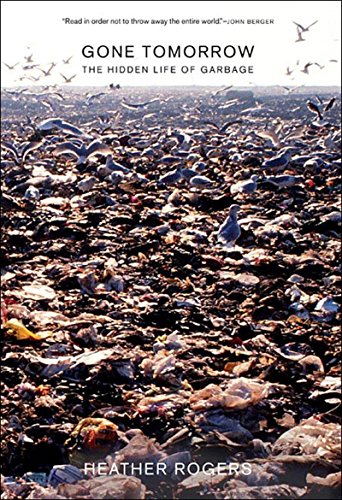
Eat a take-out meal, buy a pair of shoes, or read a newspaper, and you're soon faced with a bewildering amount of garbage. The United States is the planet's number-one producer of trash. Each American throws out 4.5 pounds daily. But garbage is also a global problem; the Pacific Ocean is today six times more abundant with plastic waste than zooplankton. How did we end up with this much rubbish, and where does it all go? Journalist and filmmaker Heather Rogers answers these questions by taking readers on a grisly, oddly fascinating tour through the underworld of garbage.
Said to "read like a thriller" ( Library Journal ), Gone Tomorrow excavates the history of rubbish handling from the 1800s to the present, pinpointing the roots of today's waste-addicted society. With a "lively authorial voice" ( New York Press ), Rogers draws connections between modern industrial production, consumer culture, and our throwaway lifestyle. She also investigates controversial topics like the politics of recycling and the export of trash to poor countries, while offering a potent argument for change.
Includes bibliographical references and index.
Reseñas proporcionadas por Syndetics
Library Journal Review
In this readable and well-researched study, writer, journalist, and filmmaker Rogers tackles garbage and the social, economic, political, and technological waste disposal choices and dilemmas that our communities face. Americans dispose of more than 700 billion pounds of paper, glass, plastic, wood, food, metal, clothing, electronics, and other refuse annually. The author examines the available options in dealing with this issue-e.g., feeding organic garbage to pigs, dumping in landfills, burning and incineration, exporting to other states or countries, and recycling and reusing disposables-and discusses their benefits and drawbacks. Her account of the criminal elements that once controlled New York City's garbage industry and how the city cleaned it up in the 1990s by establishing a garbage corporation reads like a thriller. Of particular note is Rogers's hard look at consumer habits, industrial imperatives, and the attitudes and lifestyles that generate extraordinary amounts of waste and pose a threat to the health of the planet. For on-site observations of garbage and the individuals who make their living from it, don't overlook Elizabeth Royte's Garbage Land: On the Secret Trail of Trash. Both books complement each other, offering readers a panoramic view of the garbage industry. Recommended for most collections.-Irwin Weintraub, Brooklyn Coll. Lib., New York (c) Copyright 2010. Library Journals LLC, a wholly owned subsidiary of Media Source, Inc. No redistribution permitted.
Publishers Weekly Review
Americans produce the most waste of any people on Earth, says Rogers, but few of us ever think about where all that trash goes. Rogers endeavors to show the inner workings of the waste stream, from the garbage truck to the landfill, incinerator or parts unknown. She points out that recycling, once touted as an environmental lifesaver, ?has serious flaws,? and has done little to mitigate garbage?s long history of environmental damage. Rogers also includes chapters on the history of waste removal and disposal, highlighting early sanitation efforts in New York City, as well as the multi-billion-dollar, multinational business of garbage. Consistently engaging, the book delineates the myriad problems caused by the country?s waste output, but offers very few concrete examples of what readers can do to improve the garbage situation; instead, Rogers stoically acknowledges that ?while consumers making choices with the environment in mind is a good thing, it is in no way a real solution to our trash woes.? Nevertheless, the book is an intriguing look into an often misunderstood and overlooked industry. (Oct.) Copyright 2005 Reed Business Information.
CHOICE Review
Journalist Rogers writes to encourage citizens to give greater attention to environmental stewardship. She focuses on garbage or solid waste and favors a greater effort to find better environmental management alternatives. This book does not present new science or engineering, and it does not propose new alternatives to improve solid waste management. Although sources of information are identified and referenced, the book does not contain a good comprehensive set of references to the solid waste literature. There is a need to pay greater attention to materials that are no longer needed. The book describes the present inadequate system for management of electronic waste, including computers. Life cycle analysis can be used in product design and development to find better methods to manage products and recycle materials when their useful life is finished. Rogers encourages readers to do better, but does not attempt to describe product-specific solutions. ^BSumming Up: General readers; lower-/upper-division undergraduates; professionals; two-year technical program students. L. E. Erickson Kansas State University
Booklist Review
America leads the world in garbage, and that is nothing to be proud of. A clear-thinking and peppery writer, Rogers presents a galvanizing expose of how we became the planet's trash monsters. Americans were ingeniously thrifty until industrialization ushered in consumer culture and the age of disposable goods and built-in obsolescence. But once the public was exhorted to buy stuff whether they needed it or not--and Rogers provides many eye-opening examples of corporate strategies and propaganda--new forms of garbage began to pile up and break down into toxic substances. Rogers details everything that is wrong with today's wasteful packaging, bogus recycling, and flawed landfills and incinerators. Here, too, is the inside story of the plastic revolution and the irresponsibly wasteful beverage market, the Mafia's involvement in commercial waste, and the illegal overseas shipping of garbage, especially toxic e-waste--trashed computers and cell phones. Rogers exhibits black-belt precision in her assault on American corporations that succeed in greenwashing the public while remaining hell-bent on ever-expanding production no matter what the ecological toll. Set this beside Elizabeth Royte's Garbage Land (2005), and contemplate Rogers' dictum: garbage never really goes away. --Donna Seaman Copyright 2005 Booklist
Notas de autor provistas por Syndetics
Heather Rogers is a journalist and filmmaker. Her documentary film Gone Tomorrow (2002) screened in festivals around the globe. Her writing has appeared in The Nation , Utne Reader , Z Magazine , the Brooklyn Rail , Punk Planet , and Art and Design . She lives in Brooklyn, New York.