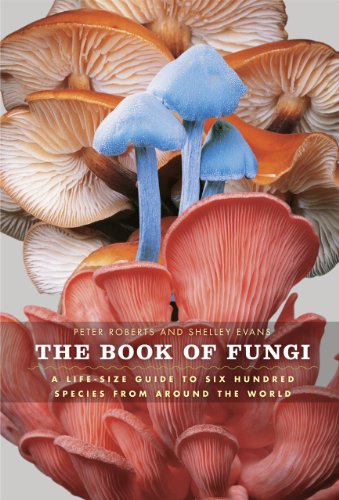

The book of fungi a life-size guide to six hundred species from around the world Peter Roberts and Shelley Evans.
Detalles de publicación: Chicago The University of Chicago Press 2011.Descripción: 655 p. ill. 27.5 cmISBN:- 9780226721170
| Imagen de cubierta | Tipo de ítem | Biblioteca actual | Biblioteca de origen | Colección | Ubicación en estantería | Signatura topográfica | Materiales especificados | Info Vol | URL | Copia número | Estado | Notas | Fecha de vencimiento | Código de barras | Reserva de ítems | Prioridad de la cola de reserva de ejemplar | Reservas para cursos | |
|---|---|---|---|---|---|---|---|---|---|---|---|---|---|---|---|---|---|---|
| Referencia | Biblioteca Mons. Iñaki Mallona (Arecibo) Sala de Referencia ab | 579.5 R6465b (Navegar estantería(Abre debajo)) | Disponible | 60000010134911 |
Descripciones mejoradas de Syndetics:
Colorful, mysterious, and often fantastically shaped, fungi have been a source of wonder and fascination since the earliest hunter-gatherers first foraged for them. Today there are few, if any, places on Earth where fungi have not found themselves a home. And these highly specialized organisms are an indispensable part of the great chain of life. They not only partner in symbiotic relationships with over ninety percent of the world's trees and flowering plant species, they also recycle and create humus, the fertile soil from which such flora receive their nutrition. Some fungi are parasites or saprotrophs; many are poisonous and, yes, hallucinogenic; others possess life-enhancing properties that can be tapped for pharmaceutical products; while a delicious few are prized by epicureans and gourmands worldwide.
In this lavishly illustrated volume, six hundred fungi from around the globe get their full due. Each species here is reproduced at its actual size, in full color, and is accompanied by a scientific explanation of its distribution, habitat, association, abundance, growth form, spore color, and edibility. Location maps give at-a-glance indications of each species' known global distribution, and specially commissioned engravings show different fruitbody forms and provide the vital statistics of height and diameter. With information on the characteristics, distinguishing features, and occasionally bizarre habits of these fungi, readers will find in this book the common and the conspicuous, the unfamiliar and the odd. There is a fungal predator, for instance, that hunts its prey with lassos, and several that set traps, including one that entices sows by releasing the pheromones of a wild boar.
Mushrooms, morels, puffballs, toadstools, truffles, chanterelles--fungi from habitats spanning the poles and the tropics, from the highest mountains to our own backyards--are all on display in this definitive work.
Includes index.
Tabla de contenidos provista por Syndetics
- Foreword(p. 6)
- Introduction(p. 8)
- What are fungi?(p. 10)
- Plant & animal partners(p. 12)
- Natural recyclers(p. 14)
- Pests & parasites(p. 16)
- Food, folklore & medicine(p. 18)
- Distribution & identifying fungi(p. 22)
- Guide to the fungi(p. 24)
- The fungi(p. 28)
- Agarics(p. 30)
- Boletes(p. 324)
- Brackets, Crusts & Jelly Fungi(p. 362)
- Tooth Fungi, Chanterelles, Clubs & Corals(p. 462)
- Puffballs & Earthstars, Bird's Nests & Stinkhorns(p. 506)
- Cup Fungi, Morels, Truffles, Flask Fungi & Lichens(p. 548)
- Appendices(p. 642)
- Glossary(p. 644)
- Resources(p. 646)
- The classification of fungi(p. 648)
- Index by common name(p. 650)
- Index by scientific name(p. 652)
- Acknowledgments(p. 656)