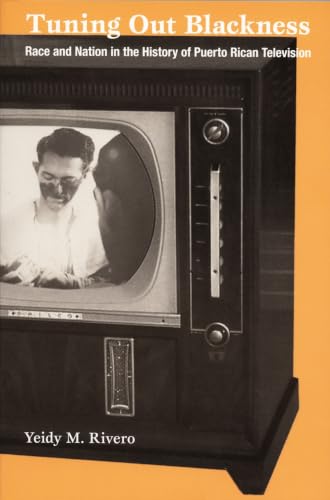

Tuning out blackness race and nation in the history of Puerto Rican television Yeidy M. Rivero.
Series Console-ing passionsDetalles de publicación: Durham Duke University Press c2005.Descripción: xii, 264 p. ill. 25 cmISBN:- 082233531X (cloth : alk. paper)
- 0822335433 (pbk. : alk. paper)
- 791.45/65289607295 22
- PN1992.3.P9 R58 2005
| Imagen de cubierta | Tipo de ítem | Biblioteca actual | Biblioteca de origen | Colección | Ubicación en estantería | Signatura topográfica | Materiales especificados | Info Vol | URL | Copia número | Estado | Notas | Fecha de vencimiento | Código de barras | Reserva de ítems | Prioridad de la cola de reserva de ejemplar | Reservas para cursos | |
|---|---|---|---|---|---|---|---|---|---|---|---|---|---|---|---|---|---|---|
| Libro | Biblioteca Encarnación Valdés Colección General bev | 791.45 R6218t (Navegar estantería(Abre debajo)) | Disponible | 80000002492158 | ||||||||||||||
| Libro | Biblioteca Encarnación Valdés Colección de Puerto Rico | 791.45 R6218t (Navegar estantería(Abre debajo)) | Disponible | 80000002492141 |
Descripciones mejoradas de Syndetics:
Tuning Out Blackness fills a glaring omission in U.S. and Latin American television studies by looking at the history of Puerto Rican television. In exploring the political and cultural dynamics that have shaped racial representations in Puerto Rico's commercial media from the late 1940s to the 1990s, Yeidy M. Rivero advances critical discussions about race, ethnicity, and the media. She shows that televisual representations of race have belied the racial egalitarianism that allegedly pervades Puerto Rico's national culture. White performers in blackface have often portrayed "blackness" in local television productions, while black actors have been largely excluded.
Drawing on interviews, participant observation, archival research, and textual analysis, Rivero considers representations of race in Puerto Rico, taking into account how they are intertwined with the island's status as a U.S. commonwealth, its national culture, its relationship with Cuba before the Cuban Revolution in 1959, and the massive influx of Cuban migrants after 1960. She focuses on locally produced radio and television shows, particular television events, and characters that became popular media icons--from the performer Ramón Rivero's use of blackface and "black" voice in the 1940s and 1950s, to the battle between black actors and television industry officials over racism in the 1970s, to the creation, in the 1990s, of the first Puerto Rican situation comedy featuring a black family. As the twentieth century drew to a close, multinational corporations had purchased all Puerto Rican stations and threatened to wipe out locally produced programs. Tuning Out Blackness brings to the forefront the marginalization of nonwhite citizens in Puerto Rico's media culture and raises important questions about the significance of local sites of television production.
Includes bibliographical references (p. [235]-254) and index.
Caribbean negritos -- Bringing the soul -- The CubaRican space revisited -- Mi familia -- Translating and representing blackness.
Tabla de contenidos provista por Syndetics
- Acknowledgments
- Introduction: Translating Televisual "Blackness"
- 1 Caribbean Negritos: Ramon Rivero, Blackface, and Black Voice in Puerto Rico
- 2 Bringing the Soul: Afros, Black Empowerment, and the Resurgent Popularity of Blackface
- 3 The Cuba Rican Space Revisited
- 4 Mi familia: A Black Puerto Rican Televisual Family
- 5 Translating and Representing Blackness
- Notes
- Bibliography
- Index
Reseñas proporcionadas por Syndetics
CHOICE Review
Ground-breaking and complex, Rivero's work describes the depiction of blacks in Puerto Rican television, drawing on historical analyses of the influence of Cuban blackface performances and Puerto Rican national conceptions of race and racial categories. Like many pioneering studies, it necessarily touches on more than these main topics. Rivero points out that while Puerto Rico pioneered US Spanish-language television programming, the island is frequently omitted from both US Latino and Latin American analyses of the television industry. Other provocative themes include reputed Puerto Rican xenophobia toward Cubans and Dominicans, Puerto Rico's troubled relations with the US, and the pervasive presence of Cuban exile scriptwriters and their influence over Puerto Rican and Latin American radio and television programming. Finally, Rivero describes the careers and public receptions of such Puerto Rican figures as Ramon "Diplo" Rivero, singer Lucecita Benitez, and Miss World Wilnelia Merced, and analyzes radio and television characters and programs such as Calderon, Lirio Blanco, Chianita, El Tremendo Hotel, Los Suegros, and Mi Familia--all informed by blackness and media depictions of the Other. A rich, engaging, vital contribution to television history and popular culture studies, Puerto Rican and Latino studies, and racial and ethnic studies. ^BSumming Up: Highly recommended. General readers through faculty. S. A. Vega Garcia Iowa State UniversityNotas de autor provistas por Syndetics
Yeidy M. Rivero is Assistant Professor of Communication and Culture at Indiana University, Bloomington.