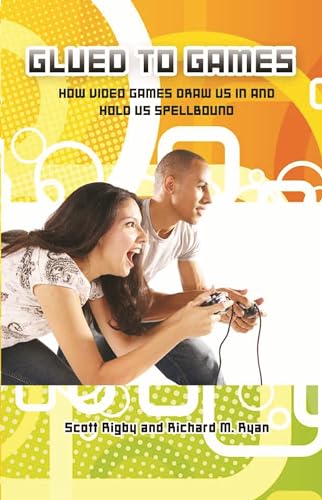

Glued to games how video games draw us in and hold us spellbound Scott Rigby and Richard M. Ryan.
Series New directions in mediaDetalles de publicación: Santa Barbara, Calif. ABC-CLIO c2011.Descripción: xiii, 186 p. ill. 25 cmISBN:- 9780313362248 (hard copy : acid-free paper)
- 794.8 R567g 22
- GV1469.3 .R55 2011
| Imagen de cubierta | Tipo de ítem | Biblioteca actual | Biblioteca de origen | Colección | Ubicación en estantería | Signatura topográfica | Materiales especificados | Info Vol | URL | Copia número | Estado | Notas | Fecha de vencimiento | Código de barras | Reserva de ítems | Prioridad de la cola de reserva de ejemplar | Reservas para cursos | |
|---|---|---|---|---|---|---|---|---|---|---|---|---|---|---|---|---|---|---|
| Libro | Biblioteca Encarnación Valdés Colección General bev | 794.8 R567g (Navegar estantería(Abre debajo)) | Disponible | 80000002463548 |
Descripciones mejoradas de Syndetics:
This book offers a practical yet powerful way to understand the psychological appeal and strong motivation to play video games.
With video game sales in the billions and anxious concerns about their long-term effects growing louder, Glued to Games: How Video Games Draw Us In and Hold Us Spellbound brings something new to the discussion. It is the first truly balanced research-based analysis on the games and gamers, addressing both the positive and negative aspects of habitual playing by drawing on significant recent studies and established motivational theory.
Filled with examples from popular games and the real experiences of gamers themselves, Glued to Games gets to the heart of gaming's powerful psychological and emotional allure--the benefits as well as the dangers. It gives everyone from researchers to parents to gamers themselves a clearer understanding the psychology of gaming, while offering prescriptions for healthier, more enjoyable games and gaming experiences.
Includes bibliographical references and index.
Tabla de contenidos provista por Syndetics
- Acknowledgments(p. IX)
- Introduction(p. XI)
- 1 The Emotional Experience of Games Today(p. 1)
- 2 Games and the Need for Competence(p. 15)
- 3 Games and the Need for Autonomy(p. 39)
- 4 Games and the Need for Relatedness(p. 65)
- 5 Immersion and Presence(p. 81)
- 6 Dangerous Waters: The Addictive Undertow of Games(p. 97)
- 7 The Appeal and Perils of Aggression in Video Games(p. 119)
- 8 Gaming Beyond Entertainment(p. 139)
- 9 Relating to Games: A Practical Road Map(p. 155)
- Index(p. 175)
Reseñas proporcionadas por Syndetics
CHOICE Review
Offering a psychological model--PENS, or player experience of need satisfaction--to explain the appeal of video games, Rigby (a specialist in the psychology of virtual worlds and interactive technologies) and Ryan (psychology, Univ. of Rochester) argue that video games fulfill three intrinsic human needs: competence, autonomy, and relatedness. In their view, video games are uniquely positioned to satisfy player needs by means of immediacy, consistency, and density (i.e., overall ability to instill satisfaction). Writing in straightforward language, the authors use a range of game types to illustrate their points. For example, they discuss intrinsic player needs related to competence in terms of musical performance games like Guitar Hero and first-person shooters like Doom. In discussing autonomy, they look to role-playing games, for example, the Fable games and simulations (e.g., The Sims). The three chapters on player needs--and additional chapters on video game addiction and violence and video games--are based on academic research and accompanied by notes. This accessible survey of the psychology of video games serves as a useful introduction. Summing Up: Recommended. Lower- and upper-division undergraduates; professionals; general readers. N. A. Baker Earlham CollegeNotas de autor provistas por Syndetics
Scott Rigby , PhD, is founder and president of Immersyve, Inc.
Richard M. Ryan is a clinical psychologist and professor of psychology, psychiatry, and education.