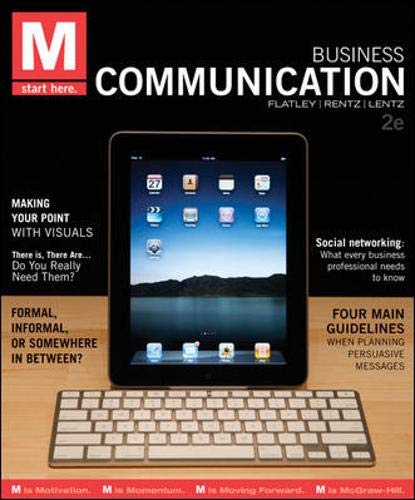

Basic business communication Marie E. Flatley,Kathryn Rentz,Paula Lentz.
Detalles de publicación: Boston McGraw-Hill/Irwin c2012.Edición: 2 nd edDescripción: 1 v. (various pagings) ill. (chiefly col.) 28 cmISBN:- 9780073403168
- 651.74 L629b 2005 22
- HF5721 .L37 2012
| Imagen de cubierta | Tipo de ítem | Biblioteca actual | Biblioteca de origen | Colección | Ubicación en estantería | Signatura topográfica | Materiales especificados | Info Vol | URL | Copia número | Estado | Notas | Fecha de vencimiento | Código de barras | Reserva de ítems | Prioridad de la cola de reserva de ejemplar | Reservas para cursos | |
|---|---|---|---|---|---|---|---|---|---|---|---|---|---|---|---|---|---|---|
| Libro | Biblioteca de Mayagüez Colección General mb | HF5721 .L37 2012 (Navegar estantería(Abre debajo)) | Disponible | 50000003209243 |
Descripciones mejoradas de Syndetics:
"M: Business Communication" was created with students' and professors' needs in mind. Written by the co-authors of "Lesikar's Business Communication: Making Connections in a Digital World, " 12/e, it provides both student and instructor with all the tools needed to navigate through the complexity of the modern business communication environment. "M: Business Communication" attends to the dynamic, fast-paced, and ever-changing means by which business communication occurs by being the most technologically current and pedagogically effective book in the field. It has realistic examples that are both consumer-and business-oriented.
Students receive a cost-effective, easy to read, focused text complete with study resources (both print and online) to help them review for tests and apply chapter concepts. Professors receive a text that contains all the pertinent information - yet in a more condensed format that is easier to cover by students. Student friendly design - "M: Business Communication" was written and designed with today's student reader in mind. The layout and design provides student visual stimulation they've come to expect. The content was written to focus on the key concepts only The examples provided have been selected for greater student appeal. The writing style is highly readable with today's student reader in mind. ALL END OF CHAPTER MATERIAL IS LOCATED ONLINE ON THE OLC. Study/Prep Cards: these Study Cards are come bound in to each new book. There is 1 Study Card for each chapter. They do not regurgitate information from the text, which allows students to use the card passively. Instead, the front of the card asks the student to write what he/she recalls from each of the learning objectives in the chapter. After completing this step, the student turns to the back to review the learning objectives broken down into bulleted lists, and then completes fill-in-the-blank application questions to test their knowledge beyond basic comprehension. The answers to these application questions are available on the bottom of the card (upside down). The point of these cards is to create useful exercises that actually help students LEARN and remember, as opposed to passively reading (or not reading) the cards.
eigm 12/2011
Includes bibliographical references (p. ) and index.
Tabla de contenidos provista por Syndetics
- Part 1 Understanding Business Communication
- Chapter 1 Communicating in the Workplace
- Part 2 Mastering Writing and Presentation Basics
- Chapter 2 Understanding the Writing Process and the Main Forms of Business Messages
- Chapter 3 Using Visuals in Written and Oral Communication
- Chapter 4 Using an Appropriate Style
- Part 3 Writing Effective Messages
- Chapter 5 Writing Good-News and Neutral Messages
- Chapter 6 Writing Bad-News Messages
- Chapter 7 Writing Persuasive Messages and Proposals
- Part 4 Writing Effective Reports
- Chapter 8 Researching and Writing Reports
- Chapter 9 Writing Short Reports
- Part 5 Using Oral and Job-Search Skills
- Chapter 10 Communicating Orally
- Chapter 11 Communicating in the Job Search
- Supplementary Chapters (On-line)
- Supplementary A Formatting Letters, Memos, and Reports
- Supplementary B Correctness of Communication
- Supplementary C Cross-Cultural Communication
- Supplementary D The Long Report
- Supplementary E Documentation of Sources