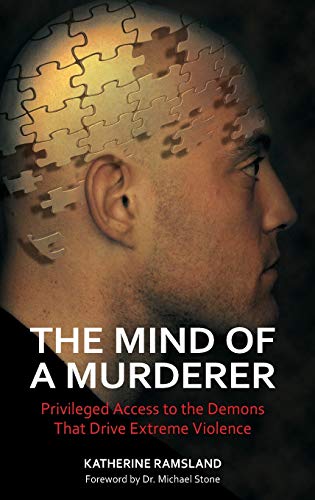

The mind of a murderer privileged access to the demons that drive extreme violence Katherine Ramsland ; foreword by Michael Stone.
Detalles de publicación: Santa Barbara, Calif. Praeger c2011.Descripción: xiii, 217 p. 25 cmISBN:- 9780313386725 (hard copy : alk. paper)
- 0313386722 (hard copy : alk. paper)
- 364.1523019 R1839m 22
- HV6515 .R2534 2011
| Imagen de cubierta | Tipo de ítem | Biblioteca actual | Biblioteca de origen | Colección | Ubicación en estantería | Signatura topográfica | Materiales especificados | Info Vol | URL | Copia número | Estado | Notas | Fecha de vencimiento | Código de barras | Reserva de ítems | Prioridad de la cola de reserva de ejemplar | Reservas para cursos | |
|---|---|---|---|---|---|---|---|---|---|---|---|---|---|---|---|---|---|---|
| Libro | Biblioteca Encarnación Valdés Colección General bev | 364.1523019 R1839m (Navegar estantería(Abre debajo)) | Disponible | 80000002463621 |
Descripciones mejoradas de Syndetics:
This unique history of the last 100 years of criminal psychology shares insights about infamous murderers from the psychiatrists and other trained psychological professionals who analyzed and treated them.
The Mind of a Murderer: Privileged Access to the Demons That Drive Extreme Violence presents a series of cases in which a psychiatrist, psychologist, or counselor gained privileged access to a mass or serial murderer, going beyond the typical mental assessment to learn more about criminal behavior. Through their work, readers are granted a unique view of criminology and a better understanding of the criminal mind.
The book opens with the earliest professional observations of criminals in the late 19th century and goes on to explore the rudimentary behavioral profiling and case analysis of the early 20th century. It shows how, by the 1960s and 1970s, behavioral professionals recognized the need for intense study of extreme offenders and got close to the likes of Richard Speck, John Wayne Gacy, and Ted Bundy to gain a fuller picture of their psychological development. Finally, readers learn how today's behavioral professionals rely on neurobiological correlates to assess predatory, impulsive, and addictive behavior.
Includes bibliographical references and index.
Tabla de contenidos provista por Syndetics
- Foreword(p. ix)
- Acknowledgments(p. xiii)
- Chapter 1 Introduction: The Criminal Type(p. 1)
- Chapter 2 Joseph Vacher and Alexandre Lacassagne(p. 9)
- Chapter 3 Peter Kürten and Karl Berg(p. 17)
- Chapter 4 Carl Panzram and Karl Menninger(p. 31)
- Chapter 5 Albert Fish and Fredric Wertham(p. 41)
- Chapter 6 Chloe Davis and J. Paul de River(p. 51)
- Chapter 7 Charles Starkweather and James Melvin Reinhardt(p. 61)
- Chapter 8 Albert DeSalvo and James Brussel(p. l7)
- Chapter 9 Richard Speck and Marvin Ziporyn(p. 83)
- Chapter 10 Santa Cruz Triple and Donald Lunde(p. 93)
- Chapter 11 Ted Bundy, Al Carlisle, and James Dobson(p. 109)
- Chapter 12 John Wayne Gacy and Helen Morrison(p. 127)
- Chapter 13 Andrei Chikatilo and Alexander Bukhanovsky(p. 135)
- Chapter 14 Jeffrey Dahmer and Roy Ratcliff(p. 145)
- Chapter 15 Andrea Yates and Phillip Resnick(p. 157)
- Chapter 16 Tommy Lynn Sells and Michael Stone(p. 169)
- Chapter 17 The Most Intimate Approach(p. 179)
- Chapter 18 The Collective Findings(p. 191)
- Notes(p. 197)
- Bibliography(p. 209)
- Index(p. 213)