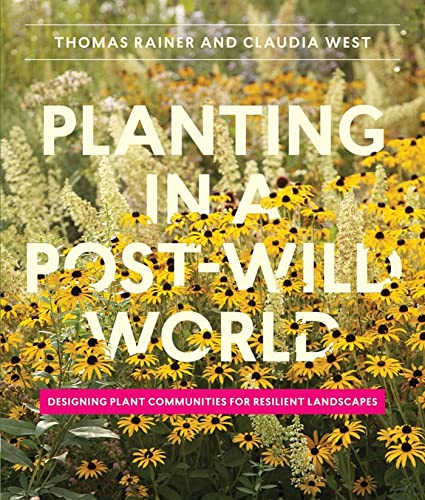

Planting in a post-wild world designing plant communities that evoke nature Thomas Rainer and Claudia West.
Idioma: Inglés Editor: Portland, Oregon Timber Press 2015Edición: First editionDescripción: 271p. ill (some col). 25cmISBN:- 9781604695533
- 712
- SB472.45 .R35 2015
| Imagen de cubierta | Tipo de ítem | Biblioteca actual | Biblioteca de origen | Colección | Ubicación en estantería | Signatura topográfica | Materiales especificados | Info Vol | URL | Copia número | Estado | Notas | Fecha de vencimiento | Código de barras | Reserva de ítems | Prioridad de la cola de reserva de ejemplar | Reservas para cursos | |
|---|---|---|---|---|---|---|---|---|---|---|---|---|---|---|---|---|---|---|
| Libro | CARIBET Biblioteca Arquitectura Colección General CARIBET | SB472.45.R35 2015 (Navegar estantería(Abre debajo)) | Disponible | 91000000048223 |
Descripciones mejoradas de Syndetics:
This post-wild landscape guide is an "optimistic call to action" to help gardeners create a harmonious environment by incoporating plant communities ( Chicago Tribune ).
Over time, with industrialization and urban sprawl, we have driven nature out of our neighborhoods and cities. But we can invite it back by designing landscapes that look and function more like they do in the wild: robust, diverse, and visually harmonious.
Featuring gorgeous photography and advice for landscapers, Planting in a Post-Wild World by Thomas Rainer and Claudia West is dedicated to the idea of a new nature--a hybrid of both the wild and the cultivated--that can nourish in our cities and suburbs.
Includes bibliographical references (p.258) and index.
Extracto provisto por Syndetics
Reseñas proporcionadas por Syndetics
CHOICE Review
Rainer, a landscape architect from the US, and West, a landscape designer from Europe, provide an excellently written, wonderfully illustrated guide to designing, planting, and managing plant installations. Advice is underpinned by a solid ecological foundation, particularly processes of succession, adaptation, and competition. The authors demonstrate how to work with site conditions to develop successful plantings requiring minimal management while maintaining the aesthetic of a grassland, woodland, or forest (three basic archetypes of plant communities). The book covers differences between natural and designed plant communities, designing for three basic relationships (plants to place, plants to people, and plants to other plants) and the full process of landscape design. Many photographs of plant species and existing designs (from rain gardens in suburban neighborhoods to green roofs in urban areas) provide helpful examples of plant communities for different planting levels (e.g., ground cover, theme plants, fillers, and structural layers) and sites. Figures of plant morphology and landscape layouts and tables of management tools clarify points in the text. The book will interest landscape architects and horticulturalists as well as more casual home gardeners. Summing Up: Recommended. All levels/libraries. --Audrey L Mayer, Michigan Technological UniversityNotas de autor provistas por Syndetics
Thomas Rainer is a registered landscape architect, teacher, and writer. He has designed landscapes for the U.S. Capitol grounds, the Martin Luther King, Jr. Memorial, and The New York Botanical Garden. His work has been featured in the the New York Times, Landscape Architecture Magazine, and Home + Design. He is a principal for the landscape architectural firm Rhodeside and Harwell, teaches planting design for the George Washington University, and writer at the award-winning site Grounded Design.Claudia West is the ecological sales manager at North Creek Nurseries, a wholesale perennial grower in Landenberg, Pennsylvania. She holds a master's degree of landscape architecture and regional planning from the Technical University of Munich, Germany. West is a sought after speaker on topics such as plant community based design and the application of natural color theories to planting design.