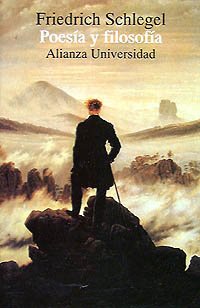
Imagen de portada de Amazon
Imagen de Amazon.com
Imagen de cubierta Syndetics
Portada de Syndetics
Imagen de OpenLibrary

Poesía y filosofía Friedrich Schlegel ; estudio preliminar y notas de Diego Sánchez Meca ; versión española de Anabel Rábalde Obradó.

Por: Colaborador(es): Series Alianza Univerversidad ; 803Detalles de publicación: Madrid Alianza 1994.Descripción: 170 p. 20 cmISBN:
  • 8420628034
Tema(s): Clasificación LoC:
  • B 3086 .S51 1994
Valoración
    Valoración media: 0.0 (0 votos)
Existencias
Imagen de cubierta Tipo de ítem Biblioteca actual Biblioteca de origen Colección Ubicación en estantería Signatura topográfica Materiales especificados Info Vol URL Copia número Estado Notas Fecha de vencimiento Código de barras Reserva de ítems Prioridad de la cola de reserva de ejemplar Reservas para cursos
Libro Biblioteca de Mayagüez Colección General mb B 3086 .S51 1994 (Navegar estantería(Abre debajo)) Disponible 50000001822336
Total de reservas: 0

Bibliografía: p.39-43.

Notas de autor provistas por Syndetics

The Schlegel brothers pioneered the study of comparative literature in Germany and laid the theoretical foundations for the romantic movement. August, the elder brother, popularized Shakespeare (see Vol. 1) in Germany by producing a new translation of 17 plays (1797--1801) in collaboration with his wife, Caroline Schlegel, herself an important literary figure. This was to be, for much of the nineteenth century, regarded as the definitive translation, and many critics still consider it, despite some errors, the best version in German. In his A Course of Lectures on Dramatic Art, delivered in Berlin and Vienna and published in 1809, August Schlegel explored the distinctions between the "classical" art of ancient Greece and the "romantic" art of the European Middle Ages. Friedrich was a bit less scholarly but more imaginative than his brother. Prone to bursts of enthusiasm, he articulated many of his most important ideas in short, epigrammatic essays, many of which were published in the Journal Anthenaem (1798--1800), which he edited with brother August and Ludwig Tieck. In one of these, he defined romanticism as a "progressive, universal poetry" that would synthesize all previous literary forms, including not only lyric and narrative prose but also criticism and humor. Friedrich Schlegel attempted to produce such a work with his novel Lucinde (1799), written largely for his wife Dorothea Veit Schlegel, the daughter of the philosopher Moses Mendelssohn. Though the novel did not meet with a favorable critical reception, the sort of art Friedrich prophesized was to be created about a century later by authors such as Thomas Mann. Toward the end of his life, Friedrich turned to the study of Indian culture, and his Uber die Sprache und Weisheit der Indier (On the Language and Wisdom of the Indians, 1808), is sometimes cited as the beginning of comparative philology.
Compartir
logopucpr-y-vive

Contáctanos

¡Queremos saber de ti!

Tel. 787.841.2000 Ext. 1801

bibliotecavaldes@pucpr.edu

⁣Búscanos en las redes

© 2026 Desarrollado por Ignite Online • All Rights Reserved • Powered by Koha.