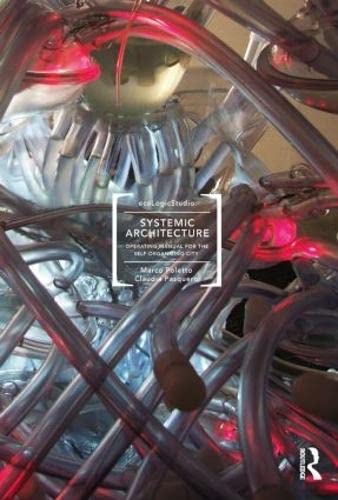

Systemic architecture : operating manual for the self organizing city / Marco Poletto and Claudia Pasquero.
Abingdon, Oxon [England] ; New York, NY : Routledge, 2012Descripción: 265 p. ill. (chiefly col.) 25 cmTipo de contenido:- text
- unmediaded
- volume
- 9780415596077
- 9780415596084
- Operating manual for the self organizing city
- NA9053.E58 P5 2012
| Imagen de cubierta | Tipo de ítem | Biblioteca actual | Biblioteca de origen | Colección | Ubicación en estantería | Signatura topográfica | Materiales especificados | Info Vol | URL | Copia número | Estado | Notas | Fecha de vencimiento | Código de barras | Reserva de ítems | Prioridad de la cola de reserva de ejemplar | Reservas para cursos | |
|---|---|---|---|---|---|---|---|---|---|---|---|---|---|---|---|---|---|---|
| Libro | CARIBET Biblioteca Arquitectura Colección General CARIBET | General NA9053.E58 P5 2012 (Navegar estantería(Abre debajo)) | 1 | Disponible | 91000000027995 |
Descripciones mejoradas de Syndetics:
This is a manual investigating the subject of urban ecology and systemic development from the perspective of architectural design. It sets out to explore two main goals: to discuss the contemporary relevance of a systemic practice to architectural design, and to share a toolbox of informational design protocols developed to describe the city as a territory of self-organization.
Collecting together nearly a decade of design experiments by the authors and their practice, ecoLogicStudio, the book discusses key disciplinary definitions such as ecologic urbanism, algorithmic architecture, bottom-up or tactical design, behavioural space and the boundary of the natural and the artificial realms within the city and architecture.
A new kind of "real-time world-city" is illustrated in the form of an operational design manual for the assemblage of proto-architectures, the incubation of proto-gardens and the coding of proto-interfaces. These prototypes of machinic architecture materialize as synthetic hybrids embedded with biological life (proto-gardens), computational power, behavioural responsiveness (cyber-gardens), spatial articulation (coMachines and fibrous structures), remote sensing (FUNclouds), and communication capabilities (Ecological Footprint Grotto).
Supporting the authors' own essays and projects are contributions from key innovators in contemporary architecture and urban design: Michael Batty, Andrew Hudson-Smith, Michael Weinstock and Patrik Schumacher.
Includes bibliographical references and index.
Intro from authors -- Q&A with Brett Steele -- Essay from authors -- Definitions -- Environments -- Machines -- Behavioral spaces -- Contribution from Patrik Schumacher -- Contribution from Mike Batty.
This is a manual investigating the subject of urban ecology and systemic development from the perspective of architectural design. It sets out to explore two main goals: to discuss the contemporary relevance of a systemic practice to architectural design, and to share a toolbox of informational design protocols developed to describe the city as a territory of self-organization. Collecting together nearly a decade of design experiments by the authors and their practice, ecoLogicStudio, the book discusses key disciplinary definitions such as ecologic urbanism, algorithmic architecture, bottom-up or tactical design, behavioural space and the boundary of the natural and the artificial realms within the city and architecture. A new kind of "real-time world-city" is illustrated in the form of an operational design manual for the assemblage of proto-architectures, the incubation of proto-gardens and the coding of proto-interfaces. These prototypes of machinic architecture materialize as synthetic hybrids embedded with biological life (proto-gardens), computational power, behavioural responsiveness (cyber-gardens), spatial articulation (coMachines and fibrous structures), remote sensing (FUNclouds), and communication capabilities (Ecological Footprint Grotto). Supporting the authors' own essays and projects are contributions from key innovators in contemporary architecture and urban design: Michael Batty, Andrew Hudson-Smith, Michael Weinstock and Patrik Schumacher.
Taylor & Francis, Jun/22/2012, 2012-956.
Notas de autor provistas por Syndetics
Marco Poletto and Claudia Pasquero are co-founders of ecoLogicStudio and Unit Masters at the Architectural Association.
ecoLogicStudio has built an international reputation for its innovative research combining systemic thinking with algorithmic design and large-scale prototyping. Completed projects include a public library, the "Lightwall" house and a large eco-roof prototype. ecoLogicStudio has presented installations at the most important Architecture Biennales, including Venice, London and Seville, Istanbul and Milan Fuorisalone.
Claudia and Marco lecture internationally and in 2012 will be Visiting Master tutors at the IAAC in Barcelona and Hans Strauch Visiting Critics at Cornell University in Ithaca, and will co-direct the new AA Visiting School in Milan, titled "Cyber-Gardening the City".
They live and work in London.