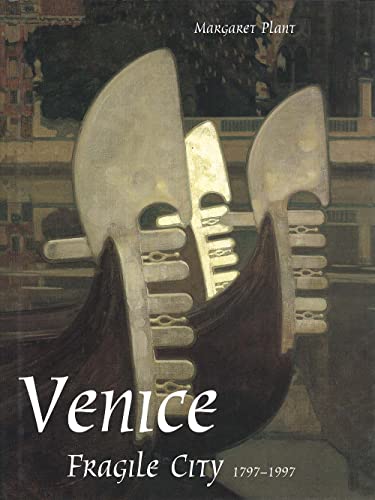

Venice : fragile city 1797-1997. / Margaret Plant. txt
Idioma: Español London : Yale University Press, 2002Descripción: x, 550 p. ill. 29 cmTipo de contenido:- text
- unmediaded
- volume
- 0300083866
- 9780300083866
- NA1121.V4 P59 2002
| Imagen de cubierta | Tipo de ítem | Biblioteca actual | Biblioteca de origen | Colección | Ubicación en estantería | Signatura topográfica | Materiales especificados | Info Vol | URL | Copia número | Estado | Notas | Fecha de vencimiento | Código de barras | Reserva de ítems | Prioridad de la cola de reserva de ejemplar | Reservas para cursos | |
|---|---|---|---|---|---|---|---|---|---|---|---|---|---|---|---|---|---|---|
| Libro Col. General CARIBET | CARIBET Biblioteca Arquitectura Colección General CARIBET | General NA1121.V4 P59 2002 (Navegar estantería(Abre debajo)) | 1 | Disponible | 91000000002147 |
Descripciones mejoradas de Syndetics:
To the delight of visitors--and sometimes the dismay of residents--Venice is a city that appears to have resisted modernization. Its canals, gondolas, and picturesque buildings seem little changed since the Renaissance. This engrossing and strikingly illustrated book presents a wide-ranging cultural history of the city from 1797 until 1997, and shows how it has in fact changed and adapted and how perceptions of it have shaped its reality.
The book charts Venice's architectural and urban changes, the conservation efforts to protect the city and lagoon against the sea, and the social restructuring of the city, from Napoleon's conquest through the upheavals of the World Wars to the battles against depopulation and the threats posed by the sea, industrial pollution, and mass tourism. Above all, it explores the myths that surround the city--created by writers, artists, architects, musicians, and filmmakers who have come to visit, and by the Venetians themselves--alongside the realities of living and working in a fragile city.
Include index.
Includes bibliographical references (p. 461-531) and index.
Contents:
Acknowledgements ix --
Introduction 9 --
Part I 7 --
1 'The lion of Venice will lift his paws from the earth and leave them but little on the ocean': The end of the Republic 9 --
A Venetian enlightenment? 10 --
The foreign view 21 --
The end of the Republic 25 --
The municipality 29 --
The work of public instruction 32 --
The end of the municipality 35 --
Spoliation 36 --
Elegies for the Republic 39 --
2 Caged lion: Austrian and French rule, 1798–1814 43 --
Austrian rule, 1798–1806 43 --
French governance: Prince Eugène de Beauharnais 48 --
Urban change: The decrees of 1806 50 --
The Arsenale and the port 50 --
French writers 53 --
Napoleon's grand tour and the Royal decree, 1807 56 --
Public spaces: Via Eugenia and the Public Gardens 59 --
Preservation and patrimony 61 --
The Island cemetery 65 --
The Royal Palace 65 --
Canova and the Venetians 71 --
The Ateneo and the Accademia 74 --
Rossini's premières 76 --
The blockade (1813–1814) and the fall of Napoleon 77 --
3 Venice in the theatre of Europe: Second Austrian rule, 1814–1848 81 --
The return of the horses 81 --
Hardship, and the death of Canova 84 --
Calumny: Darù's history of the Republic 87 --
The theatre of betrayal 89 --
The Bravo at large 95 --
The city in water 97 --
Custodians of the Republic 99 --
'Ammiglioramenti': The improvements in Venice 106 --
The city in love 111 --
The city of music 116 --
Panoramic city 117 --
4 'Venice will resist the Austrians at any cost': Modernisation, revolution, resistance 121 --
'No one enters Venice as a stranger' 124 --
Ruskin's Stones 131 --
Risorgimento 134 --
The Scientific Congress, 1847 136 --
The revolution of 1848–1849 138 --
The Austrians return 145 --
Modernisation 146 --
Tourism and the fashion for bathing 149 --
Passive resistance 152 --
Art for the Risorgimento 155 --
5 Venice in Italy: After 1866 159 --
Venice to Vienna 161 --
Austria and venezianità 162 --
Late betrayals 163 --
The urgency of modernisation 168 --
Industrialisation 173 --
The Arsenale in United Italy 174 --
Glass and lace 176 --
The loss of history and the visual arts 180 --
Tourism 182 --
The restoration debate 185 --
The polemics of conservation 188 --
Past and present, Molmenti and Favretto 190 --
Disappearing Venice and the custodians of the past 193 --
6 Love, art and death in Fin-de-Siècle Venice 195 --
Wagner's death in Venice 195 --
After Wagner: The Lagunenstadt 197 --
Verdi and Otello 199 --
Love/death 200 --
The Fortuny phenomenon 204 --
D'Annunzio's City of Fire 206 --
Venise le Rouge: Safeguarding the picturesque 208 --
Venezianità 212 --
City of Modern Art: The Cosmopolis 215 --
Vienna/Venice 223 --
Turn of the century: Visitor Proust 224 --
Cardboard cities 225 --
Part 2 231 --
7 The heavy past: From the turn of the century to the First World War 233 --
The fall of the Campanile 234 --
The case of modern architecture: Gothic victory 239 --
The Esposizione Internazionale d'Arte and Venetian painters 244 --
Forging a new Venice: D'Annunzio, Rilke and Baron Corvo 250 --
The new art of the movies 254 --
Housing, health and the Lido 256 --
Dying on the Lido: Thomas Mann 259 --
The Futurists attack 261 --
Foreign custodians: Simmel, Hofmannsthal, Apollinaire, Monet and Ezra Pound 264 --
8 The years of the Winged Lion: 1914–1940 271 --
The First World War: D'Annunzio's Nocturne 271 --
The creation of Porto Marghera, and early Fascism 276 --
Urban planning, 1920s and 1930s 278 --
A culture of bridges 282 --
The city of old men 285 --
Ezra Pound's Cantos 289 --
Le Corbusier 292 --
The Biennale and the Casino 294 --
New museums 304 --
The Accademia Gallery and Carlo Scarpa 307 --
Celluloid Venices and Franco Pasinetti 309 --
9 After the war: The impossible rebuilding 311 --
Venice endangered 311 --
The resistance 311 --
Harry's Bar: Ernest Hemingway and Evelyn Waugh 312 --
The new painting 324 --
The Biennale restored 327 --
The transparent and the opaque: Glass 319 --
Music and painting: Luigi Nono and Emilio Vedova 322 --
Filmed on location 326 --
French bad faith: Jean-Paul Sartre 334 --
Psycho geography 335 --
The sounds of San Marco: Michel Butor and Stravinsky 337 --
The English aesthetic: Adrian Stokes 338 --
Mapping the old city: Domestic Venice 339 --
Urban planning: Giuseppe Samonà and 'The School of Venice' 342 --
Carlo Scarpa: The Venetian architect 345 --
Modernism blocked 349 --
10 Dead or dying: Responses to the flood 355 --
3 November 1966 355 --
In defence of Marghera 358 --
Foreign death knells 362 --
Calvino's Invisible Cities and Palazzeschi's Invisible Doge 364 --
P. M. Pasinetti: Expatriate writer 367 --
Painted letters to Palladio, and Serene Waves 368 --
Comic-strip Venice: Hugo Pratt 370 --
Fictional deaths 371 --
Escaping Venice: Aldo Rossi's Analogous City and Manfredo Tafuri's Histories 376 --
Architectural fantasies: Designs for Cannaregio 378 --
The new Biennales 381 --
Cinematic adventurers: Don Giovanni, Casanova and James Bond 385 --
11 The 1980s: The city that would be modern 389 --
The incomplete city 390 --
Mapped from above 392 --
The return of Carnival 393 --
Aldo Rossi's Theatre of the World 395 --
The Biennale in the 1980s 397 --
Housing 402 --
Politics and redeployment 406 --
Luigi Nono, composer, and Massimo Cacciari, philosopher 410 --
Popular Venice 414 --
Madonna takes Venice 414 --
Pursuit 415 --
Virgins and vampires 417 --
Gore Vidal, Pink Floyd and the Crisis of Tourism 420 --
12 The double millennium: The end of the century, the end of Venice 423 --
The double flood: Tourism and Acqua Alta 423 --
The state of the Lagoon: Pollution and dredging 428 --
Redevelopment 430 --
Access 431 --
Employment, population decline and regional politics 433 --
The critique of the tourist 437 --
Patrimony and survival 438 --
The Biennale 441 --
Foreign perceptions 443 --
Crime in the Lagoon 445 --
More deaths 446 --
Ending the cult: Too much Venice 448 --
The city and the Lagoon of the past: From the present 451 --
The fire at La Fenice, 1996 452 --
The assault on the Campanile, 12 May 1997 455 --
After two hundred years 457 --
Notes 460 --
Photograph credits 532 --
Index 533 --
Stout, 04/22/03, 2003-726.
Reseñas proporcionadas por Syndetics
CHOICE Review
Plant's unparalleled synthesis of two centuries of Venetian cultural history dating from the fall of the Republic offers a valuable aid for understanding contemporary Venice. Examining the mutable, urban Venice and the "Venice of the imagination," Plant (history of art, Monash Univ., Australia) emphasizes Venetian voices responding to recurring problems causing the diminution of Venice as a living and livable city. Analyses of visual arts (cinema and painting), performing arts (opera, music, and theater), literature (histories, fiction, poetry, guide books, and memoirs), and festivals (carnivale and various biennales) develop themes of beauty, sensuality, intrigue, love, and, of course, death. Within the recurring debate of conservation versus modernization, the city seeks to accommodate mass tourism and its accompanying problems; however, no one wants to change Venice. Thus, even 19th-century renovations remain frozen under the Venetian rubric "dov'era, com'era" (where it was, as it was). The "myth of Venice" continues; foreigners imagine their Venice from long-standing viewpoints: romantic for the British, melancholic for the French, necrophilic for the Germans. Plant concludes that Venice, although a victim of her own success, defies her fragility and commodification. Lavishly illustrated. ^BSumming Up: Highly recommended. All collections. J. C. Kohl emerita, Dutchess Community CollegeNotas de autor provistas por Syndetics
Margaret Plant is Professor Emeritus of History of Art, Monash University, Melbourne.