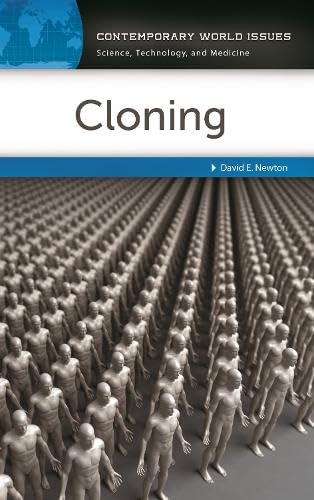
Imagen de portada de Amazon
Imagen de Amazon.com
Imagen de cubierta Syndetics
Portada de Syndetics
Imagen de OpenLibrary

Cloning [electronic resource] a reference handbook David E. Newton.

Por: Colaborador(es): Series Contemporary world issuesEditor: Santa Barbara, California ABC-CLIO, LLC [2015]Descripción: 1 online resource (xv, 326 pages) illustrations 24 cm Tipo de medio:
Tipo de soporte:
ISBN:
  • 9781610696944 (ebook)
Tema(s): Género/Forma: Clasificación CDD:
  • 571.8 23
Clasificación LoC:
  • QH442.2 .N495 2015eb
Valoración
    Valoración media: 0.0 (0 votos)
Existencias
Imagen de cubierta Tipo de ítem Biblioteca actual Biblioteca de origen Colección Ubicación en estantería Signatura topográfica Materiales especificados Info Vol URL Copia número Estado Notas Fecha de vencimiento Código de barras Reserva de ítems Prioridad de la cola de reserva de ejemplar Reservas para cursos
Libro electrónico Biblioteca de Mayagüez Acceso en línea QH442.2 .N495 2015eb (Navegar estantería(Abre debajo)) Disponible 50000003262689
Libro electrónico Biblioteca Mons. Iñaki Mallona (Arecibo) Acceso en línea Ebooks (Navegar estantería(Abre debajo)) Disponible 60000010115027
Total de reservas: 0

Descripciones mejoradas de Syndetics:

This book provides a detailed introduction to the cloning of both plants and animals and discusses the important social, ethical, political, technical, and other issues related to the practice. The history of cloning experiments dates back more than a century, but advances in technology in recent decades have multiplied the potential applications of cloning-and expanded the controversies surrounding these possibilities. Cloning: A Reference Handbook provides an accessible description of the development of plant and animal cloning from the early stages of human civilization to the present day and coherently covers the science and technology involved. It reviews the essential controversies that have arisen about cloning-particularly applications involving human DNA-as researchers have advanced and extended the tools for cloning organisms. Additionally, the book discusses public opinion about cloning and the legislative and administration actions that have been taken with regard to the practice.This single-volume work provides a broad treatment of the subject, going back further in history than is the case with most texts, covering plant cloning and providing a thorough overview of the nature of animal cloning and related issues. Examples of the topics covered include the natural "cloning" processes of regeneration in plants and animals; crucial research breakthroughs on animal cloning by Robert Briggs and Thomas King, John Gurdon, Gail Martin, James Till and Earnest McCulloch, and others; and the laws that regulate which types of cloning are allowed and prohibited in the United States and in other countries.

Instrucciones de uso: Recurso electrónico favor presionar sobre el URL disponible en la parte inferior. En caso de dudas favor consulte al Bibliotecario.

Includes bibliographical references and index.

Reseñas proporcionadas por Syndetics

CHOICE Review

The "Contemporary World Issues" series is a collection of reference works that cover a variety of controversial topics; at least 74 titles are now accessible via the Credo Reference (CH, 46-2980) interface. Each title aims to address issues of vital importance (e.g., pollution, bioengineering, immigration, censorship, cyber warfare). This recent release treats cloning, one of the oldest technical procedures but one that did not become an issue of scientific interest until the 19th century. Freelance writer Newton, author of numerous works in the series--for example, on fracking (CH, Aug'15, 52-6424) and wind energy (CH, Jul'15, 52-5661)--has written another authoritative, up-to-date, objective book on a controversial topic. Essays provide readers with overviews of particular subjects and discuss the important political, ethical, social, and technical aspects that affect everyday life. The book's seven chapters resemble the uniform arrangement of other titles in the series, providing background to the problems, alternative perspectives, and primary documents. There is a chronology, a glossary of important terms, and resources for further research. The book stands out for the excellent resources assembled, both print and electronic. The author's intent is to make the issues comprehensible not only to professionals and academics in the field but also to general readers. Summing Up: Highly recommended. All readership levels. --Margaret Slobodinsky, independent scholar

Booklist Review

This work clarifies the technology and purpose of replicating and modifying biota. The reference source guides the reader and researcher in making informed evaluations of a controversial resetting of nature's patterns. A five-page chronology covers four decades of adaptive procedures that began with fish and advanced to the rescue of the endangered gaur and ibex, neither of which survived infancy. Chapter 3 answers some of the questions that students ponder, particularly the revival of mammoths and dinosaurs, a fantasy topic in sci-fi. There is also information on the more practical uses of biotechnology, such as studying the synthesis of honeybees, creating palliative drugs from yeast, and using tissue for liver transplants. The concluding sections on data and documents precede a detailed time line from 1770 to 2015, identifying research projects by scientists worldwide. A five-page glossary covers standard terms as well as more complex concepts (e.g., totipotent, chimera, plasmid). Primary and secondary indexing itemizes concepts, scientists, and laws, including the National Research Act of 1974 and the European Union Policy on Cloning of Animals for Food Supply. A valuable reference tool for public, high-school, and community-college libraries, Newton's work offers a starting point for understanding a potentially earth-changing process.--Snodgrass, Mary Ellen Copyright 2015 Booklist

Notas de autor provistas por Syndetics

David E. Newton , EdD, has been a freelance writer of nonfiction books and ancillary materials for young adults for nearly 55 years. He has published more than 400 textbooks, research manuals, trade books, encyclopedias, and other publications.
Compartir
logopucpr-y-vive

Contáctanos

¡Queremos saber de ti!

Tel. 787.841.2000 Ext. 1801

bibliotecavaldes@pucpr.edu

⁣Búscanos en las redes

© 2026 Desarrollado por Ignite Online • All Rights Reserved • Powered by Koha.