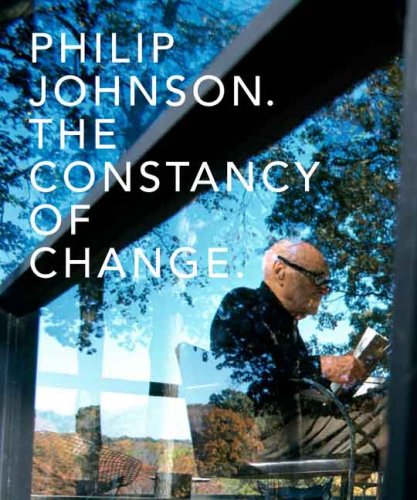
Imagen de portada de Amazon
Imagen de Amazon.com
Imagen de cubierta Syndetics
Portada de Syndetics
Imagen de OpenLibrary

Philip Johnson : the constancy of change. / edited by Emmanuel Petit ; foreword by Robert A.M. Stern ; essays by Beatriz Colomina ... [et al.]. txt

Colaborador(es): New Haven : Yale University Press : In association with the Yale University School of Architecture , 2009Descripción: ix, 278 p. ill. ;col. ;maps. ;plans. ; 28 cmTipo de contenido:
  • text
Tipo de medio:
  • unmediaded
Tipo de soporte:
  • volume
ISBN:
  • 9780300121810
  • 0300121814
Tema(s): Clasificación CDD:
  • 720.92 22
Clasificación LoC:
  • NA737.J6 P57 2009
Contenidos:
Roaming through history -- Philip Johnson: art and irony / Vincent Scully -- The autobiographical house: around a haunted hearth / Kurt W. Forster -- Philip Johnson: act one, scene one -- The museum of modern art? / Terence Riley with Joshua Sacks -- Johnson on TV / Beatriz Colomina -- Society, power, and politics -- The figurehead: on monumentality and Nihilism in Philip Johnson's life and work / Joan Ockman -- Liquidity: architecture and oil / Reinhold Martin -- Philip Johnson's empire: network power and the AT&T building / Kazys Varnelis -- Philip Johnson and the smile of Medusa / Charles Jencks -- The plot against architecture / Michael Sorkin -- Reckoning with modernism -- The delicacy of modern tastes / Detlef Mertins -- Playboy architecture then and now / Stanislaus von Moos -- Philip Johnson: breaking with modernism--the "whence & whither" of it / Phillis Lambert -- Reaction design / Mark Wigley -- Theory -- Philip Johnson: romanticism and disintegration / Peter Eisenman -- Philip Johnson and the rhetoric of the new: Panta Rhei versus the avant-garde / Ujjval Vyas -- Working out Johnson's role in history / Mark Jarzombek -- The new canaan estate: a gallery --
Resumen: Essays by Beatriz Colomina, Peter Eisenman, Kurt W. Forster, Mark Jarzombek, Charles Jencks, Phyllis Lambert, Reinhold Martin, Detlef Mertins, Joan Ockman, Terence Riley, Vincent Scully, Michael Sorkin, Kazys Varnelis, Stanislaus von Moos, Ujjval Vyas, and Mark Wigley Witty, wealthy, and well connected, the architect Philip Johnson was for years the most powerful figure in the cultural politics of his profession. As the Museum of Modern Art's founding architecture curator in the early 1930s, he helped establish modernism in the United States; as the architect of New York's AT&T buildingthe "Chippendale skyscraper"he gave postmodernism commercial viability on a large scale during the 1980s. In this book, sixteen eminent voices in the architectural establishment present their ideas on Johnson, focusing on both his eclectic design approach and his vivid intellect. Among the topics covered are Johnson's wide-ranging knowledge of art history, his endorsement of different versions of architectural modernism, his use of rhetoric and the mass media, his social persona, and his politics of patronage. Owing perhaps to the control he exerted over critiques of his work, few scholarly treatments of Johnson exist. This "unauthorized" account, the first in-depth study to follow his death, constitutes a milestone in the analysis of one of America's most renowned architects.
Premios: Haga clic para abrir en una nueva ventana
Valoración
    Valoración media: 0.0 (0 votos)
Existencias
Imagen de cubierta Tipo de ítem Biblioteca actual Biblioteca de origen Colección Ubicación en estantería Signatura topográfica Materiales especificados Info Vol URL Copia número Estado Notas Fecha de vencimiento Código de barras Reserva de ítems Prioridad de la cola de reserva de ejemplar Reservas para cursos
Libro CARIBET Biblioteca Arquitectura Colección General CARIBET General NA737.J6 P57 2009 (Navegar estantería(Abre debajo)) 1 Disponible 91000000023887
Total de reservas: 0

Descripciones mejoradas de Syndetics:

Essays by Beatriz Colomina, Peter Eisenman, Kurt W. Forster, Mark Jarzombek, Charles Jencks, Phyllis Lambert, Reinhold Martin, Detlef Mertins, Joan Ockman, Terence Riley, Vincent Scully, Michael Sorkin, Kazys Varnelis, Stanislaus von Moos, Ujjval Vyas, and Mark Wigley

Witty, wealthy, and well connected, the architect Philip Johnson was for years the most powerful figure in the cultural politics of his profession. As the Museum of Modern Art's founding architecture curator in the early 1930s, he helped establish modernism in the United States; as the architect of New York's AT&T building--the "Chippendale skyscraper"--he gave postmodernism commercial viability on a large scale during the 1980s.


In this book, sixteen eminent voices in the architectural establishment present their ideas on Johnson, focusing on both his eclectic design approach and his vivid intellect. Among the topics covered are Johnson's wide-ranging knowledge of art history, his endorsement of different versions of architectural modernism, his use of rhetoric and the mass media, his social persona, and his politics of patronage.


Owing perhaps to the control he exerted over critiques of his work, few scholarly treatments of Johnson exist. This "unauthorized" account, the first in-depth study to follow his death, constitutes a milestone in the analysis of one of America's most renowned architects.


Include index

Include Bibliography

Roaming through history -- Philip Johnson: art and irony / Vincent Scully -- The autobiographical house: around a haunted hearth / Kurt W. Forster -- Philip Johnson: act one, scene one -- The museum of modern art? / Terence Riley with Joshua Sacks -- Johnson on TV / Beatriz Colomina -- Society, power, and politics -- The figurehead: on monumentality and Nihilism in Philip Johnson's life and work / Joan Ockman -- Liquidity: architecture and oil / Reinhold Martin -- Philip Johnson's empire: network power and the AT&T building / Kazys Varnelis -- Philip Johnson and the smile of Medusa / Charles Jencks -- The plot against architecture / Michael Sorkin -- Reckoning with modernism -- The delicacy of modern tastes / Detlef Mertins -- Playboy architecture then and now / Stanislaus von Moos -- Philip Johnson: breaking with modernism--the "whence & whither" of it / Phillis Lambert -- Reaction design / Mark Wigley -- Theory -- Philip Johnson: romanticism and disintegration / Peter Eisenman -- Philip Johnson and the rhetoric of the new: Panta Rhei versus the avant-garde / Ujjval Vyas -- Working out Johnson's role in history / Mark Jarzombek -- The new canaan estate: a gallery --

Essays by Beatriz Colomina, Peter Eisenman, Kurt W. Forster, Mark Jarzombek, Charles Jencks, Phyllis Lambert, Reinhold Martin, Detlef Mertins, Joan Ockman, Terence Riley, Vincent Scully, Michael Sorkin, Kazys Varnelis, Stanislaus von Moos, Ujjval Vyas, and Mark Wigley Witty, wealthy, and well connected, the architect Philip Johnson was for years the most powerful figure in the cultural politics of his profession. As the Museum of Modern Art's founding architecture curator in the early 1930s, he helped establish modernism in the United States; as the architect of New York's AT&T buildingthe "Chippendale skyscraper"he gave postmodernism commercial viability on a large scale during the 1980s. In this book, sixteen eminent voices in the architectural establishment present their ideas on Johnson, focusing on both his eclectic design approach and his vivid intellect. Among the topics covered are Johnson's wide-ranging knowledge of art history, his endorsement of different versions of architectural modernism, his use of rhetoric and the mass media, his social persona, and his politics of patronage. Owing perhaps to the control he exerted over critiques of his work, few scholarly treatments of Johnson exist. This "unauthorized" account, the first in-depth study to follow his death, constitutes a milestone in the analysis of one of America's most renowned architects.

Reseñas proporcionadas por Syndetics

Library Journal Review

There's no arguing that Philip Johnson (1906-2005) is among the best-known names in modern architecture, but the nature and worth of his contributions are still open to plenty of debate. Petit (Yale Sch. of Architecture) offers 16 essays by distinguished critics, academics, and architects, many of whom knew Johnson personally and each of whom shines a spotlight on a different aspect of a talent notorious for its elusiveness. From longtime friend and patron Phyllis Lambert's tribute to Johnson's "intelligence [and] fearlessness" to critic Michael Sorkin's wickedly satiric "alternate history" positing Johnson's prominence in a Nazi America, these reappraisals all constitute springboards for further investigation. Other noteworthy contributors include Vincent Scully (Yale Univ.), Charles Jencks (The New Paradigm in Architecture), and architect Peter Eisenman. Each essay is well documented and includes some illustrations. Appended is an oddly unattributed but handsome photo portfolio of Johnson's Connecticut estate, where his famous Glass House is now open to the public. Academic and large public libraries will want to supplement Franz Schulze's comprehensive Philip Johnson: Life and Work with Petit's thought-provoking addendum.-David Soltesz, Cuyahoga Cty. P.L., Parma, OH (c) Copyright 2010. Library Journals LLC, a wholly owned subsidiary of Media Source, Inc. No redistribution permitted.

Publishers Weekly Review

Responding to criticism of the skyscrapers he was building in 1983, Pritzker Prize-winning architect Philip Johnson (1906-2005) replied, "I am a whore." The 16 essayists in this volume, edited by Petit, assistant professor at Yale's School of Architecture-and originally presented in a symposium co-sponsored in 2006 by Yale and the Museum of Modern Art-tackle Johnson's "whoredom," his enormous influence as a curator and the mixed quality of his built legacy from historical, theoretical and sociological perspectives. The contributors admit, as Joan Ockman writes, that "his claim to fame may be his greatest claim to fame," and that few of his critics could be as truthful about his shortcomings as was the architect himself. His involvement with Father Coughlin's anti-Semitism in the 1930s runs through many of the essays, but so does admiration for the compound he developed in New Canaan, Conn., for his Glass House and other outlying buildings. One finishes this book with the feeling that Johnson is a case for further study, summed up by one essayist as the star of "a reality-TV show that ran longer than anyone could have imagined." 163 b&w and 53 color illus. (Feb. 24) (c) Copyright PWxyz, LLC. All rights reserved

CHOICE Review

"The practice of architecture is the most delightful of all pursuits," declared Philip Johnson in 1979. This passion manifested itself in Johnson's multitude of eclectic built designs, and subsequently in the many books expounding on the influence of his cultural contributions. This new volume expands the knowledge base by reexamining modernism and Johnson's impact on architecture today. Part 1, "Roaming through History," delves into Johnson's relationship with history and how different events were used to shape his personal narrative. For example, one contributor examines the Glass House and how it served "as a kind of TV broadcasting studio" for Johnson's ideas. Part 2, "Society, Power, and Politics," focuses on Johnson's position in society, including the impact of his political persuasion and patronage. Part 3, "Reckoning with Modernism," covers the transformations within this period and Johnson's active role. Part 4, "Theory," is more esoteric in nature--clearly a departure from past literature. This well-written, well-laid-out book is laced with thoughtful black-and-white and color photographs. It brings new insights about Johnson, the world he lived in, and the shoulders he rubbed. It serves as a nice in-depth companion to a volume about another architect, Diane Maddex's Alden B. Dow: Midwestern Modern (CH, Jun'08, 45-5393). Summing Up: Recommended. Upper-division undergraduates and above; general readers. L. B. Sickels Frank Lloyd Wright Foundation

Notas de autor provistas por Syndetics

Emmanuel Petit is assistant professor at the Yale School of Architecture.

Compartir
logopucpr-y-vive

Contáctanos

¡Queremos saber de ti!

Tel. 787.841.2000 Ext. 1801

bibliotecavaldes@pucpr.edu

⁣Búscanos en las redes

© 2026 Desarrollado por Ignite Online • All Rights Reserved • Powered by Koha.