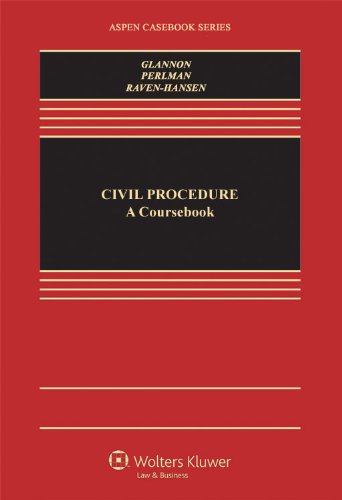

Civil procedure Joseph W. Glannon, Andrew M. Perlman, Peter Raven-Hansen.
Detalles de publicación: New York Aspen Publishers c2011.Descripción: xxxi, 1287 p. 26 cmISBN:- 9780735597891
- 0735597898
- 347.73/5 22
- KF 8839 .G578 2011
| Imagen de cubierta | Tipo de ítem | Biblioteca actual | Biblioteca de origen | Colección | Ubicación en estantería | Signatura topográfica | Materiales especificados | Info Vol | URL | Copia número | Estado | Notas | Fecha de vencimiento | Código de barras | Reserva de ítems | Prioridad de la cola de reserva de ejemplar | Reservas para cursos | |
|---|---|---|---|---|---|---|---|---|---|---|---|---|---|---|---|---|---|---|
| Libro | Biblioteca de Derecho Mons. Fremiot Torres Oliver Colección General biblioteca derecho | KF 8839 .G578 2011 (Navegar estantería(Abre debajo)) | Disponible | 70000000890096 |
Descripciones mejoradas de Syndetics:
This innovative casebook, written by an outstanding team of Civil Procedure scholars and teachers, is more informative, transparent, and accessible than a typical casebook. For example, Civil Procedure provides an introduction to each case to help students understand the context for the opinion and to flag important issues to look for while reading the case. After each case, the book provides textual materials and questions, but, unconventionally, the book answers almost all of the questions that are posed. The book has short chapters of manageable scope and uses a different font and a shaded border for the text of opinions. The book also includes multiple choice questions to test students understanding of new concepts followed by an analysis. Each chapter ends with a summary of key concepts. The book also has a companion website and a Rules Supplement.
This casebook aims to be approachable and accessible for students and professors alike. Characteristics that take it out of the realm of typical casebooks include:
Different treatment of cases Cases are selected to clarify and convey basic concepts Brief, accessible introductions precede the cases and help students understand the opinions and guide them to the important issues Author-written textual materials and questions with answers follow the cases, facilitating students understanding of the issues and allowing professors to focus class time on sophisticated material Different pedagogy Shorter chapters make the material more manageable Materials are organized with students and ease of study in mind : each chapter begins with a mini-table of contents and ends with a summary of the fundamental points covered in that chapter Questions are presented in various formats , including multiple choice questions and issue analyses Students are carefully walked through the thought processes involved in answering the questions Different design A different look signals and supports the innovations Interior design differentiates the various elements of the book , such as author-written text, case and statutory material, and pedagogy Use of visuals such as charts and photosIncludes index.
An introduction to American courts -- Litigation process and sources of procedural law -- Diversity jurisdiction in the federal courts -- Federal question jurisdiction -- Removal of cases from state to federal court -- The evolution of personal jurisdiction -- Specific in personam jurisdiction -- Other constitutional bases for personal jurisdiction -- Long-arm statutes -- The constitutional requirement of notice and methods of service of process -- Basic venue : statutory allocation of cases within a court system -- Challenges to venue : transfers and dismissals -- Basic pleading -- Responding to the complaint (or not?) -- Care and candor in pleading -- Amending pleadings -- Joinder of claims and parties -- Complex joinder : intervention, interpleader, and required parties -- Class actions -- Supplemental jurisdiction in the federal courts -- Informal investigation and the scope of discovery -- Discovery tools -- Discovery control and abuse -- State law in federal courts : the Erie doctrine -- Substance and procedure under the Erie doctrine -- Pretrial case management -- Dispositions without trial -- The right to jury trial -- Judgment as a matter of law (directed verdict and JNOV) -- Controlling the jury -- New trial and relief from judgment -- Appeals -- Claim preclusion -- Issue preclusion : further limits to relitigation.
Tabla de contenidos provista por Syndetics
- Part I Introduction
- Ch. 1 An Introduction to American Courts
- Ch. 2 The Litigation Process and Sources of Procedural Law
- Part II Subject Matter Jurisdiction
- Ch. 3 Diversity Jurisdiction in the Federal Courts
- Ch. 4 Federal Question Jurisdiction
- Ch. 5 Removal of Cases from State to Federal Court
- Part III Personal Jurisdiction
- Ch. 6 The Evolution of Personal Jurisdiction
- Ch. 7 Specific In Personam Jurisdiction
- Ch. 8 Other Constitutional Bases for Personal Jurisdiction
- Ch. 9 Long-Arm Statutes
- Ch. 10 The Constitutional Requirement of Notice and Methods of Service of Process
- Part IV Venue
- Ch. 11 Basic Venue: Statutory Allocation of Cases Within a Court System
- Ch. 12 Challenges to Venue: Transfers and Dismissals
- Part V Pleading
- Ch. 13 Basic Pleading
- Ch. 14 Responding to the Complaint (Or Not?)
- Ch. 15 Care and Candor in Pleading
- Ch. 16 Amending Pleadings
- Part VI Joinder and Supplemental Jurisdiction
- Ch. 17 Joinder of Claims and Parties
- Ch. 18 Complex Joinder: Intervention, Interpleader, and Required Parties
- Ch. 19 Introduction to Class Actions
- Ch. 20 Supplemental Jurisdiction in the Federal Courts
- Part VII Discovery
- Ch. 21 Informal Investigation and the Scope of Discovery
- Ch. 22 Discovery Tools
- Ch. 23 Discovery Control and Abuse
- Part VIII Choice of Law
- Ch. 24 State Law in Federal Courts: The Erie Doctrine
- Ch. 25 Substance and Procedure under the Erie Doctrine
- Part IX Pretrial and Trial
- Ch. 26 Pretrial Case Management
- Ch. 27 Dispositions Without Trial
- Ch. 28 The Right to Jury Trial
- Ch. 29 Judgment as a Matter of Law (Directed Verdict and JNOV)
- Ch. 30 Controlling the Jury
- Ch. 31 New Trial and Other Relief from Judgment
- Part X After Final Judgment
- Ch. 32 Appeals
- Ch. 33 Claim Preclusion
- Ch. 34 Issue Preclusion