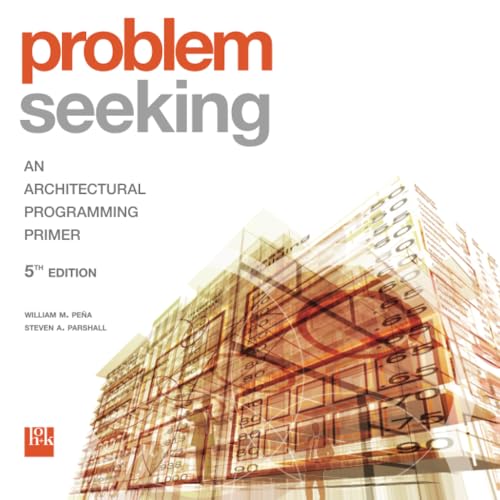

Problem seeking : an architectural programming primer / William M. Peña, Steven A. Parshall. txt
New Jersey : John Wiley & Sons, Inc. , 2012Edición: 5th editionDescripción: 274 p. ill. 22 cmTipo de contenido:- text
- unmediaded
- volume
- 9781118084144
- 9781118133613
- 9781118133620
- 9781118152874
- 9781118152928
- 9781118152935
- Architectural programming primer
- 720.285
- NA2728 P46 2012
| Imagen de cubierta | Tipo de ítem | Biblioteca actual | Biblioteca de origen | Colección | Ubicación en estantería | Signatura topográfica | Materiales especificados | Info Vol | URL | Copia número | Estado | Notas | Fecha de vencimiento | Código de barras | Reserva de ítems | Prioridad de la cola de reserva de ejemplar | Reservas para cursos | |
|---|---|---|---|---|---|---|---|---|---|---|---|---|---|---|---|---|---|---|
| Libro | CARIBET Biblioteca Arquitectura Colección General CARIBET | General NA2728 P46 2012 (Navegar estantería(Abre debajo)) | 1 | Disponible | 91000000043984 |
Descripciones mejoradas de Syndetics:
The classic programming guide for architects and clients¿¿--fully updated and revised
Architectural programming is a team effort that requires close cooperation between architects and their clients. Problem Seeking, Fifth Edition lays out a five-step procedure that teams can follow when programming any building or series of buildings, from a small house to a hospital complex. This simple yet comprehensive process encompasses the entire range of factors that influence the design of buildings.
This Fifth Edition of the only programming guide appropriate for both architect and client features new information related to BIM, integrated practice, and sustainable design when programming. Supplemented with more than 120 illustrations and diagrams updated for this edition, this indispensable resource provides revised technical information and faster, easier access to explanations, examples, and tools, including:
Guidance on incorporating the latest technological tools when programming
A primer on discounted cash flow analysis and net present value analysis
Project statement examples organized by project phase and building type
Useful techniques for data management, functional relationship analysis, and more
Includes bibliographical references (p. 265-266) and index.
Tabla de contenidos provista por Syndetics
- Foreword(p. vii)
- Preface(p. ix)
- Acknowledgments(p. xi)
- Part One (p. 1)
- Problem Seeking
- An Architectural Programming Primer
- Overview(p. 2)
- The Primer(p. 2)
- The Search(p. 4)
- Programmers and Designers(p. 6)
- Analysis and Synthesis(p. 8)
- The Separation(p. 10)
- The Interface(p. 12)
- Process(p. 14)
- Five Steps(p. 14)
- Procedure(p. 16)
- Considerations(p. 18)
- The Whole Problem(p. 18)
- Four Considerations(p. 20)
- Framework(p. 22)
- Information(p. 24)
- Information Index Matrix(p. 26)
- Organizing Information(p. 28)
- Two-Phase Process(p. 30)
- Data Clog(p. 32)
- Processing and Discarding(p. 34)
- Participation(p. 36)
- User on Team(p. 36)
- Effective Group Action(p. 38)
- Team(p. 40)
- Participatory Process(p. 42)
- Background Information(p. 43)
- Decision Making(p. 44)
- Communication(p. 46)
- Steps(p. 48)
- Establish Goals(p. 48)
- Collect and Analyze Facts(p. 50)
- Uncover and Test Concepts(p. 52)
- Determine Needs(p. 66)
- Cost Estimate Analysis(p. 68)
- Abstract to the Essence(p. 70)
- State the Problem(p. 72)
- Summary(p. 74)
- Programming Principles(p. 74)
- Part Two (p. 77)
- How to Use the Method
- Introduction(p. 78)
- Definitions and Examples(p. 78)
- On Theory and Process(p. 80)
- On Considerations(p. 85)
- On Goals(p. 85)
- On Facts(p. 89)
- On Concepts(p. 90)
- On Needs(p. 96)
- On Problem Statements(p. 124)
- Programming Procedures(p. 146)
- Establish Goals(p. 146)
- Collect and Analyze Facts(p. 148)
- Uncover and Test Concepts(p. 150)
- Determine Needs(p. 152)
- State the Problem(p. 153)
- Programming Activities(p. 154)
- Typical Programming Activities(p. 154)
- Four Degrees of Sophistication(p. 164)
- Variable Conditions(p. 168)
- How to Simplify Design Problems(p. 170)
- Useful Techniques(p. 172)
- Data Management(p. 173)
- Questionnaires(p. 184)
- Interviews and Work Sessions(p. 194)
- Audio- and Videoconferencing(p. 206)
- Functional Relationship Analysis(p. 208)
- Gaming and Simulation(p. 210)
- Space Lists(p. 216)
- Program Development(p. 222)
- Brown Sheets and Visualization(p. 231)
- Analysis Cards and Wall Displays(p. 236)
- Electronic White Boards and Flip Charts(p. 246)
- Electronic Presentations(p. 253)
- Programming Reports(p. 255)
- Program Evaluation(p. 256)
- Building Evaluation(p. 260)
- Selected Bibliography(p. 265)
- Index(p. 267)
- About The Authors(p. 273)
Notas de autor provistas por Syndetics
William M. Pea, Faia, a retired partner of Caudill Rowlett Scott, is often referred to as the "father" of architectural programming, having spent more than fifty years developing, refining, and explaining the programming process.Steven A. Parshall, Faia, is a Senior Vice President of HOK, Inc. and Director of Programming. He has been lead programmer on more than 250 major international building projects.