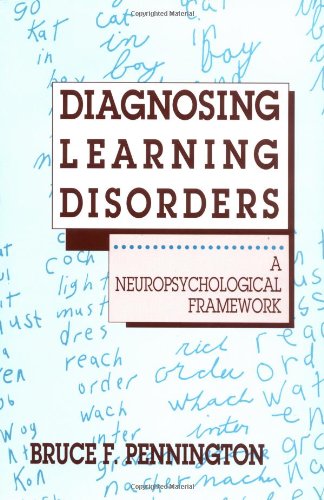

Diagnosing learning disorders a neuropsychological framework Bruce F. Pennington ; foreword by Martha Bridge Denckla.
Detalles de publicación: New York Guilford Press c1991.Descripción: xvi, 224 p. ill. 24 cmISBN:- 0898625637 (acid-free paper)
- 618.92/85/889075 20
| Imagen de cubierta | Tipo de ítem | Biblioteca actual | Biblioteca de origen | Colección | Ubicación en estantería | Signatura topográfica | Materiales especificados | Info Vol | URL | Copia número | Estado | Notas | Fecha de vencimiento | Código de barras | Reserva de ítems | Prioridad de la cola de reserva de ejemplar | Reservas para cursos | |
|---|---|---|---|---|---|---|---|---|---|---|---|---|---|---|---|---|---|---|
| Libro | Biblioteca Encarnación Valdés Colección General bev | 618.9285 P414d (Navegar estantería(Abre debajo)) | Disponible | 80000001332470 |
Descripciones mejoradas de Syndetics:
Although a variety of professionals regularly evaluate large numbers of children with learning problems, very little exists in the way of uniform standards or approaches, either within or across disciplines. This unique work synthesizes--in one accessible volume--the available information on learning disorders from such relevant disciplines as education, neuropsychology, cognitive psychology, and child psychiatry. Presenting the state of the art in both research and practice, DIAGNOSING LEARNING DISORDERS combines a comprehensive review of the etiology and neuropsychology of each disorder with a detailed section on diagnosis and treatment.
Part I covers background issues that are important for understanding subsequent chapters on specific learning disorders. The author provides a neuropsychological framework for the nosology that is used and delineates the validity of the diagnostic approach being proposed. Providing a format for reviewing what is known about each of the disorders, he discusses the clinical processes of making diagnostic decisions and providing feedback. The relationships between symptoms, history, behavioral observations, test data, and the diagnostic conclusion are analyzed. Guidelines for communicating a diagnosis to parents, the children themselves, and other professionals are included.
In Part II, each chapter focuses on a specific learning disorder. These include: dyslexia and other developmental language disorders, attention deficit hyperactivity disorder, right hemisphere learning disorder, autism spectrum disorder, and acquired memory disorder. Each chapter is divided into two sections, one reviewing the research on the disorder and the other considering differential diagnosis and treatment options. Each chapter offers a basic definition of the disorder and takes into account four levels of analysis: etiology, brain mechanisms, neuropsychological phenotype, and symptoms. Detailed case presentations are provided to help clinicians become more proficient at the differential diagnosis of these common problems of childhood. Rounding out the volume, Part III examines the implications for research and practice.
Both scholarly and clinically practical, DIAGNOSING LEARNING DISORDERS is a valuable resource for neuropsychologists, school psychologists, child clinical and developmental psychologists, speech and language pathologists, special educators, child psychiatrists, and pediatricians. It also serves as a text for graduate courses on learning disabilities, developmental disabilities, cognitive assessment, and developmental neuropsychology.
Includes bibliographical references (p. 193-217) and index.
Tabla de contenidos provista por Syndetics
- Part I Background
- Neuropsychological Model
- Issues in Syndrome Validation
- The Process of Differential Diagnosis
- Part II Specific Learning Disorders
- Dyslexia and Other Developmental Language Disorders
- Attention Deficit Hyperactivity Disorder:Executive Function Deficits
- Right Hemisphere Learning Disorders
- Autism Spectrum Disorders
- Acquired Memory Disorders
- Part III Implications
- Providing Feedback
- Implications for Research and Practice