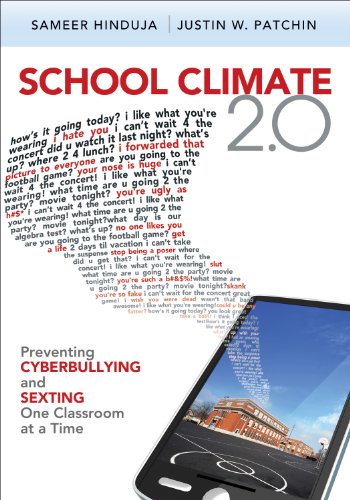

School climate 2.0 preventing cyberbullying and sexting one classroom at a time Sameer Hinduja, Justin W. Patchin.
Detalles de publicación: Thousand Oaks Corwin Press c2012.Descripción: xvii, 193 p. ill. 26 cmISBN:- 9781412997836 (pbk.)
- 371.58 H6626s 23
- LB3013.3 .H568 2012
| Imagen de cubierta | Tipo de ítem | Biblioteca actual | Biblioteca de origen | Colección | Ubicación en estantería | Signatura topográfica | Materiales especificados | Info Vol | URL | Copia número | Estado | Notas | Fecha de vencimiento | Código de barras | Reserva de ítems | Prioridad de la cola de reserva de ejemplar | Reservas para cursos | |
|---|---|---|---|---|---|---|---|---|---|---|---|---|---|---|---|---|---|---|
| Libro | Biblioteca Encarnación Valdés Colección General bev | 371.58 H6626s (Navegar estantería(Abre debajo)) | Disponible | 80000002505975 |
Descripciones mejoradas de Syndetics:
Empower students and staff to prevent cyberbullying and sexting
Bullying is not new, but its venues have expanded to include social media and mobile phones. When students receive hurtful, threatening, or sexually explicit electronic messages, it affects their ability to concentrate on schoolwork. Renowned cyberbullying experts Sameer Hinduja and Justin W. Patchin connect the off-campus, high-tech behaviors of teens to the school environment and provide educators with a road map for developing a positive school climate that counteracts cyberbullying and sexting. School Climate 2.0 differentiates cyberbullying from traditional bullying and offers specific strategies for improving school climate, including
Building a sense of community Peer mentoring Social norming Data-driven action plans Youth grassroots campaigns Multi-pronged policy and programming approaches by adultsIncluded are anecdotes, stories, and high-profile case examples that illustrate the research. The book′s companion website features a Twitter feed and Facebook Fan Page with regular PreventionPoints you can put into action quickly, downloadable activities and worksheets, questions to facilitate staff and student discussions, and emerging best practices in school climate research and evaluation--powerful tools for bully-proofing your school.
Includes bibliographical references and index.
Teens, technology, and trouble -- School climate: where it begins and ends -- Adolescent mistreatment in the 21st century: an introduction to cyberbullying -- Adolescent relationships in the 21st century: an introduction to sexting -- School climate and online misbehaviors -- Strategies for improving your school climate -- It takes a village: social norms, bystanders, and peer mentoring -- Prevention through assessment: taking the pulse of your school and students -- Effective prevention requires effective response.
Tabla de contenidos provista por Syndetics
- Preface(p. xi)
- Important Features of the Book(p. xii)
- Breakdown of Chapters(p. xiii)
- Acknowledgments(p. xv)
- About the Authors(p. xvii)
- 1 Teens, Technology, and Trouble(p. 1)
- The Story of Sam(p. 1)
- What Would Happen to Sam Today?(p. 2)
- Teens and Technology(p. 4)
- Technology in Schools(p. 5)
- Breakout Box: Delete Day(p. 7)
- Why Schools Must Respond to Cyberbullying and Sexting(p. 8)
- Technology Isn't the Problem(p. 9)
- The Power of a Positive School Climate(p. 10)
- Summary(p. 11)
- Discussion Questions(p. 12)
- 2 School Climate: Where It Begins and Ends(p. 15)
- What Exactly Is School Climate?(p. 16)
- Assessing Your School's Climate(p. 16)
- Breakout Box: A Positive School Climate Makes Everything Possible(p. 17)
- Our School Climate Measure(p. 19)
- School Climate and Behaviors at School(p. 20)
- The Social Bond(p. 21)
- Breakout Box: School Climate and Its Effect on School Social Issues(p. 22)
- School Climate and Bullying(p. 23)
- Breakout Box: The Benefits of a Positive School Climate(p. 23)
- Summary(p. 24)
- Discussion Questions(p. 24)
- 3 Adolescent Mistreatment in the 21st Century: An Introduction to Cyberbullying(p. 29)
- Bullying at School(p. 29)
- Consequences of Bullying(p. 30)
- What Is Cyberbullying?(p. 31)
- Breakout Box: A Teenaged Target's Cry for Help(p. 32)
- The Cyberbullied(p. 34)
- The Cyberbully(p. 36)
- Where Does Cyberbullying Occur?(p. 37)
- Correlates of Cyberbullying(p. 38)
- Cyberbullying and Self-Esteem(p. 39)
- Cyberbullying and Suicide(p. 40)
- Cyberbullying and School-Related Delinquency and Violence(p. 40)
- Unique Features of Cyberbullying(p. 41)
- Breakout Box: Decoding Your Digital Footprint(p. 42)
- Breakout Box: Unique Characteristics of Cyberbullying(p. 43)
- The Relationship Between Traditional Bullying and Cyberbullying(p. 43)
- Summary(p. 44)
- Discussion Questions(p. 44)
- 4 Adolescent Relationships in the 21st Century: An Introduction to Sexting(p. 49)
- Sexting in the News(p. 50)
- High-Profile Incidents(p. 53)
- Why Do Teens Engage in Sexting?(p. 53)
- Breakout Box: Adolescent Anger Lands Teen on the Sex Offender Registry(p. 54)
- Sexting Images Go Viral(p. 57)
- How Many Teens Really Participate in Sexting?(p. 58)
- National Campaign to Prevent Teen and Unplanned Pregnancy(p. 58)
- Cox Communications(p. 60)
- MTV/AP(p. 61)
- Pew Internet & American Life Project(p. 61)
- Crimes Against Children Research Center(p. 61)
- Our Own Survey(p. 62)
- Sexting: A Continuum of Behaviors(p. 64)
- Crimes Against Children Research Center Typology(p. 65)
- Sexting and the Law(p. 66)
- Breakout Box: Selected State Sexting Bills(p. 68)
- Summary(p. 69)
- Discussion Questions(p. 70)
- 5 School Climate and Online Misbehaviors(p. 77)
- Breakout Box: School Climate and Cyberbullying(p. 78)
- School Climate and Behaviors Online(p. 78)
- Our Research(p. 79)
- Educators' Efforts Matter(p. 82)
- Whom Do Targets Tell About Their Experiences With Cyberbullying?(p. 83)
- Expectation of Discipline(p. 84)
- Summary(p. 85)
- Discussion Questions(p. 85)
- 6 Strategies for Improving Your School Climate(p. 87)
- Top-Down Approach(p. 88)
- Know Their Names(p. 89)
- Community Building(p. 90)
- Small Teacher-Student Ratios(p. 91)
- Stay in the Loop(p. 92)
- Clearly Define What Is "Not Cool"(p. 93)
- Breakout Box: Staying in the Loop: What I've Learned by Listening and Understanding(p. 94)
- Monitor Behaviors and Respond Fairly and Consistently to Problems(p. 95)
- Encourage Active Student Participation in Decision Making(p. 97)
- Student-Teacher Evaluations(p. 98)
- Encourage Reporting of Any Inappropriate Behavior(p. 99)
- Cultivate Hope(p. 101)
- The Important Role of School Counselors(p. 101)
- Breakout Box: School Counselors Can Help(p. 102)
- Inform and Involve the Community(p. 103)
- Continue to Lay the Groundwork(p. 104)
- Use Resources Available to You(p. 104)
- Breakout Box: What YOU Can Do to Spark Climate Change in Your School(p. 105)
- Summary(p. 107)
- Discussion Questions(p. 108)
- 7 It Takes a Village: Social Norms, Bystanders, and Peer Mentoring(p. 111)
- Social Norming(p. 112)
- An Overview of Social Norms Theory(p. 113)
- Social Norms Theory and Traditional Bullying(p. 117)
- Using Social Norming to Prevent Cyberbullying and Sexting(p. 119)
- Coordinate a Student Play(p. 120)
- Breakout Box: Using Stage Productions to Enhance School Climate(p. 121)
- Role-Playing(p. 121)
- Solidarity Walk or March(p. 122)
- Four Corners(p. 122)
- Breakout Box: Canadian Initiatives: Students Making a Difference Against Bullying(p. 123)
- Pledges(p. 124)
- Stop Standing By and Start Standing Up!(p. 125)
- Breakout Box: Minnesota Twins(p. 128)
- Peer Mentoring(p. 129)
- Summary(p. 131)
- Discussion Questions(p. 132)
- 8 Prevention Through Assessment: Taking the Pulse of Your School and Students(p. 139)
- Survey Your Students(p. 140)
- Breakout Box: Talking Points: How to Conduct Research Among Your Students(p. 141)
- Sampling(p. 142)
- Breakout Box: Use Data to Guide Your Climate Improvement Efforts(p. 144)
- Survey Development(p. 144)
- Survey Administration(p. 148)
- Breakout Box: Assessment Leads to Better Understanding(p. 148)
- Don't Forget About the Adults!(p. 149)
- Focus Groups(p. 150)
- Breakout Box: Sample Focus Group Questions(p. 151)
- Confidentiality, Consent, and Ethical Issues(p. 152)
- Summary(p. 153)
- Discussion Questions(p. 153)
- Appendix A Our Survey Questions(p. 155)
- Appendix B Psychometric Properties for Cyberbullying Scale(p. 159)
- 9 Effective Prevention Requires Effective Response(p. 163)
- Can Schools Respond to Behaviors That Occur Away From Campus?(p. 164)
- Just Say No to "Zero Tolerance": Utilize Informal Responses When Appropriate(p. 166)
- Natural and Logical Consequences(p. 167)
- Breakout Box: What Schools Should Do When Made Aware of a Cyberbullying Incident(p. 168)
- When Can Educators Search the Contents of Student Cell Phones?(p. 168)
- Special Considerations When Responding to Sexting Incidents(p. 170)
- Breakout Box: What Schools Should Do When Made Aware of a Sexting Incident(p. 172)
- Policy Issues(p. 172)
- Cyberbullying(p. 174)
- Breakout Box: Elements of a School Cyberbullying Policy(p. 175)
- Sexting(p. 175)
- Breakout Box: Elements of a School Sexting Policy(p. 176)
- When to Get Law Enforcement Involved(p. 177)
- Educate Students About the Consequences Before the Behavior(p. 178)
- Breakout Box: One School's Response to Social Networking Drama(p. 178)
- A Call for Education and Outreach(p. 179)
- Summary(p. 180)
- Discussion Questions(p. 181)
- Index(p. 185)