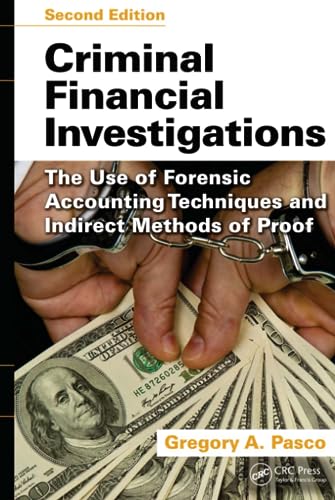

Criminal financial investigations : the use of forensic accounting techniques and indirect methods of proof / Gregory A. Pasco.
Detalles de publicación: CRC Press : Boca Raton, FL, c2013.Edición: 2nd edDescripción: xvii, 277 p. : ill. ; 24 cmTipo de contenido:- 9781466562622 (hbk. : alk. paper)
- 363.25 23
- KF8968.15 .P37 2013
| Imagen de cubierta | Tipo de ítem | Biblioteca actual | Biblioteca de origen | Colección | Ubicación en estantería | Signatura topográfica | Materiales especificados | Info Vol | URL | Copia número | Estado | Notas | Fecha de vencimiento | Código de barras | Reserva de ítems | Prioridad de la cola de reserva de ejemplar | Reservas para cursos | |
|---|---|---|---|---|---|---|---|---|---|---|---|---|---|---|---|---|---|---|
| Libro | Biblioteca de Mayagüez Colección General mb | KF8968.15 .P37 2013 (Navegar estantería(Abre debajo)) | Disponible | 50000003264479 |
Descripciones mejoradas de Syndetics:
Understanding the financial motivations behind white collar crime is often the key to the apprehension and successful prosecution of these individuals. Now in its second edition, Criminal Financial Investigations: The Use of Forensic Accounting Techniques and Indirect Methods of Proof provides direct instruction on the "how to" aspects of criminal financial investigations, taking readers through the different approaches used in gathering evidence and demonstrating how to present circumstantial evidence to a judge or jury in a simple and convincing manner. Simplifying how the financial pieces fit together, this text:
Presents the logic and reasoning involved in constructing a financial criminal investigation Describes the requirements for legal acceptance of forensic accounting investigations Includes relevant examples of the step-by-step processes involved in financial investigations Explores the pitfalls--and how to avoid them--in financial investigating Contains two investigations with step-by-step procedures from initial inquiry to case completion--for use as term or topical assignments or to promote class discussionNew Chapters in the Second Edition:
What Is a Financial Investigation? Indirect Methods in Tax Investigations Unique Aspects of Criminal Tax Investigations Innovative Applications
Written by a former Special Agent with the Criminal Investigation Division of the U.S. Internal Revenue Service, this volume sets out a successful methodology enabling readers to identify, pursue, and successfully prosecute financial white collar crime.
Includes bibliographical references and index.
eigm 03/2015
Tabla de contenidos provista por Syndetics
- Foreword(p. xiii)
- Preface(p. xv)
- About the Author(p. xvii)
- 1 Introduction(p. 1)
- What Is Forensic Accounting?(p. 1)
- Criminological Theories(p. 2)
- Motive(p. 2)
- Opportunity(p. 4)
- Financial Crimes(p. 5)
- Legal Requirements(p. 6)
- 2 The Financial Disciplines(p. 9)
- General Business Operations(p. 9)
- Providing Goods(p. 9)
- Providing Services(p. 10)
- Providing Ideas(p. 10)
- Record Retention(p. 11)
- Basic Accounting(p. 12)
- Books and Records(p. 13)
- Basic Tax Law(p. 15)
- Regulatory Agencies(p. 16)
- 3 Characteristics of Financial Crimes(p. 19)
- Spending(p. 20)
- Saving(p. 21)
- The Structure(p. 21)
- Conspiracy(p. 22)
- Fraud(p. 25)
- 4 Categories of Theft(p. 29)
- Theft(p. 30)
- Burglary(p. 30)
- Larceny(p. 31)
- Robbery(p. 31)
- Embezzlement(p. 31)
- Swindle(p. 31)
- Schemes(p. 39)
- 5 The Paper Trail(p. 45)
- What Is the "Paper Trail?"(p. 45)
- What Does the Paper Trail Look Like?(p. 46)
- Check Registers(p. 46)
- Stocks and Bonds(p. 47)
- Real Property(p. 48)
- Vehicles(p. 50)
- Other Assets(p. 51)
- Jewelry(p. 52)
- Furs and Clothing(p. 52)
- Collectibles(p. 52)
- Antiques(p. 53)
- Philately(p. 53)
- Numismatics(p. 53)
- Artwork(p. 54)
- Liabilities(p. 55)
- 6 Collecting and Preserving Evidence(p. 57)
- Interviewing(p. 58)
- 7 Gathering Documentary Evidence(p. 63)
- Documentation(p. 63)
- Relevance(p. 64)
- Materiality(p. 65)
- Competency(p. 65)
- 8 Gathering Evidence through Observation(p. 83)
- Observation(p. 83)
- Surveillance(p. 84)
- Moving Surveillance(p. 87)
- Electronic Surveillance and Monitoring(p. 89)
- Telephonic Intercepts(p. 89)
- Undercover Operations and Body Wires(p. 90)
- Search and Seizure(p. 92)
- Reasonable or Unreasonable(p. 93)
- Probable Cause(p. 94)
- Oath or Affirmation(p. 94)
- Particular Description(p. 94)
- Preparing an Affidavit for a Search Warrant(p. 95)
- The Affidavit(p. 96)
- The Affiant(p. 96)
- Probable Cause(p. 96)
- Oath or Affirmation(p. 97)
- Particular Description(p. 97)
- Executing the Warrant(p. 98)
- 9 What Is a Financial Investigation?(p. 101)
- The Theory behind Indirect Methods of Proof(p. 107)
- 10 Requirements for Indirect Methods of Proof(p. 113)
- Effects of Holland v. United States(p. 118)
- Use of Net Worth Method Where Books Are Apparently
- Adequate(p. 120)
- Establishing a Definite Opening Net Worth(p. 121)
- The Government V Investigation of Leads(p. 123)
- Net Worth Increases Must Be Attributable to Taxable Income(p. 124)
- The Burden of Proof Remains on the Government(p. 125)
- Willfulness Must Be Present(p. 125)
- The Charge to the Jury(p. 125)
- 11 The Standard Methods of Proof(p. 131)
- Specific Items(p. 131)
- Bank Deposits and Cash Expenditures(p. 134)
- Net Worth and Personal Expenditures(p. 142)
- Hybrid Methods(p. 145)
- Percentage Markup(p. 145)
- The Cash-T(p. 146)
- 12 What Processes Are Common to All Indirect Methods of Proof?(p. 149)
- Starting Point(p. 150)
- Likely Source of Income(p. 151)
- Identify All of the Players(p. 154)
- Following All Available Leads(p. 155)
- Mathematical Accuracy(p. 157)
- Addressing Potential Defenses(p. 158)
- The Cash Hoard(p. 158)
- Personal Loans(p. 160)
- Denial of True Ownership(p. 160)
- 13 The Specific Items Case(p. 163)
- Case Summary(p. 164)
- Evidence Developed(p. 164)
- Other Information(p. 165)
- 14 The Bank Deposits and Cash Expenditures Case(p. 177)
- Case Summary(p. 178)
- 15 The Net Worth and Personal Expenditures Case(p. 197)
- Case Summary(p. 198)
- Cash on Hand(p. 202)
- Cash in Banks(p. 202)
- House: 100 Maple Street(p. 203)
- New House(p. 203)
- Donut Shop(p. 203)
- Stocks and Bonds(p. 203)
- Ford Taurus(p. 204)
- Jeep Cherokee/Lincoln(p. 204)
- Colorado Condominium(p. 204)
- 16 Indirect Methods in Tax Investigations(p. 211)
- Types of Tax Crimes(p. 212)
- Understating Income(p. 213)
- Overstating Expenses(p. 214)
- Other Tax Crimes(p. 216)
- Tax-Related Crimes(p. 216)
- False Returns(p. 217)
- False Preparer Schemes(p. 217)
- Tax Shelter Schemes(p. 218)
- 17 Unique Aspects of Criminal Tax Investigations(p. 221)
- Additional Steps Needed in Tax Cases(p. 223)
- 18 The Case Report(p. 229)
- Introduction(p. 229)
- Recommended Charges(p. 230)
- History of Subjects(p. 230)
- Business History(p. 231)
- Theory(p. 232)
- Venue(p. 233)
- Starting Point(p. 234)
- Likely Source of Income(p. 235)
- Evidence of Intent(p. 235)
- Evidence(p. 236)
- Assets(p. 236)
- Cash on Hand(p. 236)
- Cash in Banks(p. 236)
- 100 Maple Street(p. 236)
- Ford Taurus(p. 237)
- Liabilities(p. 237)
- Mortgage: Donut Shop(p. 237)
- Mortgage: Condominium(p. 237)
- Expenditures(p. 237)
- Watches(p. 237)
- Spa Visits(p. 237)
- Defense of Subject(p. 238)
- Conclusions and Recommendations(p. 239)
- 19 Preparation for Trial(p. 243)
- Packaging the Evidence(p. 243)
- Grand Jury Presentation(p. 244)
- Pretrial Conferences(p. 245)
- Pretrial Interviews(p. 246)
- The Trial(p. 247)
- 20 Innovative Applications(p. 249)
- Forfeiture(p. 249)
- Money Laundering(p. 251)
- Financial Investigating and Counterterrorism(p. 256)
- Index(p. 261)
Notas de autor provistas por Syndetics
Gregory A. Pasco is a professor of criminal justice at Colorado Technical University's Sioux Falls, South Dakota campus. Pasco spent more than 28 years in federal law enforcement as a special agent with the Criminal Investigation Division of the Internal Revenue Service (IRS). During this time, he conducted more than 100 financial criminal investigations. He worked in the IRS Organized Crime Unit in Detroit, Michigan, and with the Narcotics Task Forces in New Mexico and Ohio, and completed his federal law enforcement career in South Dakota. During his career, Pasco became qualified as an expert witness in criminal tax computations and was accepted as such in federal district court. He was also called upon to provide electronic surveillance and monitoring assistance in other investigations, and was qualified and testified as an expert witness in this area in federal district court. He has also been qualified as an expert witness in the area of money laundering.