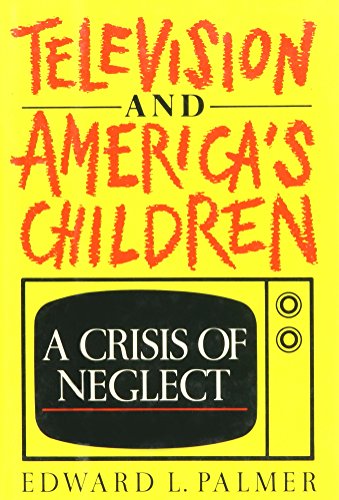

Television & America's children a crisis of neglect Edward L. Palmer.
Detalles de publicación: New York Oxford University Press 1988.Descripción: xxv, 194 p. 22 cmISBN:- 0195055403 (alk. paper)
- 791.45/088054 19
- PN1992.8.C46 P36 1988
| Imagen de cubierta | Tipo de ítem | Biblioteca actual | Biblioteca de origen | Colección | Ubicación en estantería | Signatura topográfica | Materiales especificados | Info Vol | URL | Copia número | Estado | Notas | Fecha de vencimiento | Código de barras | Reserva de ítems | Prioridad de la cola de reserva de ejemplar | Reservas para cursos | |
|---|---|---|---|---|---|---|---|---|---|---|---|---|---|---|---|---|---|---|
| Libro | Biblioteca Encarnación Valdés Colección General bev | 791.45 P173t (Navegar estantería(Abre debajo)) | Disponible | 80000001284903 |
Descripciones mejoradas de Syndetics:
Children's television in America is in a deplorable state of neglect. Since the demise of Captain Kangaroo in the early '80s, there has been no regular weekday programming for children on the three major commercial networks, and very little on chronically underfunded Public TV. Yet as Edward Palmer points out in this illuminating volume, America could easily have the finest children's television in the world, for less than one cent per day for each of the nation's 42 million children. Why have we failed to provide quality programming for young viewers?
Part of the blame, Palmer argues, falls on the prevalent attitude of commercial TV, where the rule is "don't sell shows to viewers, sell viewers to advertisers." Unfortunately, except at Christmas time, children have little impact on the marketplace and are of no interest to advertisers. Thus, when the FCC removed the threat of regulation on the industry in 1983 to allow free market forces to reign, children's shows with educational values nearly vanished from commercial television. Programs such as The Today Show now claim all the morning slots, and the highly profitable soap operas and talk shows fill the afternoons. And Public Television, with its meager $4.58 per capita annual funding, offers at most 90 hours of new programs a year (compared to 590 hours produced by the BBC). Other countries surpass us in a number of important respects, but Palmer contends that quality programming is within our reach. He outlines the nature and costs of a children's service modeled on Sesame Street and other award-winning programs world-wide, and discusses ways to fund it.
At a time when the American school system is failing to meet the educational demands of our children, television could provide an excellent preparation for and supplement to traditional schooling. In this valuable book, Edward Palmer shows how it can be done.
Includes index.
Bibliography: p. 171-189.
Reseñas proporcionadas por Syndetics
Library Journal Review
Here's a worthwhile book that gives fresh, imaginative, yet practical ideas for the uses of television as an educational tool. Palmer, an independent consultant for Sesame Street and Children's Television Workshop, argues that TV, among the most important teachers of children, can be used relatively cheaply to provide quality education. He deplores the lack of educational programming on commercial stations, citing vast discrepancies in how broadcasting institutions are formed. Although a bit academic, this book is both original and far more positive than Marie Winn's The Plug-In Drug (Viking, 1985. rev. ed.) or Patricia Marks Greenfield's Mind and Media (Harvard, 1984). Annette V. Janes, Hamilton P.L., Mass. (c) Copyright 2010. Library Journals LLC, a wholly owned subsidiary of Media Source, Inc. No redistribution permitted.CHOICE Review
Books on television and children have been common in the past, but there are not many today that do as good a job of summing up what is known about--and what is wrong with--American television for children as this one does. Palmer, one of the founders of the pioneering Children's Television Workshop 20 years ago, worked with CTW for 16 years and is now an independent advisor in applications of television to health and educational needs. He writes from his own experience plus visits to several other countries. This background enables him to suggest several models for what the US might be doing with television if commercial success were not the only holy grail to be sought. Chapters assess why commercial television has failed, the limited and limiting role of the FCC, the fund-started successes of public broadcasting, the relationship of television and reading, a 30-page case study from the inside of Sesame Street, and some conclusions in the form of recommendations of how to make the system work for children rather than aim at them. This is a thoughtful book with a lot of useful ideas, which avoids the "damn television" approach and instead tries to build on what we have now. The result is a readily usable guide for undergraduates and the public at large. -C. H. Sterling, The George Washington UniversityNotas de autor provistas por Syndetics
About the Author:Edward L. Palmer is an independent consultant for educational and health-related television programs. He is a former Vice President for Research at the Children's Television Workshop.