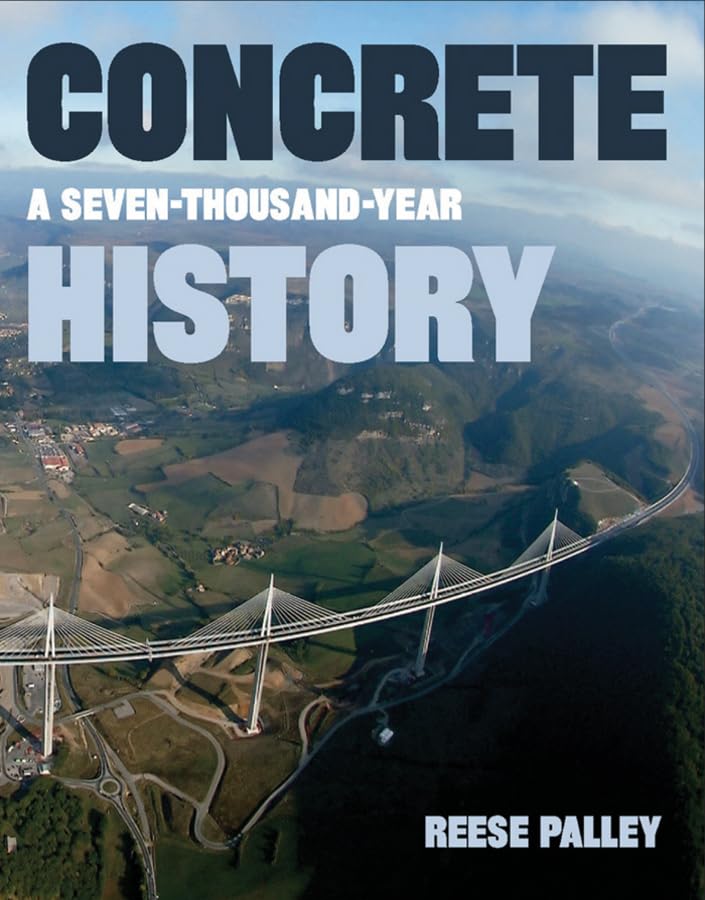
Imagen de portada de Amazon
Imagen de Amazon.com
Imagen de cubierta Syndetics
Portada de Syndetics
Imagen de OpenLibrary

Concrete a seven-thousand-year history Reese Palley.

Por: Idioma: Español Detalles de publicación: New York The Quantuck Lane Press 2010.Edición: 1st edDescripción: 232p. 24cmISBN:
  • 9781593720391
Tema(s): Clasificación CDD:
  • 620.1/3609 22
Clasificación LoC:
  • TA439 .P245 2010
Contenidos:
The great agglomeration -- Between Egypt and Rome -- Roman concrete and its impact on world history -- Vitruvius and Giocondo, 1445-1525 -- Joseph Moxon, 1627-1691 -- Concrete in the eighteenth century -- The twentieth century -- The wizard of Menlo Park -- What is art? -- Flagler's folly -- A woeful century -- The industry -- Lunar transit -- Epilogue.
Valoración
    Valoración media: 0.0 (0 votos)
Existencias
Imagen de cubierta Tipo de ítem Biblioteca actual Biblioteca de origen Colección Ubicación en estantería Signatura topográfica Materiales especificados Info Vol URL Copia número Estado Notas Fecha de vencimiento Código de barras Reserva de ítems Prioridad de la cola de reserva de ejemplar Reservas para cursos
Libro CARIBET Biblioteca Arquitectura Colección General CARIBET TA439.P245 2010 (Navegar estantería(Abre debajo)) Disponible 91000000027151
Total de reservas: 0

Descripciones mejoradas de Syndetics:

For seven thousand years concrete has periodically shaped the path of human progress. Reese Palley's fascinating history of this ubiquitous and versatile material chronicles the repeated and often centuries-long losses of the technology and its many reemergences and the cultural, scientific, and engineering accomplishments it has enabled.

Palley takes us from concrete's earliest beginnings, including the startling proof that at least one of the pyramids was partially poured, through the building of the Eddystone Light, to the dramatic building explosion in the use of concrete during the twentieth century and the start of the twenty-first century. He discusses the environmental impact of the production of concrete and attempts to find substitutes for the burning of lime. He ends by contemplating outer space, where almost all of the elements needed to build extraterrestrial communities already exist in the chemical makeup of the moon and Mars.

The great agglomeration -- Between Egypt and Rome -- Roman concrete and its impact on world history -- Vitruvius and Giocondo, 1445-1525 -- Joseph Moxon, 1627-1691 -- Concrete in the eighteenth century -- The twentieth century -- The wizard of Menlo Park -- What is art? -- Flagler's folly -- A woeful century -- The industry -- Lunar transit -- Epilogue.

Reseñas proporcionadas por Syndetics

CHOICE Review

Palley, an author, independent art gallery operator, and raconteur, writes with a tragic combination of flair and carelessness. "Rock and sand, trace chemicals and limestone are the stuff of Mars as they are of earth," Palley asserts in the preface. In fact, planetary geologists have yet to find any limestone on Mars. The chapter "Pyramidiots" promotes a marginally supported theory that large structural blocks in the Great Pyramids were cast concrete, without addressing the criticisms that consign this theory to "fringe science" status. In the "What Is Art?" chapter, Palley states that Samuel P. Dinsmoor died in Lucas, Ohio. (p.105. However, Dinsmoor's concrete folk art masterpiece and mausoleum, Garden of Eden, is found at his home in Lucas, Kansas. The book contains many other typographical and factual errors. The title misleads; the author writes not the history of a technology or a material, but instead a selective, personal appreciation of objects made from concrete throughout history. Though some of these vignettes prove interesting, the lack of factual reliability and balanced analysis limits this book's utility for academic audiences. Summing Up: Not recommended. S. A. Curtis University of Missouri - Kansas City

Notas de autor provistas por Syndetics

Historian Reese Palley is the author of many books and articles, including Wooden Ships & Iron Men: The Maritime Art of Thomas Hoyne, Concrete: A Seven-Thousand Year History, and The Answer: Why Only Mini Nuclear Power Plants Can Save the World. He lives in Philadelphia.
Compartir
logopucpr-y-vive

Contáctanos

¡Queremos saber de ti!

Tel. 787.841.2000 Ext. 1801

bibliotecavaldes@pucpr.edu

⁣Búscanos en las redes

© 2026 Desarrollado por Ignite Online • All Rights Reserved • Powered by Koha.