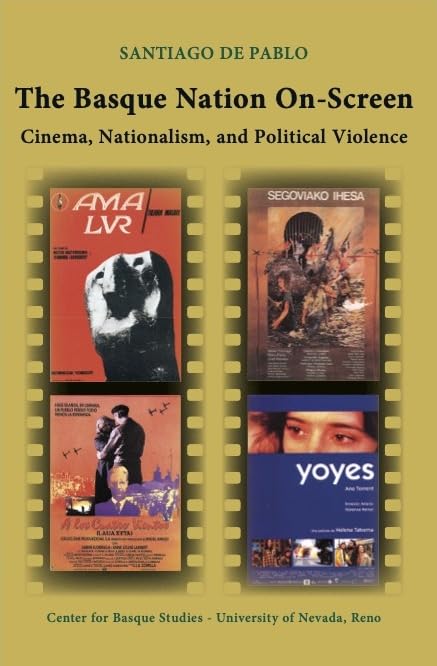

The Basque nation on-screen cinema, nationalism, and political violence Santiago de Pablo ; translated by Robert Forstag.
Idioma: Inglés Lenguaje original: Español Series Douglass scholar series ; no. 2Detalles de publicación: Reno, Nev. Center for Basque Studies, University of Nevada, Reno 2012.Descripción: 471 p. ill. 25 cmISBN:- 9781935709244 (hardcover)
- 9781935709237 (pbk. : alk. paper)
- 791.436581 P112b 23
- PN1995.9.B29 P225 2012
| Imagen de cubierta | Tipo de ítem | Biblioteca actual | Biblioteca de origen | Colección | Ubicación en estantería | Signatura topográfica | Materiales especificados | Info Vol | URL | Copia número | Estado | Notas | Fecha de vencimiento | Código de barras | Reserva de ítems | Prioridad de la cola de reserva de ejemplar | Reservas para cursos | |
|---|---|---|---|---|---|---|---|---|---|---|---|---|---|---|---|---|---|---|
| Libro | Biblioteca Encarnación Valdés Colección General bev | 791.436581 P112b (Navegar estantería(Abre debajo)) | Disponible | 80000002488990 |
Descripciones mejoradas de Syndetics:
Films may be thought of not only as witnesses to historical processes but also as models in their own right that exercise an influence on society, changing the way it sees itself. It is in this way that such representations help forge collective memory. In those places where there are national conflicts, the cinema plays an important role in shaping dichotomous identities. The Basque Country is an interesting case study in terms of exploring the complex relationships among films, society, nationalism, and political violence, which Santiago de Pabloanalyzes in this work, the second in the William A. Douglass Distinguished Scholar Series. The purpose of this book is to examine the historical relationship between films and Basque nationalism from a twofold perspective: the use of cinematic productions by Basque nationalism as a means of inculcating national identity and ideology, and the depiction of Basque nationalism--and especially of ETA terrorism--in films. Cinema provides new analytical perspectives of the history of Basque nationalism and has contributed to the strengthening of Basque national identity, to shaping its collective store of ideas, and to fostering a historical memory of an unmistakably nationalist stripe that is in constant dialogue with--and at times opposed to--other views and national identities that coexist in today's pluralistic Basque Country.
Translation of an unpublished Spanish manuscript.
Includes bibliographical references (p. [421]-439) and index.
Introduction -- A brief history of Basque nationalism -- Cinema and Basque national identity: two parallel developments -- From Sabino Arana to the Civil War -- Defeat, Franco's repression, and exile -- ETA during the Franco years: symbols in construction -- An uneasy transition -- Repression and dirty war -- Coming back home -- ETA in action -- The victims' hour of reckoning -- Conclusion.