Imagen de portada de Amazon
Imagen de Amazon.com
Imagen de cubierta Syndetics
Portada de Syndetics
Imagen de OpenLibrary

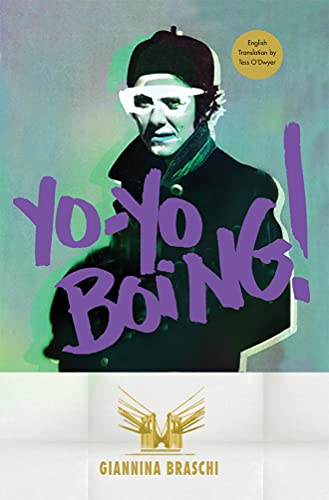
Yo-yo Boing! Giannina Braschi , [translation from the Spanish by Tess O' Dwyer].

Por: Colaborador(es): Idioma: Detalles de publicación: Las Vegas, NV AmazonCrossing 2011.Descripción: 244 p. 22 cmISBN:
  • 9781611090635
Títulos uniformes: Tema(s):
Valoración
    Valoración media: 0.0 (0 votos)
Existencias
Imagen de cubierta Tipo de ítem Biblioteca actual Biblioteca de origen Colección Ubicación en estantería Signatura topográfica Materiales especificados Info Vol URL Copia número Estado Notas Fecha de vencimiento Código de barras Reserva de ítems Prioridad de la cola de reserva de ejemplar Reservas para cursos
Libro Biblioteca Encarnación Valdés Colección de Puerto Rico 863.44 B8231y 2011 I (Navegar estantería(Abre debajo)) Disponible 80000002450800
Total de reservas: 0

Descripciones mejoradas de Syndetics:

This groundbreaking novel, set in New York City during the 1990s, is guaranteed to be unlike any literary experience you have ever had. Acclaimed Puerto Rican author Giannina Braschi has crafted this creative and insightful examination of the Hispanic-American experience, taking on the voices of a variety of characters-painters, poets, sculptors, singers, writers, filmmakers, actors, directors, set designers, editors, and philosophers-to draw on their various cultural, economic, and geopolitical backgrounds to engage in lively cultural dialogue. Their topics include love, sex, food, music, books, inspiration, despair, infidelity, jobs, debt, war, and world news. Braschi's discourse winds throughout the city's public, corporate, and domestic settings, offering an inside look at the cultural conflicts that can occur when Anglo Americans and Latin Americans live, work, and play together. Hailed by Publishers Weekly as "a literary liberation," this energetic and comical novel celebrates the contradiction that makes contemporary American culture so wonderfully diverse.

First published in Spanglish in 1998 to rave reviews, this is the first English publication of Yo-Yo Boing!

Yo-Yo Boing! was originally published in 1998 by Latin American Literary Review Press, Pittsburg, PA.

Translation of: Yo -yo Boing! , c 1998.

Reseñas proporcionadas por Syndetics

Library Journal Review

Though touted as a novel, this is more of a hybrid, both linguistically and structurally. It opens with a ten-page monolog in Spanish called "Close-Up," related by a woman assessing her physical, emotional, and intellectual features. The second section, "Blow-Up," centers on a conversation‘half Spanish, half English‘also narcissistic but at times focused outward, in which the speakers make emotional, intellectual, and artistic judgments about themselves and others. In the final short section, "Black-Out," a woman named Giannina, presumably the author, returns to a Spanish monolog. Braschi writes beautiful, malleable Spanish, playing with word forms in a musical, rhythmic way‘some passages are a tour de force‘but she is not as sure-footed in English. Though the long central dialog can be tiring, the book is often exciting, as much a performance piece as a novel, reflecting the way language is actually used. Purchase for literary, Latino, and feminist collections.‘Harold Augenbraum, Mercantile Lib., New York (c) Copyright 2010. Library Journals LLC, a wholly owned subsidiary of Media Source, Inc. No redistribution permitted.

Publishers Weekly Review

Writing in an elevated version of the "code-switching" half-Spanish, half English that is the daily language of many U.S.-born Latinos, Braschi's (Empire of Dreams) novel is at once a literary liberation and a frustrating challenge. Dispensing with a traditional story line, the work takes the form of an exuberant discussion involving an indeterminate number of speakers. Confusingly, these interlocutors are indicated only by a dash, not by name, while they yo-yo between languages and from subject to subject: writers, films, sex, childhood, family and, ultimately, Puerto Rican artistic expression in New York City. Allusions come helter-skelter, as Fellini, Pee-Wee Herman, Nabokov and even Columbia University Latin Americanist Jean Franco are invoked, celebrated and derided. The character who declares "Pero no me vas a tumbar al suelo [you're not going to knock me to the ground] after you've given me wings" expresses the conversation's conflicted mood and overarching defiant pride. Braschi's melange of prose and poetry, English and Spanish, is admirable for its energy, its experimental format and its insistence on Spanglish as a literary language, but those very qualities will render it of interest only to the most literary-minded of bilingualists. (Sept.) (c) Copyright PWxyz, LLC. All rights reserved
Compartir
logopucpr-y-vive

Contáctanos

¡Queremos saber de ti!

Tel. 787.841.2000 Ext. 1801

bibliotecavaldes@pucpr.edu

⁣Búscanos en las redes

© 2026 Desarrollado por Ignite Online • All Rights Reserved • Powered by Koha.