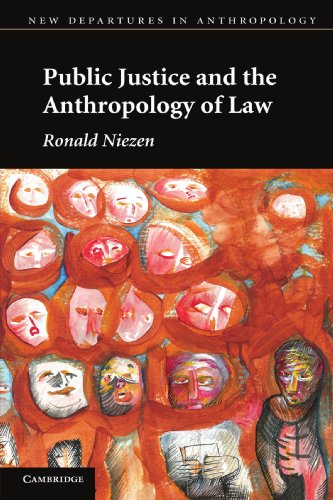

Public justice and the anthropology of law Ronald Niezen.
Series New departures in anthropologyDetalles de publicación: Cambridge, UK New York Cambridge University Press 2010.Descripción: xiv, 254 p. 24 cmISBN:- 9780521152204 (pbk. : alk. paper)
- 0521152208 (pbk. : alk. paper)
- 340.115 N682p 22
- K3242 .N543 2010
| Imagen de cubierta | Tipo de ítem | Biblioteca actual | Biblioteca de origen | Colección | Ubicación en estantería | Signatura topográfica | Materiales especificados | Info Vol | URL | Copia número | Estado | Notas | Fecha de vencimiento | Código de barras | Reserva de ítems | Prioridad de la cola de reserva de ejemplar | Reservas para cursos | |
|---|---|---|---|---|---|---|---|---|---|---|---|---|---|---|---|---|---|---|
| Libro | Biblioteca Encarnación Valdés Colección General bev | 340.115 N682p (Navegar estantería(Abre debajo)) | Disponible | 80000002441585 | ||||||||||||||
| Libro | Biblioteca Encarnación Valdés Colección General bev | 340.115 N682p (Navegar estantería(Abre debajo)) | c.2 | Disponible | 80000002441486 |
Descripciones mejoradas de Syndetics:
In this powerful, timely study Ronald Niezen examines the processes by which cultural concepts are conceived and collective rights are defended in international law. Niezen argues that cultivating support on behalf of those experiencing human rights violations often calls for strategic representations of injustice and suffering to distant audiences. The positive impulse behind public responses to political abuse can be found in the satisfaction of justice done. But the fact that oppressed peoples and their supporters from around the world are competing for public attention is actually a profound source of global difference, stemming from differential capacities to appeal to a remote, unknown public. Niezen's discussion of the impact of public opinion on law provides fresh insights into the importance of legally-constructed identity and the changing pathways through which it is being shaped - crucial issues for all those with an interest in anthropology, politics and human rights law.
Includes bibliographical references (p. 235-244) and index.
The imagined order -- The power of persons unknown -- Cultural lobbying -- The invention of indigenous peoples -- Civilizing a divided world -- Reconciliation -- Juridification.
Tabla de contenidos provista por Syndetics
- Preface(p. xi)
- 1 The imagined order(p. 1)
- 2 The power of persons unknown(p. 26)
- 3 Cultural lobbying(p. 67)
- 4 The invention of indigenous peoples(p. 105)
- 5 Civilizing a divided world(p. 137)
- 6 Reconciliation(p. 179)
- 7 Juridification(p. 217)
- References(p. 235)
- Index(p. 245)