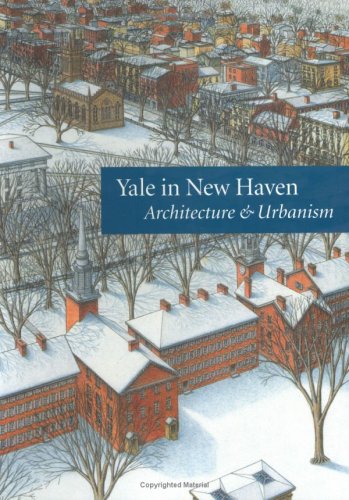

Yale in New Haven : Architecture and Urbanism. / Vincent Scully; Catherine Lynn; Erik Vogt; Paul Goldberger txt
Idioma: Español New Haven : Yale University , 2004Descripción: 406 p. ill. ;col. ; 30 cmTipo de contenido:- text
- unmediaded
- volume
- 0974956503
- 9780974956503
- NA735.N39 S38 2004
| Imagen de cubierta | Tipo de ítem | Biblioteca actual | Biblioteca de origen | Colección | Ubicación en estantería | Signatura topográfica | Materiales especificados | Info Vol | URL | Copia número | Estado | Notas | Fecha de vencimiento | Código de barras | Reserva de ítems | Prioridad de la cola de reserva de ejemplar | Reservas para cursos | |
|---|---|---|---|---|---|---|---|---|---|---|---|---|---|---|---|---|---|---|
| Libro | CARIBET Biblioteca Arquitectura Colección General CARIBET | General NA735.N39 S38 2004 (Navegar estantería(Abre debajo)) | 1 | Disponible | 91000000002006 |
Include index
Include Bibliography
Yale in New Haven: an introduction / Vincent Scully --
A new heaven & a new earth: the origin and meaning of the nine-square plan / Erik Vogt --
Cultivating types: the rise & fall of the brick row / Erik Vogt --
Building Yale & razing it from the Civil War to the Great Depression / Catherine Lynn --
The city redeemed: New Haven's civic improvement plan of 1910 / Erik Vogt --
A new Yale: the pope plan of 1919 / Erik Vogt --
James Gamble Rogers & the shaping of Yale in the twentieth century / Paul Goldberger --
Modern architecture at Yale: a memoir / Vincent Scully --
In this first major book devoted to the history of Yale s architecture and planning, four authors explore the physical shaping and reshaping of a great university that for over three centuries has been entangled with the idealism, ambition, and fate of its host city. The catalyst for much of the scholarly work is Vincent Scully, who grew up in New Haven when it was dominated by mighty factories, studied at Yale when James Gamble Rogers's Gothic colleges were still very new, became an influential member of the art history faculty soon after the Second World War, and is still teaching at Yale. Scully introduces the present critical history with an incisive overview of the architectural relationship between Yale and New Haven and concludes it with a memoir assessing Yale's widely influential modern building program, which has profoundly affected the course of American architecture and planning. He follows these themes through New Haven's redevelopment projects of the 1960s, subsequent urban problems, and Yale's recent role in the city s revitalization.Six other essays-- by Catherine Lynn, Erik Vogt, and Paul Goldberger-- take up many of Scully s topics in greater detail: the scriptural basis for New Haven's nine-square plan of 1638, unique in the English colonies; the rise and fall of Yale s Brick Row, designed by John Trumbull and James Hillhouse; the university's Victorian building experiments and brief enthusiasm for grand classical monuments; New Haven s Civic Improvement Plan of 1910, by Cass Gilbert and Frederick Law Olmsted, Jr.; John Russell Pope s plan of 1919 for a greatly expanded Yale campus; and the relationship of Rogers's closed quadrangles to the city's streets, with an assessment of the ways Rogers coped with the contradictory goals of civic generosity and institutional privacy. Fully illustrated with 47 color and 288 black-and-white images.
Notas de autor provistas por Syndetics
Vincent Joseph Scully Jr. was born in New Haven, Connecticut on August 21, 1920. He received a bachelor's degree in English from Yale University. During World War II, he served in the Marine Corps. He received a Ph.D. in art history from Yale University in 1949. His thesis, The Shingle Style: Architectural Theory and Design from Richardson to the Origins of Wright, was published as a book in 1955. He taught at Yale from 1947 until 2009.He wrote several books during his lifetime including American Architecture and Urbanism; The Earth, the Temple, and the Gods: Greek Sacred Architecture; Pueblo: Mountain, Village, Dance; Architecture: The Natural and the Manmade; and Yale in New Haven: Architecture and Urbanism. He received the National Medal of Arts in 2004. He died from complications of Parkinson's disease on November 30, 2017 at the age of 97.
(Bowker Author Biography)