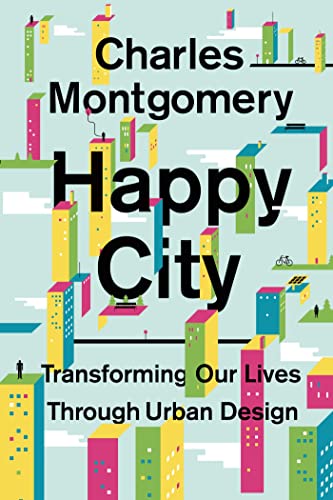

Happy City : transforming our lives through urban design. / Charles Montgomery. txt
Editor: New York : Farrar, Straus and Giroux , [2014]Edición: First paperback editionDescripción: 355 p. 24 cm illTipo de contenido:- text
- unmediaded
- volume
- 9780374168230
- 9780374534882
- 307.1/216 23
- HT166 M5865 2014
| Imagen de cubierta | Tipo de ítem | Biblioteca actual | Biblioteca de origen | Colección | Ubicación en estantería | Signatura topográfica | Materiales especificados | Info Vol | URL | Copia número | Estado | Notas | Fecha de vencimiento | Código de barras | Reserva de ítems | Prioridad de la cola de reserva de ejemplar | Reservas para cursos | |
|---|---|---|---|---|---|---|---|---|---|---|---|---|---|---|---|---|---|---|
| Libro | CARIBET Biblioteca Arquitectura Colección General CARIBET | General HT166 M5865 2013 (Navegar estantería(Abre debajo)) | 1 | Disponible | 91000000047696 |
Descripciones mejoradas de Syndetics:
A globe-trotting, eye-opening exploration of how cities can--and do--make us happier people
Charles Montgomery's Happy City will revolutionize the way we think about urban life.
After decades of unchecked sprawl, more people than ever are moving back to the city. Dense urban living has been prescribed as a panacea for the environmental and resource crises of our time. But is it better or worse for our happiness? Are subways, sidewalks, and tower dwelling an improvement on the car-dependence of sprawl?
The award-winning journalist Charles Montgomery finds answers to such questions at the intersection between urban design and the emerging science of happiness, and during an exhilarating journey through some of the world's most dynamic
cities. He meets the visionary mayor who introduced a "sexy" lipstick-red bus to ease status anxiety in Bogotá; the architect who brought the lessons of medieval Tuscan hill towns to modern-day New York City; the activist who turned Paris's urban freeways into beaches; and an army of American suburbanites who have transformed their lives by hacking the design of their streets and neighborhoods.
Full of rich historical detail and new insights from psychologists and Montgomery's own urban experiments, Happy City is an essential tool for understanding and improving our own communities. The message is as surprising as it is hopeful: by retrofitting our cities for happiness, we can tackle the urgent challenges of our age. The happy city, the green city, and the low-carbon city are the same place, and we can all help build it.
Include bibliography.
Contents:
1. Mayor of Happy 3 --
2. The City Has Always Been a Happiness Project 17
3. The Broken Social Scene 44 --
4. How W Got Here 63 --
5. Getting It Wrong 78 --
6. How to Be Closer 106 --
7. Convivialities 146 --
8. Mobilicities I: How Moving Fells, and Why It Does Not Feel Better 176 --
9. Mobilities II: Freedom 196 --
10. Who Is the City For? 227 --
11. Everything Is Connected to Everything Else 251 --
12. Retrofitting Sprawl 271 --
13. Save Your City, Save Yourself 295 --
Epilogue: The Beginning 315 --
Notes 323 --
Acknowledgments 327 --
"A journalist travels the world and investigates current socioeconomic theories of happiness to discover why most modern cities are designed to make us miserable, what we can do to change this, and why we have more to learn from poor cities than from prosperous ones"--
Tabla de contenidos provista por Syndetics
- 1 The Mayor of Happy(p. 3)
- 2 The City Has Always Been a Happiness Project(p. 17)
- 3 The (Broken) Social Scene(p. 44)
- 4 How We Got Here(p. 63)
- 5 Getting It Wrong(p. 78)
- 6 How to Be Closer(p. 106)
- 7 Convivialities(p. 146)
- 8 Mobilicities I: How Moving Feels, and Why It Does Not Feel Better(p. 176)
- 9 Mobilicities II: Freedom(p. 196)
- 10 Who Is the City For?(p. 227)
- 11 Everything Is Connected to Everything Else(p. 251)
- 12 Retrofitting Sprawl(p. 271)
- 13 Save Your City, Save Yourself(p. 295)
- Epilogue: The Beginning(p. 315)
- Notes(p. 323)
- Acknowledgments(p. 357)
Extracto provisto por Syndetics
Reseñas proporcionadas por Syndetics
Publishers Weekly Review
Can cities make us better people? Is the suburban American Dream really a nightmare? In this lively and accessible book, journalist Montgomery (The Shark God) marshals decades of interdisciplinary research into an effective argument against what he calls the "dispersed city"-the modern city/suburb designed around the automobile. The result is a succession of arguments meant to debunk individualism and show how citizens thrive on contact with others. In Montgomery's hands, urban design proves not only exciting, but integral to our future. He persuasively demonstrates that designing cities with social beings in mind can make them more pleasant places to live, and shows why suburbs are experiencing higher crime, as well as a significant happiness deficit. Furthermore, this passionate jeremiad argues that urban design often reinforces inequality, and Montgomery includes useful prescriptions for creating what he calls "the fair city," as well as addressing issues like gentrification. For Montgomery, the city is a "happiness project" that exists in part to corral our conviviality and channel it productively. Though Montgomery's argument may seem strange at first, the book will likely make you a believer. 68 b&w illus. Agent: Rebecca Gradinger, Fletcher & Co. (Nov.) (c) Copyright PWxyz, LLC. All rights reserved.CHOICE Review
Through the combination of neuroscience, behavioral economics, architecture, and the relatively new "science of happiness," Montgomery, a journalist, issues a call to action for how the 21st-century metropolis can reclaim well-being for its citizens. He asserts that the primary decline in quality of life in the urban setting is directly linked to the infrastructure supporting aggressive suburban sprawl and car culture. In fact, the first half of the book focuses on the unhappy city in consideration of social survey data, interdisciplinary case studies, and the author's anecdotal experiences--ranging from "Repo Tours" of foreclosed homes in the exurbs of the Bay Area to participation in the BMW Guggenheim Lab urban space project. But the second half follows up quickly with concrete examples of measures taken in different megacities to improve upon and sustain a healthy, humane civic structure. For professionals or academics in urban planning, architecture, or sustainable design, this book proposes nothing particularly new or groundbreaking. However, Happy City will greatly benefit those new to thinking holistically about the built environment as an entity vulnerable to illness but capable of prosperity and good fortune for its residents. Summing Up: Recommended. Lower- and upper-level undergraduates; general readers. H. B. Bennett Princeton UniversityBooklist Review
What is considered the happiest city on earth? Improbably, it just might be Bogota, Colombia, where drug lords ruled, bicycles now roll, and pedestrians stroll in a city with a mayor committed to transforming his town's image and its people's lives. What's the secret to his success? Not surprisingly, restricting traffic plays a huge part in Bogota's livability, but banning cars isn't the be-all and end-all to urban bliss. As Montgomery illustrates through vibrant discussions of the physics, physiology, and psychology of urban, suburban, and exurban dwellers, multiple factors must coalesce before a city, large or small, can achieve perfection. All of which may become terribly muddled as climate change and resource depletion stress urban centers to an untenable tipping point. Touting extensive research tempered by anecdotal examples, Montgomery enumerates the mistakes made not only by the people who plan and govern cities but also by the people who live in them, and he offers cautious reassurance that it's not too late to turn things around for all cities.--Haggas, Carol Copyright 2010 BooklistNotas de autor provistas por Syndetics
Charles Montgomery is an award-winning journalist and the author of The Shark God , which won the 2005 Charles Taylor Prize for Literary Non-Fiction under its Canadian
title, The Last Heathen .