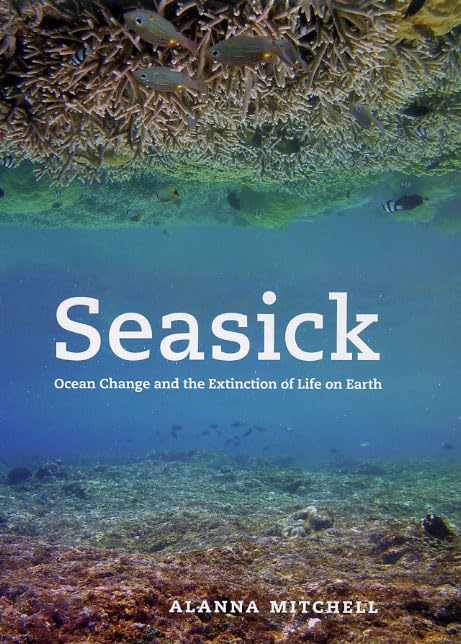
We have long lorded over the ocean. But only recently have we become aware of the myriad life-forms beneath its waves. We now know that this delicate ecosystem is our life-support system; it regulates the earth's temperatures and climate and comprises 99 percent of living space on earth. So when we change the chemistry of the whole ocean system, as we are now, life as we know it is threatened.
In Seasick, veteran science journalist Alanna Mitchell dives beneath the surface of the world's oceans to give readers a sense of how this watery realm can be managed and preserved, and with it life on earth. Each chapter features a different group of researchers who introduce readers to the importance of ocean currents, the building of coral structures, or the effects of acidification. With Mitchell at the helm, readers submerge 3,000 feet to gather sea sponges that may contribute to cancer care, see firsthand the lava lamp-like dead zone covering 17,000 square kilometers in the Gulf of Mexico, and witness the simultaneous spawning of corals under a full moon in Panama.
The first book to look at the planetary environmental crisis through the lens of the global ocean, Seasick takes the reader on an emotional journey through a hidden realm of the planet and urges conservation and reverence for the fount from which all life on earth sprang.
Includes bibliographical references and index.
Tabla de contenidos provista por Syndetics
Prologue(p. IX)
1 The last best place on earth(p. 1)
2 Reading the vital signs: Oxygen(p. 16)
3 Reading the vital signs: pH(p. 35)
4 Reading the vital signs: Metabolism(p. 46)
5 Reading the vital signs: Fecundity(p. 59)
6 Reading the vital signs: Life force(p. 75)
7 Reading the vital signs: Medical history(p. 90)
8 Reading the vital sign that is China(p. 102)
9 Reading the vital signs: Adaptability(p. 114)
10 Finding hope(p. 122)
Epilogue: A call for wisdom(p. 133)
Acknowledgments(p. 137)
Selected Bibliography(p. 139)
Index(p. 153)
Reseñas proporcionadas por Syndetics
Library Journal Review
The oceans occupy 99 percent of the living space on Earth and are crucial to human welfare. How are they impacted by global warming? Mitchell (Dancing at the Dead Sea: Tracking the World's Environmental Hotspots) takes readers on a maritime journey to learn about the effects of higher temperatures, salinity, acidity, and volume on marine animals and plants. The author travels to the Great Barrier Reef, the Gulf of Mexico, China, and Spain, among other places, interviews scientists, goes on marine research vessels and a diving expedition, describes the current destruction of coral reefs and declining fish populations, and explains why we should care. She focuses on greenhouse gases, while Richard Ellis in The Empty Ocean concentrates on overfishing and the destruction of marine habitats through human activities. Verdict Mitchell's book serves as a useful introduction for general readers unaware of the effects of global climate change and high school students exploring a career path in the marine and environmental sciences. While somewhat superficial compared with Ellis's book, it does present a strong case for urgency in solving the problem of global warming.-Judith B. Barnett, Univ. of Rhode Island Lib., Kingston (c) Copyright 2010. Library Journals LLC, a wholly owned subsidiary of Media Source, Inc. No redistribution permitted.
CHOICE Review
Seasick recounts the author's personal discovery of the ocean's troubled state and Earth's worrisome future. Following her participation in ongoing field studies, visits to marine research laboratories, and attendance at scientific meetings, Mitchell, a science and environmental writer, provides a narrative serving two roles that make the work accessible to general readers. First, her lucid, unencumbered description of the changes occurring in the chemistry, biology, and physical structure of the oceans and identification of the most likely factors driving those changes will be comprehensible to a broad audience. Second, her brief vignettes of scientists and their activities capture the practice of marine science realistically. Understanding that research is gritty, contentious, hindered by complexity, and frequented by missteps should provide lay readers a better perspective for understanding the conclusions of scientific inquiry and the reasons they are often in dispute. Previous books have attempted to alert the general public to the dangers associated with continuing the world's current activities in the marine realm, but Seasick achieves that goal better than most. Summing Up: Recommended. Lower- and upper-division undergraduates, two-year technical program students, and general readers. S. R. Fegley University of North Carolina at Chapel Hill
Notas de autor provistas por Syndetics
Alanna Mitchell spent fourteen years as a writer covering science and the environment at the Globe and Mail. She is the author of Dancing at the Dead Sea: Tracking the World's Environmental Hotspots, also published by the University of Chicago Press. In 2010, Mitchell received the Grantham Prize for Excellence in Reporting on the Environment for Seasick . She is the first book author to win the Grantham Prize, and the first Canadian.
Seasick
APA
Mitchell A., . (2009). Seasick: ocean change and the extinction of life on earth. London: University of Chicago Press.
Chicago
Mitchell Alanna, . 2009. Seasick: ocean change and the extinction of life on earth. London: University of Chicago Press.
Harvard
Mitchell A., . (2009). Seasick: ocean change and the extinction of life on earth. London: University of Chicago Press.
MLA
Mitchell Alanna, . Seasick: ocean change and the extinction of life on earth. London: University of Chicago Press. 2009.