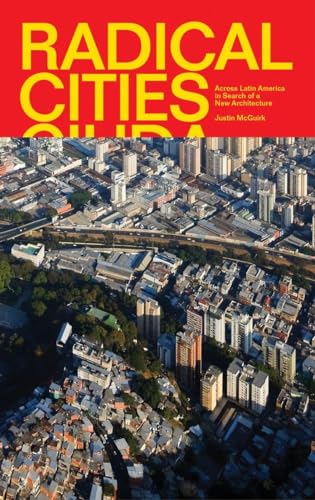
Imagen de portada de Amazon
Imagen de Amazon.com
Imagen de cubierta Syndetics
Portada de Syndetics
Imagen de OpenLibrary

Radical cities : across Latin America in search of a new architecture / Justin McGuirk. txt

Por: Editor: London : Verso , 2014Descripción: 296 p. ill. 22 cmTipo de contenido:
  • text
Tipo de medio:
  • unmediaded
Tipo de soporte:
  • volume
ISBN:
  • 9781781682807
Tema(s): Clasificación CDD:
  • 720.1
Clasificación LoC:
  • NA2543.S6 M39 2014
Contenidos:
In Radical Cities, Justin McGuirk travels across Latin America in search of activist architects, politicians and radical communities. From Chile to Brazil, and from Mexico to Argentina, McGuirk discovers people who have begun rebuilding and redesigning their environments in radically new ways.
Valoración
    Valoración media: 0.0 (0 votos)
Existencias
Imagen de cubierta Tipo de ítem Biblioteca actual Biblioteca de origen Colección Ubicación en estantería Signatura topográfica Materiales especificados Info Vol URL Copia número Estado Notas Fecha de vencimiento Código de barras Reserva de ítems Prioridad de la cola de reserva de ejemplar Reservas para cursos
Libro CARIBET Biblioteca Arquitectura Colección General CARIBET General NA2543.S6 M39 2015 (Navegar estantería(Abre debajo)) 1 Disponible 91000000043059
Libro CARIBET Biblioteca Arquitectura Colección General CARIBET General NA2543.S6 M39 2015 (Navegar estantería(Abre debajo)) 2 Disponible 91000000047126
Total de reservas: 0

Descripciones mejoradas de Syndetics:

What makes the city of the future? How do you heal a divided city?

In Radical Cities, Justin McGuirk travels across Latin America in search of the activist architects, maverick politicians and alternative communities already answering these questions. From Brazil to Venezuela, and from Mexico to Argentina, McGuirk discovers the people and ideas shaping the way cities are evolving.

Ever since the mid twentieth century, when the dream of modernist utopia went to Latin America to die, the continent has been a testing ground for exciting new conceptions of the city. An architect in Chile has designed a form of social housing where only half of the house is built, allowing the owners to adapt the rest; Medellín, formerly the world's murder capital, has been transformed with innovative public architecture; squatters in Caracas have taken over the forty-five-story Torre David skyscraper; and Rio is on a mission to incorporate its favelas into the rest of the city.

Here, in the most urbanised continent on the planet, extreme cities have bred extreme conditions, from vast housing estates to sprawling slums. But after decades of social and political failure, a new generation has revitalised architecture and urban design in order to address persistent poverty and inequality. Together, these activists, pragmatists and social idealists are performing bold experiments that the rest of the world may learn from.

Radical Cities is a colorful journey through Latin America--a crucible of architectural and urban innovation.

Includes index.

Includes bibliographical references.

In Radical Cities, Justin McGuirk travels across Latin America in search of activist architects, politicians and radical communities. From Chile to Brazil, and from Mexico to Argentina, McGuirk discovers people who have begun rebuilding and redesigning their environments in radically new ways.

Reseñas proporcionadas por Syndetics

Library Journal Review

Journalist and curator McGuirk presents a simple premise: the efficacy of completely planned cities is a myth and the various solutions to housing the urban dwellers of Latin America's booming metropolises illustrate perfectly this point. Whether the reader of this lively journey through the slums of Lima, Peru; the beachside developments of desert Chile; the dystopian towers of Caracas, Venezuela; the housing estates of Mexico City; and other spots will agree with McGuirk is moot because the writing is engaging, the characters and places fascinating, and the ideas of housing and community resonate far beyond Latin America. We visit a Caracas skyscraper in which thousands of previously homeless residents have created a barrio in the sky after the death of the building's developer. The theme of residents participating in the organization and building of at least part of their residence is illustrated in the half houses of Iquique, Chile. The rebellion against the gridwork face of 20th-century urbanism is never far from the center of this highly readable account. VERDICT This work will appeal not only to architecture and design professionals but also to urban dwellers and lovers of lively travel writing.-David -McClelland, Andover, NY (c) Copyright 2014. Library Journals LLC, a wholly owned subsidiary of Media Source, Inc. No redistribution permitted.

Publishers Weekly Review

According to art critic and curator McGuirk in this bracing debut, modernism's utopian ambitions reached their nadir in Lima, Peru, in the 1960s with a scrapped social housing project called PREVI. Writing with verve and purpose, McGuirk explores how a new generation is developing strategies to build equitable communities in Latin America. From architects to social organizers and populist leaders, these "idealistic pragmatists" are concerned with small but focused interventions, with human needs rather than style. These activists work across political divides and under less than ideal conditions, and most importantly, they regard the slums not as the problem, but the inevitable solution. Reporting from Buenos Aires, Lima, Rio, and Tijuana, among other locations, McGuirk eloquently considers the implications of different housing projects and phenomena. He visits a "vertical gymnasium" in a slum outside Caracas, Venezuela, that helped violent crime rates drop 30%. He climbs Torre David, the unfinished skyscraper in Caracas that's home to 3,000 squatters, whose fusion of formal and informal elements could serve as a model for urban housing around the world. As McGuirk writes, "This is not a book about objects, but about actions." Like these activist architects, he is not interested in attractive buildings (there are none here in the traditional sense), but effective civic renewal. (June) (c) Copyright PWxyz, LLC. All rights reserved.

Notas de autor provistas por Syndetics

Justin McGuirk is a writer and curator, and has worked as the Guardian's design columnist and the editor of Icon magazine. He is also the director of Strelka Press and the design consultant to Domus , and his writing has appeared in the Observer , the Times , Disegno , Art Review , Condé Nast Traveller , Form , the Architects Journal , Architecture d'Aujourd'hui . In 2012 he was awarded the Golden Lion at the Venice Biennale of Architecture for an exhibition he curated with Urban Think Tank. He is the incoming Chief Curator of the Design Museum in London.
Compartir
logopucpr-y-vive

Contáctanos

¡Queremos saber de ti!

Tel. 787.841.2000 Ext. 1801

bibliotecavaldes@pucpr.edu

⁣Búscanos en las redes

© 2026 Desarrollado por Ignite Online • All Rights Reserved • Powered by Koha.