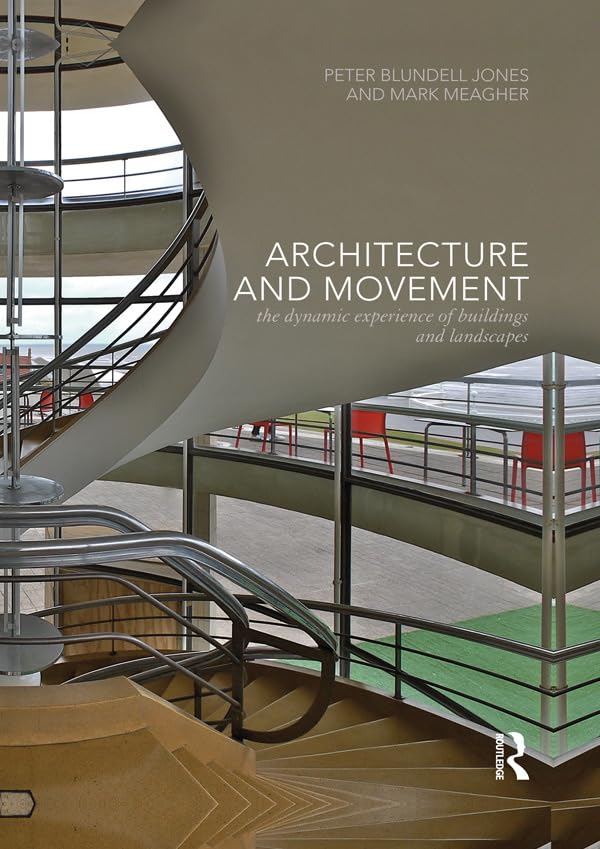

Architecture and movement : the dynamic experience of buildings and landscapes / PeterBlundell Jones and Mark Meagher txt
Oxon : Routledge , 2015Edición: First publishedDescripción: 298 p. ill., plans 25 cmTipo de contenido:- text
- unmediaded
- volume
- 9780415725354
- 720
- NA2765 A73 2015
| Imagen de cubierta | Tipo de ítem | Biblioteca actual | Biblioteca de origen | Colección | Ubicación en estantería | Signatura topográfica | Materiales especificados | Info Vol | URL | Copia número | Estado | Notas | Fecha de vencimiento | Código de barras | Reserva de ítems | Prioridad de la cola de reserva de ejemplar | Reservas para cursos | |
|---|---|---|---|---|---|---|---|---|---|---|---|---|---|---|---|---|---|---|
| Libro | CARIBET Biblioteca Arquitectura Colección General CARIBET | General NA2765 A73 2015 (Navegar estantería(Abre debajo)) | 1 | Disponible | 91000000042432 |
Descripciones mejoradas de Syndetics:
The experience of movement, of moving through buildings, cities, landscapes and in everyday life, is the only involvement most individuals have with the built environment on a daily basis. User experience is so often neglected in architectural study and practice. Architecture and Movement tackles this complex subject for the first time, providing the wide range of perspectives needed to tackle this multi-disciplinary topic.
Organised in four parts it:
documents the architect's, planner's, or designer's approach, looking at how they have sought to deploy buildings as a promenade and how they have thought or written about it. concentrates on the individual's experience, and particularly on the primacy of walking, which engages other senses besides the visual. engages with society and social rituals, and how mutually we define the spaces through which we move, both by laying out routes and boundaries and by celebrating thresholds. analyses how we deal with promenades which are not experienced directly but via other mediums such as computer models, drawings, film and television.The wide selection of contributors include academics and practitioners and discuss cases from across the US, UK, Europe and Asia. By mingling such disparate voices in a carefully curated selection of chapters, the book enlarges the understanding of architects, architectural students, designers and planners, alerting them to the many and complex issues involved in the experience of movement.
Includes index.
Includes bibliographical references.
Tabla de contenidos provista por Syndetics
- Contributors(p. ix)
- Acknowledgements(p. xii)
- Introduction(p. 1)
- Part 1 Moving through buildings and landscapes: the designer's perspective
- 1.0 Introduction to Part 1(p. 11)
- 1.1 The classical authors(p. 19)
- 1.2 Viollet-le-duc on the medieval cloister(p. 23)
- 1.3 Charles Gamier: Le théâtre, Chapter 4, Staircases(p. 25)
- 1.4 Hermann Muthesius: Wie baue ich mein Haus(p. 35)
- 1.5 Architectural promenades through the Villa Savoye(p. 44)
- 1.6 Gunnar Asplund: 'pictures with marginal notes from the Gothenburg Art and Industry Exhibition', 1923(p. 50)
- 1.7 Frank Lloyd Wright's use of movement(p. 55)
- 1.8 Hans Scharoun and movement: the Kassel Project 1952(p. 65)
- 1.9 Move to the light(p. 72)
- 1.10 Odysseus and Kalypso - at home(p. 81)
- Part 2 Movement as experienced by the individual(p. 91)
- 2.0 Introduction to Part 2(p. 93)
- 2.1 The primacy of bodily experience(p. 96)
- 2.2 From health to pleasure: the landscape of walking(p. 102)
- 2.3 Architecture of walking(p. 112)
- 2.4 Sonndscape and movement(p. 121)
- 2.5 From foot to vehicle(p. 128)
- 2.6 Moving round the ring road(p. 135)
- 2.7 The geometry of moving bodies(p. 142)
- 2.8 Pedestrians and traffic(p. 149)
- Part 3 Movement as social and shared(p. 157)
- 3.0 Introduction to Pan 3(p. 159)
- 3.1 Space as a product of bodily movement: centre, path and threshold(p. 164)
- 3.2 Rievaulx and the Order of St Benedict(p. 172)
- 3.3 Lucien Kroll: the door(p. 177)
- 3.4 The Japanese tea ceremony(p. 178)
- 3.5 The East Royal Tombs of the Qing Dynasty(p. 185)
- 3.6 The automated gardens of Lunéville: from the self-moving landscape to the circuit walk(p. 196)
- 3.7 Lauriston School(p. 204)
- Part 4 The representation of movement(p. 213)
- 4.0 Introduction to Part 4(p. 215)
- 4.1 House construction among the Dong(p. 220)
- 4.2 Movement and the use of the sequential section by Enric Miralles and Mathur and da Cunha(p. 230)
- 4.3 From models to movement? Reflections on some recent projects by Herzog & de Meuron(p. 239)
- 4.4 Filmic Space: an encounter with Patrick Keiller(p. 244)
- 4.5 Diasporic experience and the need for topological methods(p. 251)
- 4.6 Open design: thoughts on software and the representation of movement(p. 258)
- 4.7 The matter of movement(p. 266)
- Conclusion(p. 277)
- Bibliography(p. 287)
- Index(p. 295)
Notas de autor provistas por Syndetics
Peter Blundell Jones is Professor of Architecture as the University of Shelfield and a prolific author on architectural history and theory. He has written monographs on the work of Erik Gunnar Asplund, Hans Scharoun, Hugo Harring Gnter Behnisch Peter Hbner and the Graz School.Mark Meagher is a lecturer at the University of Sheffield school of Architecture. His research and teaching focus on application of digital software and devices in design education, data visualization and fabrication.