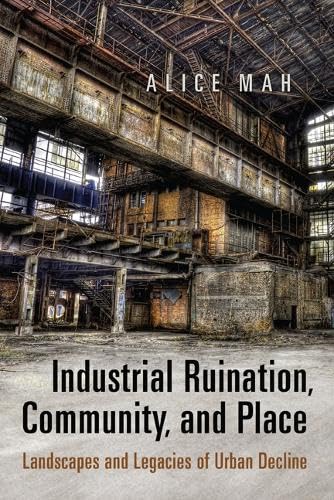

Industrial ruination, community, and place landscapes and legacies of urban decline Alice Mah.
Detalles de publicación: Toronto University of Toronto Press c2012.Descripción: viii, 236 p. ill. 23 cmISBN:- 9781442613577
- 1442613572
- 307.76 M2141i 23
- HT151 .M342 2012
| Imagen de cubierta | Tipo de ítem | Biblioteca actual | Biblioteca de origen | Colección | Ubicación en estantería | Signatura topográfica | Materiales especificados | Info Vol | URL | Copia número | Estado | Notas | Fecha de vencimiento | Código de barras | Reserva de ítems | Prioridad de la cola de reserva de ejemplar | Reservas para cursos | |
|---|---|---|---|---|---|---|---|---|---|---|---|---|---|---|---|---|---|---|
| Libro | Biblioteca Encarnación Valdés Colección General bev | 307.76 M2141i (Navegar estantería(Abre debajo)) | Disponible | 80000002524695 |
Descripciones mejoradas de Syndetics:
Abandoned factories, shipyards, warehouses, and refineries are features of many industrialized cities around the world. But despite their state of decline, these derelict sites remain vitally connected with the urban landscapes that surround them. In this enlightening new book, Alice Mah explores the experiences of urban decline and post-industrial change in three different community contexts: Niagara Falls, Canada/USA; Newcastle-upon-Tyne, UK; and Ivanovo, Russia.
Employing a unique methodological approach that combines ethnographic, spatial, and documentary methods, Mah draws on international comparisons of the landscapes and legacies of industrial ruination over the past forty years. Through this, she foregrounds the complex challenges of living with prolonged uncertainty and deprivation amidst socioeconomic change. This rich comparative study makes an essential contribution to far-reaching debates about the decline of manufacturing, regeneration, and identity, and will have important implications for urban theory and policy.
Includes bibliographical references (p. [209]-223) and index.
Tabla de contenidos provista por Syndetics
- List of Figures(p. vii)
- Acknowledgments(p. ix)
- 1 Introduction(p. 3)
- Part 1 Case Studies
- 2 "When the Smell Goes, the Jobs Go": Ambivalent Nostalgia and Traumatic Memory in Niagara Falls(p. 37)
- 3 Protracted Decline and Imminent Regeneration: Memory and Uncertainty in Walker, Newcastle upon Tyne(p. 69)
- 4 "We Ruined Everything around Us, but We Couldn't Change Ourselves": Enduring Soviet and Textile Identities in Ivanovo(p. 98)
- Part 2 Themes of Industrial Ruination
- 5 Reading Landscapes of Ruination, Deprivation, and Decline(p. 129)
- 6 Devastation, but also Home(p. 153)
- 7 Imagining Change, Reinventing Place(p. 175)
- 8 Conclusion(p. 195)
- Notes(p. 203)
- References(p. 209)
- Index(p. 225)