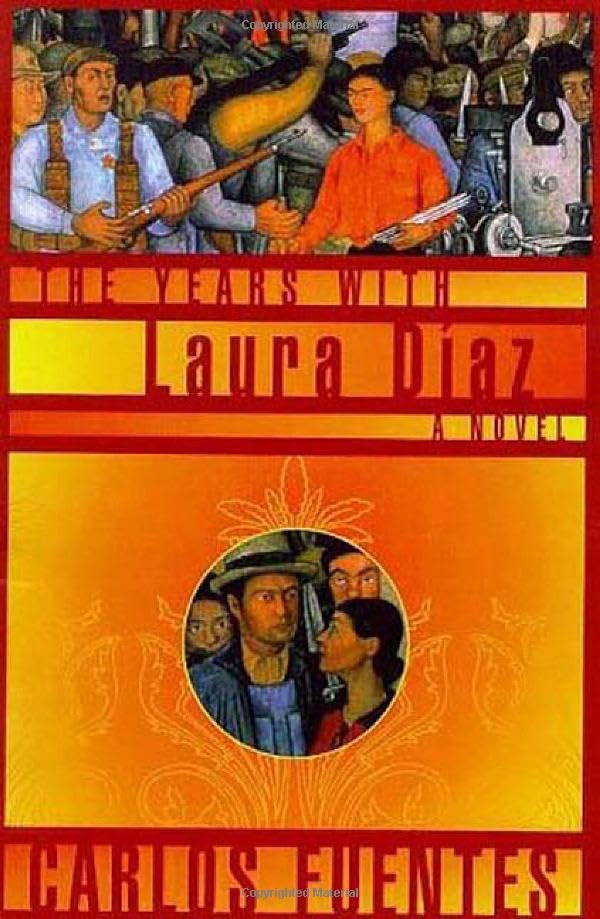
Imagen de Amazon.com

Portada de Syndetics
Imagen de OpenLibrary
The years with Laura Díaz Carlos Fuentes ; translated from the Spanish by Alfred Mac Adam.
Detalles de publicación: New York Farrar, Straus and Giroux 2000.Edición: 1st edDescripción: 516 p. 24 cmISBN:- 0374293414 (alk. paper)
- 863/.64 21
- PQ7297.F793 A7613 2000
| Imagen de cubierta | Tipo de ítem | Biblioteca actual | Biblioteca de origen | Colección | Ubicación en estantería | Signatura topográfica | Materiales especificados | Info Vol | URL | Copia número | Estado | Notas | Fecha de vencimiento | Código de barras | Reserva de ítems | Prioridad de la cola de reserva de ejemplar | Reservas para cursos | |
|---|---|---|---|---|---|---|---|---|---|---|---|---|---|---|---|---|---|---|
| Libro | Biblioteca Encarnación Valdés Colección General bev | M 863.64 F954a I (Navegar estantería(Abre debajo)) | Disponible | 80000002529322 |
Total de reservas: 0
Tabla de contenidos provista por Syndetics
- 1. Detroit: 1999(p. 3)
- 2. Catemaco: 1905(p. 12)
- 3. Veracruz: 1910(p. 39)
- 4. San Cayetano: 1915(p. 59)
- 5. Xalapa: 1920(p. 86)
- 6. Mexico City: 1922(p. 106)
- 7. Avenida Sonora: 1928(p. 126)
- 8. Paseo de la Reforma: 1930(p. 145)
- 9. The Interoceanic Train: 1932(p. 160)
- 10. Detroit: 1932(p. 182)
- 11. Avenida Sonora: 1934(p. 203)
- 12. Parque de la Lama: 1938(p. 221)
- 13. Cafe de Paris: 1939(p. 242)
- 14. Every Place, the Place: 1940(p. 260)
- 15. Colonia Roma: 1941(p. 283)
- 16. Chapultepec-Polanco: 1947(p. 305)
- 17. Lanzarote: 1949(p. 331)
- 18. Avenida Sonora: 1950(p. 353)
- 19. Cuernavaca: 1952(p. 372)
- 20. Tepoztlan: 1954(p. 391)
- 21. Colonia Roma: 1957(p. 422)
- 22. Plaza Rio de Janeiro: 1966(p. 452)
- 23. Tlatelolco: 1968(p. 471)
- 24. Zona Rosa: 1970(p. 480)
- 25. Catemaco: 1972(p. 498)
- 26. Los Angeles: 2000(p. 507)
- Acknowledgments(p. 515)
Reseñas proporcionadas por Syndetics
Library Journal Review
In 1999, the narrator of this novel arrives in the urban decay of Detroit to make a television special about the work of Mexican muralists in the United States and instead launches into a saga of the generations that precede and follow his remarkable Mexican great-grandmother, Laura Diaz. Elaborating on many of the elements that appeared in Fuentes's earlier masterpiece, The Death of Artemio Cruz, this fictionalized memoir brilliantly recaptures the turbulent and exciting history of 20th-century Mexico. It all begins when Laura's German grandfather, Don Felipe, obtains a mail-order atheist bride from his homeland, who promptly announces that despite their Protestant heritage, they will be having a Catholic wedding. Laura herself is a friend of Diego Rivera and Frida Kahlo and the lover of great men, but her brother, son, and grandson are all casualties of Mexico's tragically unsettled politics. In his epilog, where he recites the details of his own genealogy, Fuentes acknowledges his own real-life position within the clan of Laura Diaz. A mural-mosaic of recent Mexican history by an author who has witnessed, scrutinized, and interpreted that history like no other, this roman fleuve of a novel can hardly fail to entertain and enlighten. [Previewed in Prepub Alert, LJ 6/15/00.]DJack Shreve, Allegany Coll. of Maryland, Cumberland (c) Copyright 2010. Library Journals LLC, a wholly owned subsidiary of Media Source, Inc. No redistribution permitted.Publishers Weekly Review
In a masterwork imbued with historical anecdotes, mystical imagery and revelations about human existence, Fuentes (The Death of Artemio Cruz) relates the story of 20th-century Mexico through the fictional biography of Laura D!az. Narrated by Laura's great-grandson, a photographer and documentary filmmaker, the central thread is straightforward: Laura grows from an unusually observant child into an attractive and passionate young woman, survives numerous revolutions and world wars, several lovers and one husband. The catalyst that keeps this chronicle engaging is Laura's desire to steer the course of her life above and beyond the political currents surging through Mexican society. Much of her life revolves around her rising and falling romances: with a Casanova who vanishes when Laura gets too close to him, a Communist whose search for his missing wife precludes their relationship and a screenwriter who is slowly dying of emphysema. She eventually marries Juan Francisco, an activist whose political passion initially attracts Laura, but ultimately disturbs and alienates her. The union produces two sons. In her later years, inspired by close acquaintances with the artists Diego Rivera and Frida Kahlo, Laura becomes a photographer (she photographs Kahlo's body while it is being cremated) and achieves renown almost instantly. While in other books Fuentes's characteristic riffs and dizzying, cascading sentences were intended as potential expansions of the novel, this time these gestures are used for the deepening development of the content of the book rather than of its form. Fuentes's emotional commitment to his subject shows in the lucidity of the book's underlying intellectual dialoguesDthe opposition of communism and fascism, the corrosion of individual identities by historical processesDwhich Fuentes is able to animate with a learned lyricism that should make this volume one of his most admired and memorable. (Oct.) (c) Copyright PWxyz, LLC. All rights reservedBooklist Review
"[Is it] possible to live the life of a dead woman exactly as she lived it, to discover the secret of her memory?" asks the narrator of The Years with Laura Diaz, Fuentes' new novel. In this case, the dead woman is Laura Diaz, Fuentes' version of a Mexican Every Woman, and her memory is none other than the turbulent history of twentieth-century Mexico. The novel begins in 1999 when photographer Santiago Lopez-Alfaro arrives in Detroit to film a documentary about the Mexican muralists in the U.S. There he comes across the image of an unnamed woman immortalized on the mural of the famous Diego Rivera. He soon realizes that "those almost golden eyes, mestizo, between European and Mexican" belonged to his great-grandmother, Laura Diaz. Thereafter, the novel recounts the life of Diaz, from the settlement of her German grandparents in Mexico in the late 1800s (based on the true story of the migration of Fuentes' European ancestors to Mexico) to her experience of the Mexican Revolution and its aftermath. In many ways, Laura Diaz is the female counterpart to Artemio Cruz, the hero of Fuentes' 1962 novel, The Death of Artemio Cruz. If Cruz, the former revolutionary turned capitalist, symbolized for Fuentes Mexico's quest for wealth at the expense of moral values, then Diaz, the politically committed artist, stands as the pillar of integrity and hope for twentieth-century Mexico. In Laura Diaz, Fuentes has created a remarkable heroine. --Veronica ScrolNotas de autor provistas por Syndetics
Carlos Fuentes was born in Panama on November 11, 1928. He studied law at the National University of Mexico and did graduate work at the Institute des Hautes Etudes in Switzerland. He entered Mexico's diplomatic service and wrote in his spare time. His first novel, Where the Air Is Clear, was published in 1958. His other works include The Death of Artemio Cruz, Destiny and Desire, and Vlad. The Old Gringo was later adapted as a film starring Gregory Peck and Jane Fonda in 1989. He won numerous awards including the Fuentes the Romulo Gallegos Prize in Venezuela for Terra Nostra, the National Order of Merit in France, the Cervantes Prize in 1987, and Spain's Prince of Asturias Award for literature in 1994.He also wrote essays, short stories, screenplays, and political nonfiction. In addition to writing, he taught at numerous universities, including Columbia, Harvard, Princeton, and Brown. He served as the ambassador of Mexico to France. He died on May 15, 2012 at the age of 83.
(Bowker Author Biography)