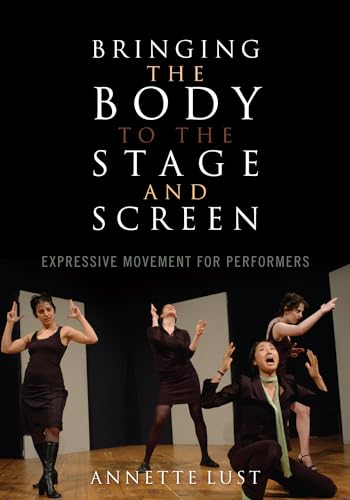

Bringing the body to the stage and screen expressive movement for performers Annette Lust ; with movement consultant Jo Tomalin ; illustrations by C. Yeaton.
Detalles de publicación: Lanham, Md. Scarecrow Press 2012.Descripción: xxi, 342 p. ill. 27 cmISBN:- 9780810881242 (alk. paper)
- 9780810882126 (pbk. : alk. paper)
- 9780810881259 (ebook)
- 792.028 L972b 23
- PN2071.M6 L87 2012
| Imagen de cubierta | Tipo de ítem | Biblioteca actual | Biblioteca de origen | Colección | Ubicación en estantería | Signatura topográfica | Materiales especificados | Info Vol | URL | Copia número | Estado | Notas | Fecha de vencimiento | Código de barras | Reserva de ítems | Prioridad de la cola de reserva de ejemplar | Reservas para cursos | |
|---|---|---|---|---|---|---|---|---|---|---|---|---|---|---|---|---|---|---|
| Libro | Biblioteca Encarnación Valdés Colección General bev | 792.028 L972b (Navegar estantería(Abre debajo)) | c.2 | Disponible | 80000002505231 | |||||||||||||
| Libro | Biblioteca Encarnación Valdés Colección General bev | 792.028 L972b (Navegar estantería(Abre debajo)) | Disponible | 80000002490780 |
Descripciones mejoradas de Syndetics:
As stage and screen artists explore new means to enhance their craft, a new wave of interest in expressive movement and physical improvisation has developed. And in order to bring authenticity and believability to a character, it has become increasingly vital for actors to be aware of movement and physical acting. Stage and screen artists must now call upon physical presence, movement on stage, non-verbal interactions, and gestures to fully convey themselves.
In Bringing the Body to the Stage and Screen , Annette Lust provides stage and screen artists with a program of physical and related expressive exercises that can empower their art with more creativity. In this book, Lust provides a general introduction to movement, including definitions and differences between movement on the stage and screen, how to conduct a class or learn on one''s own, and choosing a movement style. Throughout the book and in the appendixes, Lust incorporates learning programs that cover the use of basic physical and expressive exercises for the entire body. In addition, she provides original solo and group pantomimes; improvisational exercises; examples of plays, fiction, poetry, and songs that may be interpreted with movement; a list of training centers in America and Europe; and an extensive bibliography and videography.
With 15 interviews and essays by prominent stage and screen actors, mimes, clowns, dancers, and puppeteers who describe the importance of movement in their art and illustrated with dozens of photos of renowned world companies and artists, Bringing the Body to the Stage and Screen will be a valuable resource for theater teachers and students, as well as anyone engaged in the performing arts.
With 15 interviews and essays by prominent stage and screen actors, mimes, clowns, dancers, and puppeteers who describe the importance of movement in their art and illustrated with dozens of photos of renowned world companies and artists, Bringing the Body to the Stage and Screen will be a valuable resource for theater teachers and students, as well as anyone engaged in the performing arts.expressive exercises for the entire body. In addition, she provides original solo and group pantomimes; improvisational exercises; examples of plays, fiction, poetry, and songs that may be interpreted with movement; a list of training centers in America and Europe; and an extensive bibliography and videography.
With 15 interviews and essays by prominent stage and screen actors, mimes, clowns, dancers, and puppeteers who describe the importance of movement in their art and illustrated with dozens of photos of renowned world companies and artists, Bringing the Body to the Stage and Screen will be a valuable resource for theater teachers and students, as well as anyone engaged in the performing arts.expressive exercises for the entire body. In addition, she provides original solo and group pantomimes; improvisational exercises; examples of plays, fiction, poetry, and songs that may be interpreted with movement; a list of training centers in America and Europe; and an extensive bibliography and videography.
With 15 interviews and essays by prominent stage and screen actors, mimes, clowns, dancers, and puppeteers who describe the importance of movement in their art and illustrated with dozens of photos of renowned world companies and artists, Bringing the Body to the Stage and Screen will be a valuable resource for theater teachers and students, as well as anyone engaged in the performing arts.videography.
With 15 interviews and essays by prominent stage and screen actors, mimes, clowns, dancers, and puppeteers who describe the importance of movement in their art and illustrated with dozens of photos of renowned world companies and artists, Bringing the Body to the Stage and Screen will be a valuable resource for theater teachers and students, as well as anyone engaged in the performing arts.
Includes bibliographical references (p. 319-328) and index.
Tabla de contenidos provista por Syndetics
- Foreword(p. vii)
- Preface(p. ix)
- Acknowledgments(p. xiii)
- Introduction: Goals and Objectives for Learning to Move Expressively(p. xv)
- Part I Physical and Expressive Exercises(p. 1)
- 1 Definitions of Stage and Screen Movement, Mime, Pantomime, Corporeal Mime, Stage Combat, Physical Theatre, and Physical Improvisation(p. 3)
- 2 Conducting a Class and Practicing on One's Own(p. 11)
- 3 Basic Physical and Expressive Exercises(p. 17)
- 4 Utilizing Movement to Create a Visual Image(p. 99)
- Part II Subjects for Improvisation, Pantomimes, Nonverbal Acting, Physicalizing the Word, and Mime and Text(p. 119)
- 5 Improvisation(p. 121)
- 6 Pantomimes and Scenes for Nonverbal Acting(p. 129)
- 7 Physicalizing the Word, Mime and Text(p. 143)
- Part III Interviews and Essays(p. 191)
- 8 A Conversation with Bill Irwin on Mime and Acting(p. 193)
- 9 Interview with Bernie Schürch and Floriana Frassetto of the Swiss Mummenschanz Company(p. 197)
- 10 Interview with Geoff Hoyle on the Mime-Clown-Actor's Art(p. 201)
- 11 Etienne Decroux and the Contemporary Theatre: Decroux Corporeal Mime(p. 205)
- 12 Interview with Joanna Sherman and Michael McGuigan on the Bond Street Theatre(p. 215)
- 13 On Movement Training for the Actor(p. 221)
- 14 Dance and the Female Body(p. 225)
- 15 Interview with Liebe Wetzel on Movement in Puppetry(p. 227)
- 16 Images and Body Expression in Film; Gift of the Gods(p. 233)
- 17 Theatrical Dance(p. 235)
- 18 The Clown Conservatory Teaching of Professional Clowns in the Twenty-first Century(p. 237)
- 19 Movement for Puppeteers(p. 239)
- 20 Too Much Geniality: Notes and Quotes on a Reappraisal: Stage Versus Screen Acting(p. 241)
- 21 The Body of Theater(p. 245)
- 22 How Charlie Chaplin Spun Stagecraft into Cinematic Gold(p. 247)
- Epilogue(p. 253)
- Appendixes
- A Creating a Movement Training Program: Ten Sample Lessons(p. 253)
- B Resources for Mime Plays, Pantomimes, Themes for Improvisation, and Scenes with and without Words(p. 267)
- C Constructing a Mime Piece or Mimodrama(p. 281)
- D Schools and Movement Training Centers(p. 289)
- E Publications, Organizations, Festivals, and Resource Centers(p. 307)
- F Selected Videography and DVDs(p. 311)
- Selected Bibliography(p. 319)
- Index(p. 329)
- About the Author(p. 341)