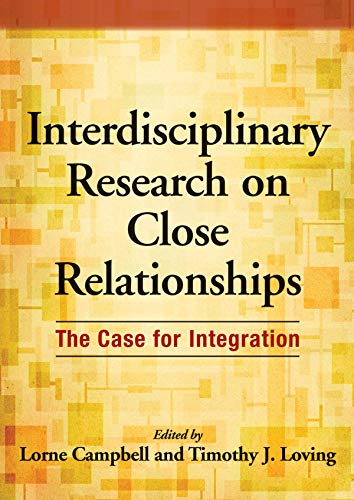

Interdisciplinary research on close relationships the case for integration edited by Lorne Campbell and Timothy J. Loving.
Detalles de publicación: Washington, D.C. American Psychological Association c2012.Descripción: xii, 296 p. 26 cmISBN:- 9781433810725
- 1433810727
- 155.9/2 23
- BF636 .I57 2012
| Imagen de cubierta | Tipo de ítem | Biblioteca actual | Biblioteca de origen | Colección | Ubicación en estantería | Signatura topográfica | Materiales especificados | Info Vol | URL | Copia número | Estado | Notas | Fecha de vencimiento | Código de barras | Reserva de ítems | Prioridad de la cola de reserva de ejemplar | Reservas para cursos | |
|---|---|---|---|---|---|---|---|---|---|---|---|---|---|---|---|---|---|---|
| Libro | Biblioteca Encarnación Valdés Colección General bev | 155.9 I6117 2012 (Navegar estantería(Abre debajo)) | Disponible | 80000002450875 |
Descripciones mejoradas de Syndetics:
This book argues that close personal relationships are most fruitfully explored through interdisciplinary collaboration. Such cooperation permits researchers to integrate a variety of perspectives on how close relationships develop, function, and interact in various contexts. The contributors examine aspects of both early and adult relationships, and of parent-child relationships. Their chapters demonstrate how theorists and researchers versed in developmental, social, and cross-cultural psychology, as well as evolutionary science, individual differences, and psychophysiology, can collaborate and generate new thinking on familiar topics.
This excellent resource will be well received by researchers and students in the social sciences who are interested in a broader, more collaborative approach to relationship science.
Includes bibliographical references and index.
Tabla de contenidos provista por Syndetics
- Contributors(p. ix)
- Preface(p. xi)
- Chapter 1 Research on Close Relationships: Call for an Interdisciplinary Integration(p. 3)
- I Interpersonal Responsiveness in Close Relationships(p. 25)
- Chapter 2 Perceived Partner Responsiveness as an Organizing Theme for the Study of Relationships and Well-Being(p. 27)
- Chapter 3 The Emergence of Social Approach and Avoidance Motivation in Early Parent-Child Relationships(p. 53)
- Chapter 4 Emotion Regulation in Close Relationships: Implications for Social Threat and Its Effects on Immunological Functioning(p. 83)
- II Relationships in Early Life(p. 107)
- Chapter 5 Parent-Child and Child-Peer Close Relationships: Understanding Parental Influences on Peer Relations From a Cultural Context(p. 109)
- Chapter 6 Social Networks and Attachment Bonds During Adolescence: Implications for Early Pair Bonding and Risky Behaviors(p. 135)
- III Adult Relationships(p. 153)
- Chapter 7 An Organizational-Developmental Perspective on Functioning in Adult Romantic Relationships(p. 155)
- Chapter 8 Putting Marriage in Its Context: The Influence of External Stress on Early Marital Development(p. 179)
- Chapter 9 The Utility of Evolutionary Perspectives on Romantic Relationships: Women's Estrus as Illustration(p. 205)
- Chapter 10 Examining Divorce Consequences and Policies and the Question: Is Marriage More Than a Piece of Paper?(p. 227)
- IV Conclusions(p. 251)
- Chapter 11 A Path to Interdisciplinary Scholarship(p. 253)
- Chapter 12 Back to the Future: Resurrecting and Vitalizing the Unrealized Call for Interdisciplinary Research on Close Relationships(p. 273)
- Index(p. 283)
- About the Editors(p. 295)
Reseñas proporcionadas por Syndetics
CHOICE Review
While on sabbatical leave at the Department of Human Development and Family Services at the University of Texas at Austin, Campbell (Univ. of Western Ontario, Canada) discovered a distinctiveness within that department: scholars in it represented a variety of disciplines and used myriad methodological approaches, the common focus being close relationships. The conversations within this department--which included Loving, Campbell's coeditor--were illuminating and challenging given the broad topics approached from multiple viewpoints. The challenge was to recognize gaps exposed by the disciplinary divergences. The department hosted a symposium with the objective of providing a comprehensive interdisciplinary perspective. This well-attended symposium led to lively discussion and ultimately this book, which includes contributions by 21 scholars. Although all the contributors are apparently psychologists, they express a clear determination to foster interdisciplinary work--and the book includes an analysis of the obstacles that need to be overcome. Of particular interest is a paper by Aletha Huston, who describes her 40-year career of involvement in interdisciplinary academic work. For its holistic focus this is a groundbreaking book; it is also a valuable resource for research on close relationships. Includes chapter references. Summing Up: Highly recommended. Upper-division undergraduates through faculty and professionals. D. Sydiaha emeritus, University of SaskatchewanNotas de autor provistas por Syndetics
Lorne Campbell earned his PhD in social psychology at Texas A&M University in 2001. He was an assistant professor at Simon Fraser University before joining the faculty at the University of Western Ontario in 2002, where he is currently an associate professor of psychology. From 2008 to 2009, Dr. Campbell was a Harrington Faculty Fellow at the University of Texas at Austin in the Department of Human Development and Family Sciences.Dr. Campbell is a recognized expert in the fields of interpersonal relationships, research design and data analysis, and evolutionary psychology. He is on the editorial board of the Journal of Personality and Social Psychology and Personality and Social Psychology Bulletin and is the editor of the journal Personal Relationships .
His research is currently funded by the Social Science and Humanities Research Council of Canada, and his work has been published in the Journal of Personality and Social Psychology, Personality and Social Psychology Bulletin, Personal Relationships, Personality and Individual Differences, and the Journal of Social and Personal Relationships .
Timothy J. Loving received his PhD in social psychology from Purdue University in 2001. He is currently an associate professor in the University of Texas at Austin's Department of Human Development and Family Sciences. Prior to arriving at Texas, he received postdoctoral training at the Ohio State University College of Medicine, where he was funded by a National Institutes of Health training grant in psychoneuroimmunology.
Dr. Loving's research addresses the mental and physical health impact of relationship transitions, with a particular focus on affectively positive transitions (e.g., falling in love) and the role that network members serve as relationship partners adapt to these transitions. He is an associate editor of Personal Relationships and a member of the editorial board for the Journal of Personality and Social Psychology .
His research is currently funded by a grant from the National Institute of Child Health and Human Development, and his work has been published in the Journal of Personality and Social Psychology, Personal Relationships, Psychosomatic Medicine, Psychoneuroendocrinology, and Archives of General Psychiatry .