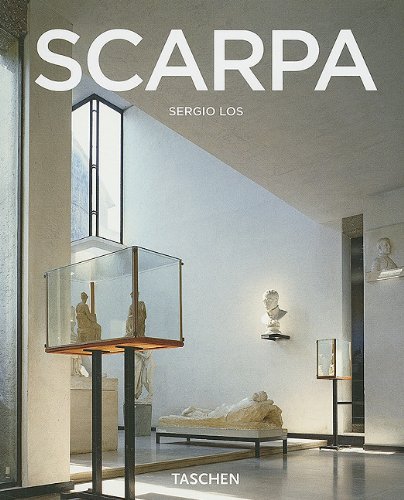

Carlo Scarpa : a poet of architecture. / Sergio Los ; Peter Gössel (ed.) txt
Idioma: Español United States : Taschen, 2009Edición: NA1123.S35 L67 2009Descripción: 96 p. chiefly col. ill. ; plans ; 23 cmTipo de contenido:- text
- unmediaded
- volume
- 9783836507288
- NA1123.S35 L67 2009
| Imagen de cubierta | Tipo de ítem | Biblioteca actual | Biblioteca de origen | Colección | Ubicación en estantería | Signatura topográfica | Materiales especificados | Info Vol | URL | Copia número | Estado | Notas | Fecha de vencimiento | Código de barras | Reserva de ítems | Prioridad de la cola de reserva de ejemplar | Reservas para cursos | |
|---|---|---|---|---|---|---|---|---|---|---|---|---|---|---|---|---|---|---|
| Libro Col. General CARIBET | CARIBET Biblioteca Arquitectura Colección General CARIBET | General NA1123.S35 L67 2009 (Navegar estantería(Abre debajo)) | 1 | Disponible | 91000000013086 |
Descripciones mejoradas de Syndetics:
A Poet of Architecture Carlo Scarpa (1906-1978) was never fully appreciated during his lifetime. Instead, his work was dismissed as being "just" art, and only after his death did people begin to understand the exceptional quality of his oeuvre. This book shows the development of his individual architectural language by linking aspects of the arts with architecture. From his sensitive consideration of the urban context, to the composition of stunning details; the author manages to give the reader an insight into this outstanding architect's work. In particular, Scarpa's exhibition designs illustrate his extensive knowledge of materials and ability to solve complex structural problems. Meanwhile, Scarpa designs like the Castelvecchio Museum in Verona have become a Mecca for those seeking the ultimate refinement in exhibition design and elegant restoration. About the Series:
Each book in TASCHEN's Basic Architecture Series features: an introduction to the life and work of the architect the major works in chronological order information about the clients, architectural preconditions as well as construction problems and resolutions a list of all the selected works and a map indicating the locations of the best and most famous buildings approximately 120 illustrations (photographs, sketches, drafts and plans)
Includes bibliographical references (p. 96).
Contents:
6 Introduction --
26 Museo Correr --
28 Exhibition Design --
30 Galleria Regionale di Sicilia --
32 Gipsoteca Canoviana --
38 Casa Veritti --
42 Museo di Castelvecchio --
50 Olivetti Showroom --
54 Gavina Showroom --
58 Fondazione Querini Stampalia --
64 Casa Balboni --
66 Casa de Benedetti Bonaiuto --
68 Entrance to the Architectural Faculty --
70 Fondazione Masieri --
72 Brion Family Tomb --
80 Banca Popolare di Verona --
86 Casa Ottolenghi --
90 Life and Work --
95 Map --
96 Bibliography / Credits / The Author --
Tabla de contenidos provista por Syndetics
- Introduction(p. 6)
- MuseoCorrer(p. 26)
- Exhibition Design(p. 28)
- Galieria Regionale di Sicilia(p. 30)
- Gipsoteca Canoviana(p. 32)
- Casa Veritti(p. 38)
- Museo di Castetvecchio(p. 42)
- Olivetti Showroom(p. 50)
- Gavina Showroom(p. 54)
- Fondazione Querini-Stampalia(p. 58)
- Casa Balboni(p. 64)
- Casa de Benedetti-Bonaiuto(p. 66)
- Entrance to the Architectural Faculty(p. 68)
- Fondazione Masieri(p. 70)
- Brion Family Tomb(p. 72)
- Banca Popolare di Verona(p. 80)
- Casa Ottolenghi(p. 86)
- Life and Work(p. 90)
- Map(p. 95)
- Bibliography / Credits / The Author(p. 96)
Notas de autor provistas por Syndetics
Sergio Los (*1934) studied architecture in Venice. He worked in the office of Carlo Scarpa from 1964 to 1970 and hereby gained deep insights into various projects and the way of developing his work. 1967 he wrote the first monograph on Scarpa, numerous publications followed. From 1968 on the author taught at the Faculty of Architecture at Venice University. He ran architectural offices together with Natasha F. Pulitzer in Venice, Padua and Milan.