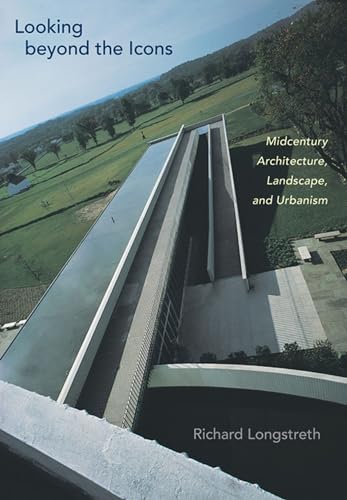

Looking beyond the icons : midcentury architecture, landscape, and urbanism. / Richard Longstreth. text
Charlottesville : University of Virginia Press , 2015Descripción: x, 271 p. ill. ;col. ; 26 cmTipo de contenido:- text
- unmediaded
- volume
- 9780813936437
- 0813936438
- 720.973 23
- NA712.5.M63 L66 2015
| Imagen de cubierta | Tipo de ítem | Biblioteca actual | Biblioteca de origen | Colección | Ubicación en estantería | Signatura topográfica | Materiales especificados | Info Vol | URL | Copia número | Estado | Notas | Fecha de vencimiento | Código de barras | Reserva de ítems | Prioridad de la cola de reserva de ejemplar | Reservas para cursos | |
|---|---|---|---|---|---|---|---|---|---|---|---|---|---|---|---|---|---|---|
| Libro | CARIBET Biblioteca Arquitectura Colección General CARIBET | General NA712.5.M63 L66 2015 c.1 (Navegar estantería(Abre debajo)) | 1 | Disponible | 91000000044404 | |||||||||||||
| Libro | CARIBET Biblioteca Arquitectura Colección General CARIBET | General NA712.5.M63 L66 2015 c.2 (Navegar estantería(Abre debajo)) | 1 | Disponible | 91000000044396 |
Descripciones mejoradas de Syndetics:
Renowned for his extensive work in architectural history and historic preservation as an educator, scholar, activist, and public lecturer, Richard Longstreth is one of the most important architectural preservationists of the recent past. Looking beyond the Icons offers a generous and diverse selection of his writings over the past twenty-five years. The author explores a variety of topics related to midcentury (ca. 1945?70) preservation efforts, including practical, intellectual, and psychological dilemmas associated with preserving the recent past, preservation-related deficiencies in the urban planning process, and preservation of specific types of buildings. This collection offers a new understanding of the richness and variety of mid-twentieth-century U.S. architecture, landscape, and urbanism, and provides a detailed analysis of both the imperatives for and the challenges involved in preserving this legacy.
Include index
Include bibliography
Style and taste -- The problem with "style" -- Taste versus history -- Some challenges of the recent past -- The difficult legacy of urban renewal -- The last landscape -- The extraordinary postwar suburb -- The lost shopping center -- Extraordinary and unknown -- New Orleans new and old: St. Frances Cabrini Church, liturgical reform, and historical association -- The power of reserve: a Christian Science complex in the heart of the nation's capital -- A modernist's tribute to Lincoln and the remembrance of the war: Richard Neutra's visitor center at Gettysburg -- Douglas Haskell's Adirondack legacy: the understated campus of North Country School and Camp Treetops -- Commonplace and taken for granted -- Assessing a vernacular landscape: a community garden in Washington, D.C. -- Nonconforming [?] modernism: the Friendship shopping center in Washington, D.C. -- The continuous transformation of Savannah's Broughton Street -- Building houses, creating community: Joseph Geeraert and the development of Twinbrook. -- Notes -- Index --
Renowned for his extensive work in architectural history and historic preservation as an educator, scholar, activist, and public lecturer, Richard Longstreth is one of the most important architectural preservationists of the recent past. Looking beyond the Icons offers a generous and diverse selection of his writings over the past twenty-five years. The author explores a variety of topics related to midcentury (ca. 1945-70) preservation efforts, including practical, intellectual, and psychological dilemmas associated with preserving the recent past, preservation-related deficiencies in the urban planning process, and preservation of specific types of buildings. This collection offers a new understanding of the richness and variety of mid-twentieth-century U.S. architecture, landscape, and urbanism, and provides a detailed analysis of both the imperatives for and the challenges involved in preserving this legacy.
Tabla de contenidos provista por Syndetics
- Acknowledgments(p. ix)
- Introduction(p. 1)
- I Style and Taste
- 1 The Problem with "Style"(p. 13)
- 2 Taste versus History(p. 20)
- II Some Challenges of the Recent Past
- 3 The Difficult Legacy of Urban Renewal(p. 27)
- 4 The Last Landscape(p. 41)
- 5 The Extraordinary Postwar Suburb(p. 51)
- 6 The Lost Shopping Center(p. 58)
- III Extraordinary and Unknown
- 7 New Orleans New and Old: St. Frances Cabrini Church, Liturgical Reform, and Historical Association(p. 69)
- 8 The Power of Reserve: A Christian Science Complex in the Heart of the Nation's Capital(p. 91)
- 9 A Modernist's Tribute to Lincoln and Remembrance of the Civil War: Richard Neutra's Visitor Center at Gettysburg(p. 111)
- 10 Douglas Haskell's Adirondack Legacy: The Understated Campus of North Country School and Camp Treetops(p. 133)
- IV Commonplace and Taken for Granted
- 11 Assessing a Vernacular Landscape: A Community Garden in Washington, D.C.(p. 153)
- 12 Nonconforming [?] Modernism: The Friendship Shopping Center in Washington, D.C.(p. 159)
- 13 The Continuous Transformation of Savannah's Broughton Street(p. 170)
- 14 Building Houses, Creating Community: Joseph Geeraert and the Development of Twinbrook(p. 195)
- Notes(p. 223)
- Index(p. 261)
Reseñas proporcionadas por Syndetics
CHOICE Review
Preservationists often lament the lack of appreciation for 18th- and 19th-century architecture and landscapes that led to their destruction, especially during the period of urban renewal following WW II. The recent past movement seeks to learn from those earlier mistakes by making a case for the preservation of the mid-20th-century built environment before it is too late. One leader of this effort is Longstreth (George Washington Univ.), who has written extensively on this subject and has personally advocated for the preservation of several mid-century buildings. In a series of essays, Longstreth examines the limitations of architectural style that has long guided preservationists in determining what to save and what to let go, the relentless pressure of redevelopment, and sweeping socioeconomic changes, which have rendered many of these modern designs seemingly obsolete. Longstreth's book includes eight case studies that demonstrate the difficulty of objectively judging the significance and value of a design that is close to the public in time and in some cases considered by the public to be aesthetically distasteful. Longstreth's essays are thought provoking and offer a real-time history of an increasingly important aspect of the historic preservation movement. Summing Up: Recommended. Upper-division undergraduates and above. --Paula Ann Mohr, independent scholarNotas de autor provistas por Syndetics
Richard Longstreth is professor of American civilization and director of the graduate program in historic preservation at George Washington University.(Bowker Author Biography)