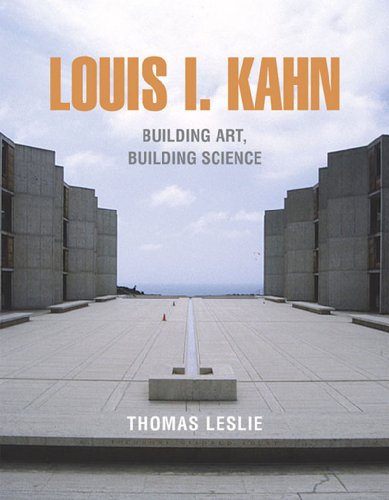

Louis I. Kahn : building art, building science. / Thomas Leslie. txt
New York : George Braziller , 2005Edición: 1st editionDescripción: xi, 274 p. ill. ; 24 cmTipo de contenido:- text
- unmediaded
- volume
- 9780807615430
- 0807615439
- Building art, building science. txt
- 727.092 22
- NA737.K32 L47 2005
| Imagen de cubierta | Tipo de ítem | Biblioteca actual | Biblioteca de origen | Colección | Ubicación en estantería | Signatura topográfica | Materiales especificados | Info Vol | URL | Copia número | Estado | Notas | Fecha de vencimiento | Código de barras | Reserva de ítems | Prioridad de la cola de reserva de ejemplar | Reservas para cursos | |
|---|---|---|---|---|---|---|---|---|---|---|---|---|---|---|---|---|---|---|
| Libro | CARIBET Biblioteca Arquitectura Colección General CARIBET | General NA737.K32 L47 2005 (Navegar estantería(Abre debajo)) | 1 | Disponible | 91000000018127 |
Descripciones mejoradas de Syndetics:
Philadelphia architect Louis I. Kahn (1901-1974) was one of the most influential American architects of the twentieth century. His work, widely recognized as a link between modern and classical traditions, is distinguished by its simple yet monumental design. In this book, Thomas Leslie shows that Kahn was also an extraordinarily gifted technologist and that his careful presentation of engineering principles set the stage for the high-tech movement in Europe and America. The examination of four major buildingsthe Yale Art Gallery, the Richards Medical Laboratories, the Salk Institute, and the Kimbell Art Museumand several smaller projects by Kahn reveals this hidden theme: an expressive integration of construction, structure, and services into buildings that dramatically highlight the processes involved in their making and function. Previously unpublished drawings, construction photographs, and sketches complement new diagrams that illustrate the profound technical poetry within Kahn's buildings. Because of its new approach to Kahn's work, this book will be a vital resource for architects and designers, both as a comprehensive analysis of these buildings and as a new interpretation of their constructed meaning. Students and educators will also benefit from the book's focus on the role of basic building science in the design and construction of four major monuments of late twentieth-century architecture. 100 black-and-white illustrations.
Include Bibliography
Beginnings --
Kahn's Process: Empiricism and Rationalism --
Kahn's Background --
George Howe and the Architectural Research Group (ARG) --
Howe, Stonorov, and Kahn --
1947: A Pivotal Year --
1947-50: Hints of a New Synthesis --
Yale University Art Gallery - New Haven, Connecticut --
Schematic Design --
The August 1951 Scheme --
The Tetrahedral Grid --
Detailing and Construction --
Opening and Reception --
Postscript: City Tower --
Richards Medical Research Laboratories - University of Pennsylvania, Philadelphia --
Trenton --
Early Designs --
Structure,Services, and Cladding: A Woven Fabric --
Production and Assembly --
Assessment --
Salk Institute for Biological Studies - La Jolla, California --
Initial Scheme --
Program --
Second Folded-Plate Scheme --
Final Scheme --
Services --
Detailing and Construction --
The Courtyard --
Assessment and Expansion --
Kimbell Art Museum - Fort Worth, Texas --
Richard Brown's Program --
Schematic Design --
Shells and Slots: The Final Roof Scheme --
Planing: "H" and "C" Schemes --
Design Development and Crisis --
Final Design --
Construction --
Assessment --
Conclusions --
Kahn and the Expression of Technology --
Five Points: Kahn's Architectural Philosophy and the Role of Building Technology --
Order, Design, and Form --
Construction and Performance --
Distinguishing, Balancing, and Weaving --
Measurable and Immeasurable --
Expression and the Aesthetic Experience --
Architecture, Experience, ad Dacca --
Philadelphia architect Louis I. Kahn (1901-1974) was one of the most influential American architects of the twentieth century. His work, widely recognized as a link between modern and classical traditions, is distinguished by its simple yet monumental design. In this book, Thomas Leslie shows that Kahn was also an extraordinarily gifted technologist and that his careful presentation of engineering principles set the stage for the high-tech movement in Europe and America. The examination of four major buildingsthe Yale Art Gallery, the Richards Medical Laboratories, the Salk Institute, and the Kimbell Art Museumand several smaller projects by Kahn reveals this hidden theme: an expressive integration of construction, structure, and services into buildings that dramatically highlight the processes involved in their making and function. Previously unpublished drawings, construction photographs, and sketches complement new diagrams that illustrate the profound technical poetry within Kahn's buildings. Because of its new approach to Kahn's work, this book will be a vital resource for architects and designers, both as a comprehensive analysis of these buildings and as a new interpretation of their constructed meaning. Students and educators will also benefit from the book's focus on the role of basic building science in the design and construction of four major monuments of late twentieth-century architecture. 100 black-and-white illustrations.