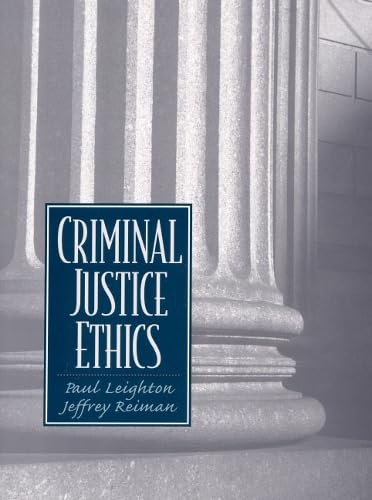
Imagen de portada de Amazon
Imagen de Amazon.com
Imagen de cubierta Syndetics
Portada de Syndetics
Imagen de OpenLibrary

Criminal justice ethics edited by Paul Leighton and Jeffrey Reiman.

Colaborador(es): Detalles de publicación: Upper Saddle River, N.J. Prentice Hall c2001.Descripción: viii, 533 p. 24 cmISBN:
  • 0130851299 (pbk.)
Tema(s): Clasificación CDD:
  • 174.9364 C9295 21
Clasificación LoC:
  • HV9950 .C74316 2001
Valoración
    Valoración media: 0.0 (0 votos)
Existencias
Imagen de cubierta Tipo de ítem Biblioteca actual Biblioteca de origen Colección Ubicación en estantería Signatura topográfica Materiales especificados Info Vol URL Copia número Estado Notas Fecha de vencimiento Código de barras Reserva de ítems Prioridad de la cola de reserva de ejemplar Reservas para cursos
Libro Biblioteca Encarnación Valdés Colección General bev 174.9364 C9295 (Navegar estantería(Abre debajo)) Disponible 80000002406687
Total de reservas: 0

Descripciones mejoradas de Syndetics:

This collection of thought-provoking, easy-to-read essays articulates drastically different moral beliefs about the relationship between criminal justice and social justice, and the importance of ethical behavior of individuals working in the system. The essays--which include hypothetical cases as well as actual court opinions--show readers how moral beliefs are examined and defended, and encourage them to examine and defend their own positions. In many cases, the articles present different sides of an issue, often in the form of direct debates between experts (e.g., feminist scholar Catherine MacKinnon on prostitution law vs the International Committee for Prostitutes' Rights and its "World Whores' Congress Statements"; O.J. Simpson attorney Johnnie Cochran vs Yale Law Professor Akhil Reed Amar). Often includes articles that argue for unpopular or unusual positions. An introduction on ethical reasoning and ethics pedagogy is followed by sections on the nature of criminal guilt, law making, law enforcement, judicial processing, punishment and emerging issues (technology and media). Issues addressed include Drug Legalization; Prostitution; Corporate Violence; Hate Crimes; Abortion; Police Ethics; Deception & Influence; Selective Enforcement; Lawyers Ethics; Plea Bargaining & Due Process; Treatment of Inmates; Death Penalty; Cyberspace; and Media. Includes resources on professional Code of Ethics. For anyone involved in/with the criminal justice system.

Includes bibliographical references.

Tabla de contenidos provista por Syndetics

  • Introduction
  • Criminal Justice Ethics
  • Teaching Ethics Ethically
  • 1 Moral Foundations of Criminal Guilt
  • The Morality of the Criminal Law
  • Crime, Minorities, and the Social Contract
  • Mens Rea
  • Case Study
  • The Crime that Never Was: A Fake Opinion in a Fake Case Involving Fakes
  • 2 What Should Be a Crime?
  • Principles
  • Excerpts fromSocial Philosophy
  • The Moral Foundations of Decriminalization
  • Cases: Drug Legalization
  • Excerpts fromLegalize It?
  • Debating American Drug Policy
  • Prostitution: In re P: let the 14-Year Old Go, the Prostitution Laws Are Unconstitutional
  • Prostitution and Civil Rights
  • International Committee for Prostitutes'
  • Rights World Charter and World Whores'
  • Congress Statements
  • Corporate Violence
  • A Crime by Any Other Name ...American Medical Association
  • The Brown and Williamson Documents: Where Do We Go From Here?
  • Looking Through a Keyhole at the Tobacco Industry
  • Hate Crimes
  • A Few Opinions on Sentencing Enhancement for Hate Crimes
  • Abortion
  • Why Abortion Is Immoral
  • Abortion, Infanticide, and the Asymmetric Value of Human Life
  • Reiman on Abortion
  • Abortion, Infanticide, and the Changing Grounds of the Wrongness of Killing: Reply to Don Marquis's "Reiman on Abortion"
  • 3 Moral Problems in Policing
  • Police Ethics
  • Ethics and Codes of Ethics
  • Deception & Influence
  • The Ethics of Deceptive Interrogation
  • Under-the-Covers Undercover Investigations: Some Reflections on the State's Use of Sex and Deception in Law Enforcement
  • The Dirty Harry Problem
  • Case Study: US v Tobias: It Is Not Entrapment for an Undercover Officer to Tell the Defendant That Making PCP Is as "Easy as Baking a Cake"
  • Selective Enforcement
  • Selective Enforcement and the Rule of Law
  • Against Police Discretion: Reply to John Kleinig
  • 4 Moral Issues in Judicial Processing and Jurisprudence
  • Lawyers' Ethics
  • The Behavior of Lawyers
  • Moral Philosophy's Standard Misconception of Legal Ethics
  • Plea Bargaining & Due Process
  • Do Criminal Defendants Have too Many Rights?
  • Criminal Justice and the Negotiated Plea
  • The Hon
  • Considering Jury "Nullification" : When May and Should A Jury Reject the Law to Do Justice?
  • 5 Penology
  • Treatment of Inmates
  • Excerpts fromJust and Painful
  • Back on the Chain Gang: Why the Eighth Amendment and the History of Slavery Prosc

Extracto provisto por Syndetics

PREFACE People seem to have endless interest in criminal justice. We relate immediately to the struggle between the forces of good and evil; we sympathize with the victims of crime and suffer with them the injustice they have experienced; we get satisfaction when the guilty receive their just deserts; and we identify with the wrongly accused and their struggle against the nearly overwhelming forces and resources of the government. This interest is not only a matter of our fears and hopes, but also a sign of our deep-seated concern with morality. We are for capital punishment or against it, for laws prohibiting abortion or drug use or against them. We think that crime is caused by poverty and thus that poor criminals deserve a special break, or we think that crime is caused by plain old orneriness and that no allowance should be made for socially disadvantaged crooks. We wonder whether lawyers can be morally good people and what makes them behave as they do. We ask, how far can the police go in using deception or sexual enticements to catch crooks? Is it entrapment if the police tell a suspect that manufacturing PCP is "as easy as baking a cake"? Would we revive chain gangs or corporal punishment? Should prostitution be legal? There seem to be no neutrals on these and similar issues. Everyone has strong opinions on the morality of criminal justice, from its policies and ideals to its practices and abuses. But these opinions are too frequently formed haphazardly, based on the experiences we have had, on our likes and dislikes, on the attitudes of those we admire, and perhaps on a good deal of misinformation. We might hear an argument that strikes us as sensible without considering another side of the issue. If our moral beliefs are not well formed, if we would not hold them after thoughtful examination of the other side (or sides) of the issue, then we may support harmful policies. We all can benefit from deeper reflection on our moral beliefs about criminal justice--and that is what criminal justice ethics is about. Ethics connotes not only morality as such, but the philosophical study of moral principles--the attempt to subject our moral beliefs to careful scrutiny. That is what this book is about. It aims not to convince readers that one set of moral beliefs is superior to others, but to assist them in reflecting on their own moral beliefs. Toward this end, we have put together a collection of articles that articulate drastically different moral beliefs about important criminal justice issues. Readers, seeing how moral beliefs are examined and defended, can examine and defend their own--or, perhaps, discover shortcomings in their own beliefs and open their minds to new ones. Toward this end, we have tried to identify particularly challenging articles, ones that argue for unpopular or unusual positions, ones that make for lively reading and discussion and that provide for thinking and rethinking. In many cases, the articles present different sides of an issue, often in the form of direct debates between experts. The reader is exposed to a variety of voices engaged in the vehement defense of principles important to them. Who better to write about prostitution law than feminist scholar Catharine MacKinnon, and who better to respond than the International Committee for Prostitutes' Rights in their "World Whores' Congress Statements"? The debate between O .J. Simpson Attorney Johnnie Cochran and Yale Law Professor Akhil Reed Amar is more engaging than a "balanced" article by a single author on whether criminal defendants have too many rights. At other times, we have selected provocative articles and allowed them to stand alone, hoping that readers themselves will enter into the debate, putting forth their own responses to positions that strike them as wrong-headed, allowing themselves to revise their opinions in the face of new ones, and to hunt for evidence important to the issues. The case studies reflect the messiness of real-life situations requiring ethical decisions or judicial opinions. The legal cases in particular allow readers to see how legal reasoning may or may not overlap with moral reflection. We have been less interested in mechanically balancing every pro with a con than with stimulating thought and inciting debate. Numerous addresses to quality Internet sites direct readers to further data, arguments and perspectives to ensure that this book opens the door to exploration rather than being a final word. Moreover, the selected articles reflect a broad conception of the field of criminal justice ethics. In addition to the standard issues--death penalty or abortion or recreational drug use or prostitution--we have viewed criminal justice as inextricably bound up with social justice. Since the criminal justice system protects the existing social and economic system, criminal justice can be no more just than the social and economic systems. Consequently, issues of social justice are issues of criminal justice. Likewise, the agents of criminal justice--police, lawyers, and even doctors administering lethal injections--are people following careers, trying to do their best in a difficult job. Consequently, issues of professional ethics are issues in criminal justice ethics. And, finally, we view criminal justice as developing over time in the face of a changing society. Thus, we have tried to identify ethical issues that are just coming over the horizon--the interest in televising execution, and, of course, the problems posed by the growing presence of computers and information technology. How does the Constitution apply to cyberspace? In these areas, our concern has been to challenge the reader to do his or her own thinking about criminal justice as it is and as it will be. To the extent we have achieved our goals in this volume, it is only with the help of many individuals. In particular, we would like to thank Paul Haskell, Jennifer Hatten, Andrew Pfeiffer, and Karen Schaumann. Thanks also to the staff of the Department of Sociology, Anthropology & Criminology at Eastern Michigan University for undertaking some of the tedious work with graciousness and thoroughness. Thanks to Karita France for getting this project under way and to Jennifer Ackerman for advice on how to navigate a range of problems; and to our editor Ross Miller and associate editor Katie Janssen. Excerpted from Criminal Justice Ethics by Paul Leighton, Jeffrey Reiman All rights reserved by the original copyright owners. Excerpts are provided for display purposes only and may not be reproduced, reprinted or distributed without the written permission of the publisher.
Compartir
logopucpr-y-vive

Contáctanos

¡Queremos saber de ti!

Tel. 787.841.2000 Ext. 1801

bibliotecavaldes@pucpr.edu

⁣Búscanos en las redes

© 2026 Desarrollado por Ignite Online • All Rights Reserved • Powered by Koha.