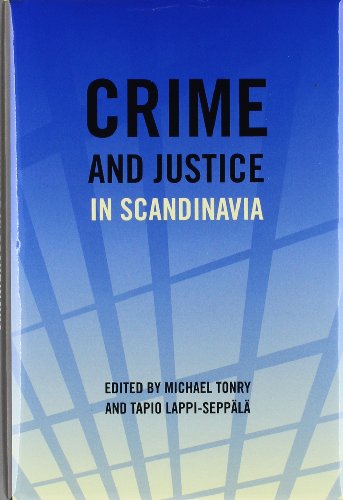

Crime and justice in Scandinavia edited by Michael Tonry and Tapio Lappi-Seppälä.
Series Crime and justice : a review of research ; v. 40 | Crime and justice (Chicago, Ill.) ; v. 40.Detalles de publicación: Chicago University of Chicago Press c2011.Descripción: x, 673 p. ill., maps 24 cmISBN:- 9780226808826 (cloth : alk. paper)
- 0226808823 (cloth : alk. paper)
- 9780226808833 (pbk. : alk. paper)
- 0226808831 (pbk. : alk. paper)
- 364.948 23
- HV6061 .C93 v.40
| Imagen de cubierta | Tipo de ítem | Biblioteca actual | Biblioteca de origen | Colección | Ubicación en estantería | Signatura topográfica | Materiales especificados | Info Vol | URL | Copia número | Estado | Notas | Fecha de vencimiento | Código de barras | Reserva de ítems | Prioridad de la cola de reserva de ejemplar | Reservas para cursos | |
|---|---|---|---|---|---|---|---|---|---|---|---|---|---|---|---|---|---|---|
| Libro | Biblioteca de Derecho Mons. Fremiot Torres Oliver Colección General biblioteca derecho | HV 7018 .5 .C755 2011 (Navegar estantería(Abre debajo)) | v. 40 | Disponible | 70000000892490 |
Descripciones mejoradas de Syndetics:
Since 1979 the Crime and Justice series has presented a review of the latest international research, providing expertise to enhance the work of sociologists, psychologists, criminal lawyers, justice scholars, and political scientists. The series explores a full range of issues concerning crime, its causes, and its cure.
Volume 40, Crime and Justice in Scandinavia, offers the most comprehensive and authoritative look ever available at criminal justice policies, practices, and research in the Nordic countries. Topics range from the history of violence through juvenile delinquency, juvenile justice, and sentencing to controversial contemporary policies on prostitution, victims, and organized crime. Contributors to this volume include Jon-Gunnar Bernburg, Ville Hinkkanen, Cecilie Høigård, Hanns von Hofer, Charlotta Holmström, Janne Kivivuori, Lars Korsell, Tapio Lappi-Seppälä, Paul Larsson, Martti Lehti, Torkild Hovde Lyngstad, Sven-Axel Månsson, Anita Rönneling, Lise-Lotte Rytterbro, Torbjørn Skardhamar, May-Len Skilbrei, and Henrik Tham.
Includes bibliographical references and index.
Crime, criminal justice, and criminology in the Nordic countries / Tapio Lappi-Seppälä and Michael Tonry -- Punishment and crime in Scandinavia, 1750-2008 / Hanns von Hofer -- Homicide in Finland and Sweden / Janne Kivivuori and Martti Lehti -- Nordic youth justice / Tapio Lappi-Seppälä -- Policing the north / Cecilie Høigård -- Sentencing theory, policy and research in the Nordic countries / Ville Hinkkanen and Tapio Lappi-Seppälä -- Delinquency research in the Nordic countries / Janne Kivivuori and Jon Gunnar Bernburg -- Is there a Nordic prostitution regime? / May-Len Skilbrei and Charlotta Holmström -- Organized crime the Nordic way / Lars Korsell and Paul Larsson -- The emergence of the crime victim: Sweden in a Scandinavian context / Henrik Tham with Anita Rönneling, and Lise-Lotte Rytterbro -- Nordic register data and their untapped potential for criminological knowledge / Torkild Hovde Lyngstad and Torbjørn Skardhamar.
This volume offers a comprehensive look at criminal justice policies, practices, and research in the Nordic countries. It shows why the Scandinavian criminal justice systems are as they are, how they are different fom those in other countries, and how they are changing. Topics range from the history of violence through juvenile delinquency, juvenile justice, and sentencing to controversial contemporary policies on prostitution, victims, and organized crime. Compared to most developed countries, especially the United States, Scandinavian criminal justice systems are, and have long been humane. Punishments are moderate, prisons are small and orderly, and few people are locked up. As elsewhere in Europe, however, Scandinavian countries face social and political challenges. Populations are becoming more diverse, the region has been affected by the global recession, and conservative political parties have gained increased influence and are beginnning to politicize crime policy debates. Scandinavian approaches to to crime and punishment offer important lessons to scholars, citizens, and policy makers in other coutnries. Their present may be our future. More ominously if they sucuumb to the xenophobic and popuilist political pressures that exist everywhere, ours may be theirs.
Notas de autor provistas por Syndetics
Michael Tonry is director of the Institute on Crime and Public Policy and the Bennett Chair in Law and Public Policy at the University of Minnesota. He is also a senior fellow at the Netherlands Institute for the Study of Crime and Law Enforcement. Tapio Lappi-Seppälä is the director general of the National Research Institute for Legal Policy in Helsinki, Finland.