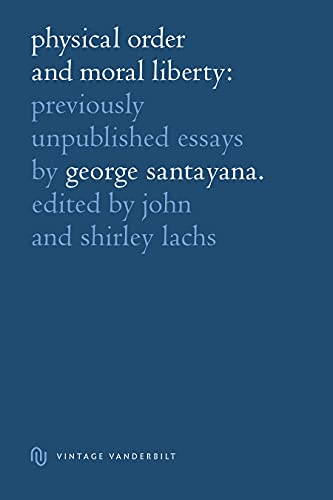
This book is a collection of fifty-five essays and fragments by George Santayana, from the Santayana collections of the Columbia University Library and the Humanities Research Center at the University of Texas.
Although the essay included are largely philosophical in nature, none is narrowly technical. The general reader should be able to understand most of the pieces, as well as enjoy their literary quality and profit by the insights and wisdom they provide. The philosopher may draw courage from the speculative spirit of the essays and benefit by Santayana's steadfast vision and his sensitivity to distinctions.
For the serious student of Santayana's thought, this volume will prove indispensable. It contains sustained philosophical studies of causation (the only ones by Santayana anywhere), substantial elaborations of Santayana's ideas on the relation of sensation to thought, and reflections on the nature of freedom and the spiritual life. In addition, Santayana develops here a new theory of "critical instants" and elaborates on his ideas of the nature of consciousness and its relations to time.
Sections on the philosophy of nature and the philosophy of mind are followed by groups of essays on ethics, the philosophy of politics, and the freedom of mind--in which, according to Santayana, the blessing of the good life consists. The book concludes with brief notes on Bergson, Democritus, and Leibniz and a longer essay on the thought of Vaihinger.
Notas de autor provistas por Syndetics
A gentle philosopher-poet, born and reared in Spain, educated at Harvard University and later professor of philosophy there, George Santayana resided in England, France, and Italy after 1914. At the beginning of World War II, he entered the nursing home in Rome managed by nuns known as the Blue Sisters and remained there until his death. His last book, The Poet's Testament (1953), contains a few unpublished lyrics, several translations, and two plays in blank verse. The title comes from the poem read at his funeral, which begins: "I give back to the earth what the earth gave/All to the furrow, nothing to the grave." Santayana wrote philosophy in an inimitable prose, enriched with imagery and metaphor. His meanings were always complex and often ironic. In this style, so untypical of the professionalized philosophy common in the English-speaking world during his lifetime, Santayana nevertheless articulated an epistemological critical realism and an ontology of essence and matter that drew the attention and admiration of philosophers and scholars. His first published philosophical book, The Sense of Beauty (1896), was an important contribution in aesthetics, a classic text that is still in use. His multivolume work The Life of Reason expresses his naturalistic philosophy of history and culture. It states the essence of his attitude toward nature, life, and society. Scepticism and Animal Faith (1923) presents his theory of knowledge and also serves as an introduction to his system of philosophy, Realms of Being (1927--40). The titles of the separate volumes of this remarkable work, now out of print, reveal the lineaments of his system: Realm of Essence (1927), Realm of Matter (1930), Realm of Truth (1937), and Realm of Spirit (1940). His ideas were "popularized" in his only novel, The Last Puritan, which became a surprise bestseller overnight. According to the New York Times, "He came into a changing American scene with a whole group of concepts that enormously enriched our thinking. He gave a moving vitality to what had often been obscure abstractions . . . he made the whole relationship of reason and beauty, each to the other, come alive and stay alive." Although Santayana's Complete Poems (1975) is out of print, several volumes of his poetry are available and are listed below. Publication of The Complete Works of George Santayana, under the general editorship of Herman J. Saatkamp, Jr., is in progress. Conforming to the guidelines of a critical edition, The Complete Works is a long-range multivolume project of which a few volumes have already appeared to critical acclaim. (Bowker Author Biography)
Physical order and moral liberty
APA
Santayana G., Lachs J. & Lachs S. (1969). Physical order and moral liberty: previously unpublished essays of George Santayana. [Nashville]: Vanderbilt University Press.
Chicago
Santayana George, Lachs John and Lachs Shirley. 1969. Physical order and moral liberty: previously unpublished essays of George Santayana. [Nashville]: Vanderbilt University Press.
Harvard
Santayana G., Lachs J. and Lachs S. (1969). Physical order and moral liberty: previously unpublished essays of George Santayana. [Nashville]: Vanderbilt University Press.
MLA
Santayana George, Lachs John and Lachs Shirley. Physical order and moral liberty: previously unpublished essays of George Santayana. [Nashville]: Vanderbilt University Press. 1969.