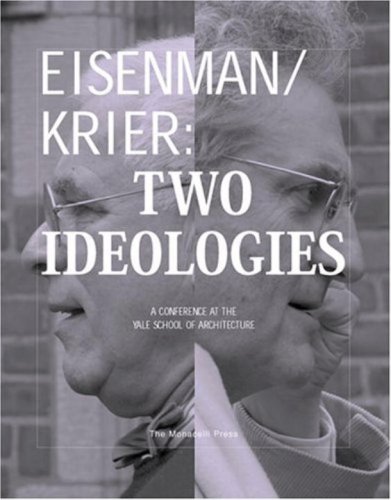

Eisenman-Krier : two ideologies : A conference at the Yale School of Architecture. / txt
New York : Monacelli Press , 2004Descripción: 160 p. ill. ; 24 cmTipo de contenido:- text
- unmediaded
- volume
- 9781580931397
- 1580931391
- 720.9045 22
- NA737.E33 E4 2004
| Imagen de cubierta | Tipo de ítem | Biblioteca actual | Biblioteca de origen | Colección | Ubicación en estantería | Signatura topográfica | Materiales especificados | Info Vol | URL | Copia número | Estado | Notas | Fecha de vencimiento | Código de barras | Reserva de ítems | Prioridad de la cola de reserva de ejemplar | Reservas para cursos | |
|---|---|---|---|---|---|---|---|---|---|---|---|---|---|---|---|---|---|---|
| Libro | CARIBET Biblioteca Arquitectura Colección General CARIBET | General NA737.E33 E4 2004 (Navegar estantería(Abre debajo)) | 1 | Disponible | 91000000001891 |
Descripciones mejoradas de Syndetics:
In November 2002, the Yale School of Architecture hosted the symposium "Eisenman/Krier: Two Ideologies," a two-day analysis -- both celebratory and critical -- of architects Peter Eisenman and Leon Krier. Eisenman, with an office in New York, and Krier, based in southern France, represent two opposing views in architecture: the modern and the classical. This dualism, which dates most explicitly to a face-off between the two architects during a meeting at Princeton University in 1977, continues to resonate within architectural design and theory today. Published in this volume are the papers delivered at the conference, which focused on the themes of history, language, urbanism, and politics. The speakers included an exceptional array of historians and critics: Stan Allen of Princeton; Maurice Culot of the Institut Français d'Architecture, Paris; Kurt Forster of the Bauhaus University in Dessau; Phyllis Lambert of the Canadian Centre for Architecture; Joan Ockman and Mark Wigley of Columbia; Demetri Porphyrios and Vincent Scully of Yale; Robert Somol of the University of California, Los Angeles; Anthony Vidler of the Cooper Union; and Sarah Whiting of Harvard. Eisenman and Krier culminated the event with presentations that made evident their lifelong commitment to architectural language, to architectural scholarship, and to architecture itself as a vital element of society and culture.
Include Bibliography
Foreword Robert A. M. Stern --
Between Utopias and Ideologies Joan Ockman --
"Eisenman/Krier: two ideologies" Exhibition, Yale School of Architecture, 2002 --
Architecture and Ideology Roger Kimball --
Eisenman and Krier: A Conversation --
History --
No Sarah Whiting --
"Colin Rowe" Anthony Vidler --
Urbanism --
Figures, Fields, and Fragments Stan Allen --
A Funny Thing Happened on the Way to the Forum: The Nolli Plan and Other Italian Jobs R. E. Somol --
Politics --
How Eisenman Cut the Gordian Knot of Architecture: Looking at Giuseppe Terragni (1904/1943) from Afar Kurt W. Forster --
On Albert Speer Maurice Culot --
Language --
Ex Nihilo Nihil Demetri Porphyrios --
The Art of Listening to Architecture Mark Wigley --
The Architects --
The Arcadian, the Utopian, and Junkspace Peter Eisenman --
Coming to Terms with Janus Leon Krier --
Afterword Vincent Scully --
Milan Pavilions Peter Eisenman and Leon Krier --
In November 2002, the Yale School of Architecture hosted the symposium "Eisenman/Krier: Two Ideologies," a two-day analysis -- both celebratory and critical -- of architects Peter Eisenman and Leon Krier. Eisenman, with an office in New York, and Krier, based in southern France, represent two opposing views in architecture: the modern and the classical. This dualism, which dates most explicitly to a face-off between the two architects during a meeting at Princeton University in 1977, continues to resonate within architectural design and theory today. Published in this volume are the papers delivered at the conference, which focused on the themes of history, language, urbanism, and politics. The speakers included an exceptional array of historians and critics: Stan Allen of Princeton; Maurice Culot of the Institut Franccedil;ais d'Architecture, Paris; Kurt Forster of the Bauhaus University in Dessau; Phyllis Lambert of the Canadian Centre for Architecture; Joan Ockman and Mark Wigley of Columbia; Demetri Porphyrios and Vincent Scully of Yale; Robert Somol of the University of California, Los Angeles; Anthony Vidler of the Cooper Union; and Sarah Whiting of Harvard. Eisenman and Krier culminated the event with presentations that made evident their lifelong commitment to architectural language, to architectural scholarship, and to architecture itself as a vital element of society and culture.
Tabla de contenidos provista por Syndetics
- Foreword(p. 7)
- Between Utopias and Ideologies(p. 9)
- "Eisenman/Krier: Two Ideologies" Exhibition, Yale School of Architecture, 2002(p. 16)
- Architecture and Ideology(p. 21)
- Eisenman and Krier: A Conversation(p. 31)
- History
- No(p. 43)
- "Colin Rowe"(p. 53)
- Urbanism
- Figures, Fields, Fragments(p. 65)
- A Funny Thing Happened on the Way to the Forum: The Nolli Plan and Other Italian Jobs(p. 79)
- Politics
- How Eisenman Cut the Gordian Knot of Architecture: Looking at Giuseppe Terragni (1904-1943) from Afar(p. 91)
- On Albert Speer(p. 99)
- Language
- Ex Nihilo Nihil(p. 111)
- The Art of Listening to Architecture(p. 119)
- The Architects
- The Arcadian, the Utopian, and Junkspace(p. 135)
- Coming to Terms with Janus(p. 139)
- Afterword(p. 149)
- Milan Pavilions(p. 154)
- Contributors(p. 160)