
Metroburbia, USA : Paul L. Knox. txt
Idioma: Español Metroburbia USA : British Library, 2008Descripción: ix, 231 p. ill. ; maps ; 24 cmTipo de contenido:- text
- unmediaded
- volume
- 9780813543574 (pbk. : alk. paper)
- 307.760973 22
- HT352.U6 K56 2008
| Imagen de cubierta | Tipo de ítem | Biblioteca actual | Biblioteca de origen | Colección | Ubicación en estantería | Signatura topográfica | Materiales especificados | Info Vol | URL | Copia número | Estado | Notas | Fecha de vencimiento | Código de barras | Reserva de ítems | Prioridad de la cola de reserva de ejemplar | Reservas para cursos | |
|---|---|---|---|---|---|---|---|---|---|---|---|---|---|---|---|---|---|---|
| Libro | CARIBET Biblioteca Arquitectura Colección General CARIBET | HT352.U6 K56 2008 (Navegar estantería(Abre debajo)) | Disponible | 91000000003483 |
Descripciones mejoradas de Syndetics:
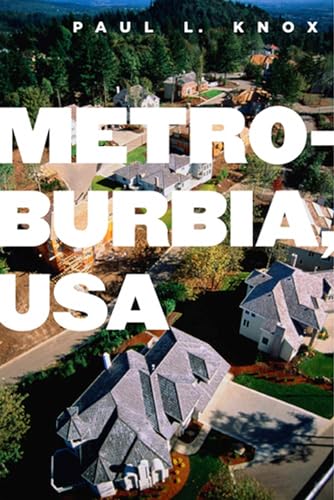
Decades of economic prosperity in the United States have redefined the American dream. Paul Knox explores how extreme versions of this dream have changed the American landscape. Increased wealth has led America's metropolitan areas to develop into vast sprawling regions of "metroburbia"ùfragmented mixtures of employment and residential settings, combining urban and suburban characteristics.
Upper-middle-class Americans are moving into larger homes in greater numbers, which leads Knox to explore the relationship between built form and material culture in contemporary society. He covers changes in home design, real estate, the work of developers, and the changing wishes of consumers. Knox shows that contemporary suburban landscapes are a product of consumer demand, combined with the logic of real estate development, mediated by design and policy professionals and institutions of governance. Suburban landscapes not only echo the fortunes of successive generations of inhabitants, Knox argues, they also reflect the country's changing core values.
Knox addresses key areas of concern and importance to today's urban planners and suburban residents including McMansions, traffic disasters, house design, homeowner's associations, exclusionary politics, and big box stores. Through the inclusion of examples and photos, Metroburbia, USA creates an accessible portrait of today's suburbs supported by data, anecdotes, and social theory. It is a broad interpretation of the American metropolitan form that looks carefully at the different influences that contribute to where and how we live today.
Index
Bibliography
Contents :
List of Figures and Tables vii --
Preface ix --
Chapter 1 Introduction 1 --
Chapter 2 Prelude : the serial enchantment of suburbia 13 --
Chapter 3 Metroburbia and the anatomy of the new metropolis 37 --
Chapter 4 Developers' utopias 66 --
Chapter 5 Comfortably numb : degenerate utopias and evangelistic consultants 89 --
Chapter 6 The politics of privatism 112 --
Chapter 7 Material culture and society in metroburbia 132 --
Chapter 8 Vulgaria : moral landscapes at the leading edges of the new metropolis 154 --
Notes 175 --
Bibliography 201 --
Index 215 --
Figures:
2.1 Sitcom suburbia 28 --
3.1 Evolving twentieth century metropolitan form 38 --
3.2 Metroburbia 39 --
3.3 The new metropolis 40 --
3.4 Infill sprawl on the fringes of Boise, Idaho 43 --
3.5 United States Housing Density 2000 48 --
3.6 Exurban character of census tracts in the greater Chicago area 49 --
3.7 Exurban character of census tracts in the greater Los Angeles era 50 --
3.8 Exurban character of census tracts in the greater Washington area 51 --
3.9 America’s megapolitan regions 54 --
3.10 Arizona’s Sun Corridor 55 --
3.11 The Carolina Piedmont region 55 --
3.12 The secession of the successful: Chicago Metropolitan Statistical Area 61 --
3.13 The secession of the successful: Dallas Metropolitan Statistical Area 62 --
3.14 The secession of the successful: Denver Metropolitan Statistical Area 63 --
3.15 The secession of the successful: Riverside San Bernadino Metropolitan Statistical Area 64 --
3.16 The secession of the successful: Washington, D.C., Metropolitan Statistical Area 65 --
4.1 Part of the entrance to The Meadows at Olde Carpenter 79 --
4.2 Toll Brothers Hampton model 81 --
4.3 Toll Brothers Columbia model 83 --
5.1 East Coast neotraditional 101 --
7.1 The VALS tm framework 137 --
7.2 Metropolitan statistical Areas with the highest percentages of Innovators and Achievers 139 --
7.3 Zip code area with a high incidence of Innovators, Washington D.C., Metropolitan Statistical Area 140 --
7.4 Zip code areas with a high incidence of Achievers, Washington D.C., Metropolitan Statistical Area 141 --
7.5 Louisville, Kentucky. Selected PROZM NE clusters by zip code 148 --
8.1 Plain ostentation. A new home in McLean, Virginia 163 --
8.2 Custom homes in The Reserve, Fairfax County, Virginia 165 --
8.3 A suburban street with homes based on a snout house design 167 --
8.4 The Toll Brothers Hampton floor plan 168 --
8.5 Macy’s Court at the Mall at Millenia, Orlando, Florida 170 --
Tables:
3.1 Median Household Income of the Top quintile of Census Tracts, Selected Metropolitan Regions, 2000 60 --
Decades of economic prosperity in the United States have redefined the American dream. Paul Knox explores how extreme versions of this dream have changed the American landscape. Increased wealth has led America?s metropolitan areas to develop into vast sprawling regions of?metroburbia??fragmented mixtures of employment and residential settings, combining urban and suburban characteristics. Upper-middle-class Americans are moving into larger homes in greater numbers, which leads Knox to explore the relationship between built form and material culture in contemporary society. He covers changes --