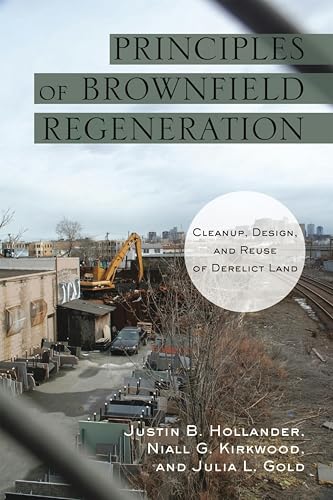

Principles of brownfield regeneration cleanup, design, and reuse of derelict land Justin B. Hollander, Niall G. Kirkwood, and Julia L. Gold.
Idioma: Inglés Washington Island Press 2010Descripción: ix, 135 p. ill. 23 cmTipo de contenido:- unmediaded
- 9781597267236 (cloth : alk. paper)
- Cleanup, design, and reuse of derelict land
- HT175 H65 2010
| Imagen de cubierta | Tipo de ítem | Biblioteca actual | Biblioteca de origen | Colección | Ubicación en estantería | Signatura topográfica | Materiales especificados | Info Vol | URL | Copia número | Estado | Notas | Fecha de vencimiento | Código de barras | Reserva de ítems | Prioridad de la cola de reserva de ejemplar | Reservas para cursos | |
|---|---|---|---|---|---|---|---|---|---|---|---|---|---|---|---|---|---|---|
| Libro | CARIBET Biblioteca Arquitectura Colección General CARIBET | General HT175 H65 2010 (Navegar estantería(Abre debajo)) | 1 | Disponible | 91000000048686 |
Descripciones mejoradas de Syndetics:
The US. EPA defines brownfields as "idle real property, the development or improvement of which is impaired by real or perceived contamination." The authors of Principles of Brownfield Regeneration argue that, compared to "greenfields"-farmland, forest, or pasturelands that have never been developed-brownfields offer a more sustainable land development choice. They believe that brownfields are central to a sustainable planning strategy of thwarting sprawl, preserving or regenerating open space, reducing greenhouse gas emissions, and reinvesting in urbanized areas.
This is the first book to provide an accessible introduction to the design, policy, and technical issues related to brownfield redevelopment. After defining brownfields and advocating for their redevelopment, the book describes the steps for cleaning up a site and creating viable land for development or open space. Land use and design considerations are addressed in a separate chapter and again in each of five case studies that make up the heart of the volume: The Steel Yard, Providence, RI; Assunpink Greenway, Trenton, NJ; June Key Community Center Demonstration Project, Portland, OR; Eastern Manufacturing Facility, Brewer, ME; and The Watershed at Hillsdale, Portland, OR. Throughout, the authors draw on interviews with people involved in brownfield projects as well as on their own considerable expertise.
Index
BIbliography.
Introduction -- Approaching brownfield redevelopment -- Remediation -- Land use and design considerations -- Case studies : The Steel Yard, Providence, Rhode Island ; Assunpink Greenway, Trenton, New Jersey ; June Key Community Center demonstration project, Portland, Oregon ; Eastern manufacturing facility, Brewer, Maine ; The Watershed at Hillsdale, Portland, Oregon.
Tabla de contenidos provista por Syndetics
- Chapter 1 Introduction(p. 1)
- Chapter 2 Approaching Brownfield Redevelopment(p. 7)
- Chapter 3 Remediation(p. 21)
- Chapter 4 Land Use and Design Considerations(p. 51)
- Chapter 5 Case Studies(p. 65)
- The Steel Yard, Providence, Rhode Island(p. 68)
- Assunpink Greenway, Trenton, New Jersey(p. 80)
- June Key Community Center Demonstration Project, Portland, Oregon(p. 91)
- Eastern Manufacturing Facility, Brewer, Maine(p. 98)
- The Watershed at Hillsdale, Portland, Oregon(p. 110)
- Additional Resources(p. 121)
- Notes(p. 125)
- Index(p. 129)