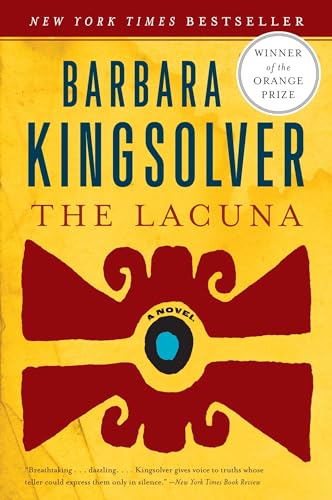

The lacuna a novel Barbara Kingsolver.
Detalles de publicación: New York ; Ontario Harper 2009.Edición: 1st edDescripción: x, 507 p. 24 cmISBN:- 9780060852580
- 813/.54 22
- PS3561.I496 L33 2009
| Imagen de cubierta | Tipo de ítem | Biblioteca actual | Biblioteca de origen | Colección | Ubicación en estantería | Signatura topográfica | Materiales especificados | Info Vol | URL | Copia número | Estado | Notas | Fecha de vencimiento | Código de barras | Reserva de ítems | Prioridad de la cola de reserva de ejemplar | Reservas para cursos | |
|---|---|---|---|---|---|---|---|---|---|---|---|---|---|---|---|---|---|---|
| Libro | Biblioteca Encarnación Valdés Colección General bev | 813.54 K554L (Navegar estantería(Abre debajo)) | Disponible | 80000002529520 |
Descripciones mejoradas de Syndetics:
New York Times Bestseller * A Best Book of the Year: New York Times, Chicago Tribune, San Francisco Chronicle, Seattle Times, and Kansas City Star * Winner of the Orange Prize
"Breathtaking. . . dazzling." -- New York Times Book Review
"Epic and deeply personal. . . . This is thought-provoking, and potentially thought-changing, historical fiction at its best." -- Dallas Morning News
In this powerfully imagined, provocative novel, Barbara Kingsolver, Pulitzer Prize-winning author and recipient of the National Book Foundation's Medal for Distinguish Contribution to American Letters, takes us on an epic journey from the Mexico of artists Diego Rivera and Frida Kahlo to the America of Pearl Harbor, FDR, and J. Edgar Hoover. The Lacuna is the poignant story of a man pulled between two nations as well as an unforgettable portrait of the artist--and of art itself.
Born in the United States, raised in Mexico, Harrison Shepherd lacks a sense of home in either. Life is whatever he learns from housekeepers who put him to work in the kitchen; from errands he runs in the streets; and, one fateful day, by mixing plaster for famed Mexican muralist Diego Rivera. He discovers a passion for Aztec history and the exotic, imperious artist Frida Kahlo, who will become his lifelong friend. When he goes to work for Lev Trotsky, an exiled political leader fighting for his life, Shepherd inadvertently casts his lot with art and revolution, newspaper headlines and howling gossip, and a risk of terrible violence.
Meanwhile, to the north, the United States will soon be caught up in the internationalist goodwill of World War II. There, in the land of his birth, Shepherd believes he might remake himself in America's hopeful image and claim a voice of his own. Through darkening years, political winds continue to toss him between north and south in a plot that turns many times on the unspeakable breach--the lacuna--between truth and public presumption.
With deeply compelling characters, a vivid sense of place, and a clear grasp of how history and public opinion can shape a life, Kingsolver has created a rich and daring work of literature, establishing its author as one of the most provocative and important of her time.
"The story of Harrison William Shepherd, a man caught between two worlds -- Mexico and the United States in the 1930s, '40s, and '50s -- and whose search for identity takes readers to the heart of the twentieth century's most tumultuous events"--Provided by publisher.
Reseñas proporcionadas por Syndetics
Library Journal Review
Diego Rivera's mural in Mexico's Palacio Nationale was only half complete the day young Harrison Shepherd stood transfixed before it, but he would be forever captive to the extraordinary power of the imagination. A solitary child, a devourer of books, left to his own devices by a mother chasing unattainable men and a father pencil pushing for the government back in the States, Harrison observes and he writes. When a quirk of fate lands him in the home of Communist sympathizers Rivera and Frida Kahlo, Rivera's wife, Harrison becomes enmeshed in the turbulent history that will inform his life and work. Through the distinctive voices of Harrison and his insightful amanuensis, Violet Brown, Kingsolver paints a verbal panorama spanning three decades and two countries. World War I veterans protesting for benefits denied, the unleashing of the atomic bomb, the McCarthy hearings, censorship of the arts, and abuse by the press corps lend credence to the sentiment that the more things change, the more they remain the same. Verdict As in The Poisonwood Bible, Kingsolver perfects the use of multiple points of view, even reprinting actual newspaper articles to blur the line between fact and fiction. This is her most ambitious, timely, and powerful novel yet. Well worth the wait.-Sally Bissell, Lee Cty. Lib. Syst., Ft. Myers, FL (c) Copyright 2010. Library Journals LLC, a wholly owned subsidiary of Media Source, Inc. No redistribution permitted.Publishers Weekly Review
Kingsolver's ambitious new novel, her first in nine years (after the The Poisonwood Bible), focuses on Harrison William Shepherd, the product of a divorced American father and a Mexican mother. After getting kicked out of his American military academy, Harrison spends his formative years in Mexico in the 1930s in the household of Diego Rivera; his wife, Frida Kahlo; and their houseguest, Leon Trotsky, who is hiding from Soviet assassins. After Trotsky is assassinated, Harrison returns to the U.S., settling down in Asheville, N.C., where he becomes an author of historical potboilers (e.g., Vassals of Majesty) and is later investigated as a possible subversive. Narrated in the form of letters, diary entries and newspaper clippings, the novel takes a while to get going, but once it does, it achieves a rare dramatic power that reaches its emotional peak when Harrison wittily and eloquently defends himself before the House Un-American Activities Committee (on the panel is a young Dick Nixon). "Employed by the American imagination," is how one character describes Harrison, a term that could apply equally to Kingsolver as she masterfully resurrects a dark period in American history with the assured hand of a true literary artist. (Nov.) (c) Copyright PWxyz, LLC. All rights reservedBooklist Review
In her first novel in nine years, Kingsolver displays the same ambition she exhibited in her best-selling The Poisonwood Bible (1998). Moving her story between Mexico and the U.S. and covering some 20 years in the life of Harrison William Shepherd, born to a social-climbing Mexican mother and an emotionally distant American father, who eventually divorce, Kingsolver weaves in pointed social commentary on dark moments in the history of both countries. Zelig-like, Shepherd is present at disturbing yet key historical events, including the violent 1933 Bonus March in Washington, D.C. Kicked out of a military academy for a homosexual liaison, Shepherd returns to Mexico; is taken into the household of Diego Rivera, Frida Kahlo, and the exiled Leon Trotsky; and witnesses Trotsky's assassination. He eventually settles in Asheville, North Carolina, becoming well known as an author of historical fiction and coming to the attention of the House Un-American Activities Committee for his leftist leanings. Kingsolver packs her novel with rich detail on everything from underwater caves to the proper way to mix the plaster Rivera uses in his murals, relaying information through a pastiche of letters, newspaper excerpts, and diary entries. As a result, the novel can be slow going, but the final section, devoted to the loving if platonic relationship between Shepherd and his dedicated stenographer, builds to a stunningly moving coda, conveying the tender emotions between two outsiders who have created their own sanctuary in the face of a hostile mainstream culture.--Wilkinson, Joanne Copyright 2009 BooklistNotas de autor provistas por Syndetics
Barbara Kingsolver was born on April 8, 1955 in Annapolis, Maryland and grew up in Eastern Kentucky. As a child, Kingsolver used to beg her mother to tell her bedtime stories. She soon started to write stories and essays of her own, and at the age of nine, she began to keep a journal. After graduating with a degree in biology form De Pauw University in Indiana in 1977, Kingsolver pursued graduate studies in biology and ecology at the University of Arizona in Tucson. She earned her Master of Science degree in the early 1980s.A position as a science writer for the University of Arizona soon led Kingsolver into feature writing for journals and newspapers. Her articles have appeared in a number of publications, including The Nation, The New York Times, and Smithsonian magazines. In 1985, she married a chemist, becoming pregnant the following year. During her pregnancy, Kingsolver suffered from insomnia. To ease her boredom when she couldn't sleep, she began writing fiction
Barbara Kingsolver's first fiction novel, The Bean Trees, published in 1988, is about a young woman who leaves rural Kentucky and finds herself living in urban Tucson. Since then, Kingsolver has written other novels, including Holding the Line, Homeland, and Pigs in Heaven. In 1995, after the publication of her essay collection High Tide in Tucson: Essays from Now or Never, Kingsolver was awarded an Honorary Doctorate of Letters from her alma mater, De Pauw University. Her latest works include The Lacuna and Flight Behavior.
Barbara's nonfiction book, Animal, Vegetable, Miracle was written with her family. This is the true story of the family's adventures as they move to a farm in rural Virginia and vow to eat locally for one year. They grow their own vegetables, raise their own poultry and buy the rest of their food directly from farmers markets and other local sources.
(Bowker Author Biography)