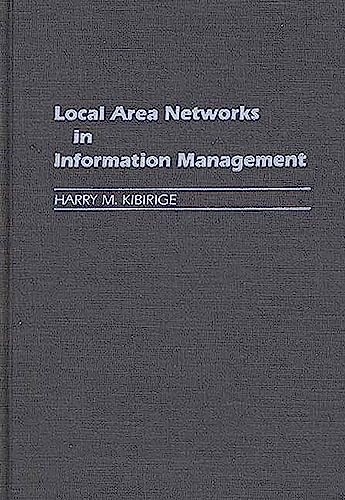

Local area networks in information management Harry M. Kibirige.
Series New directions in information management ; no. 18Detalles de publicación: New York Greenwood Press c1989.Descripción: xii, 177 p. illISBN:- 0313261911 (lib. bdg. : alk. paper)
- 004.6/8 19
- TK5105.7 .K5 1989
| Imagen de cubierta | Tipo de ítem | Biblioteca actual | Biblioteca de origen | Colección | Ubicación en estantería | Signatura topográfica | Materiales especificados | Info Vol | URL | Copia número | Estado | Notas | Fecha de vencimiento | Código de barras | Reserva de ítems | Prioridad de la cola de reserva de ejemplar | Reservas para cursos | |
|---|---|---|---|---|---|---|---|---|---|---|---|---|---|---|---|---|---|---|
| Libro | Biblioteca Encarnación Valdés Colección General bev | 004.68 K46L (Navegar estantería(Abre debajo)) | Disponible | 80000000301161 |
Descripciones mejoradas de Syndetics:
Local Area Networks (LANs) have a high potential for alleviating many of the problems associated with stand-alone microcomputers. Networking microcomputers to share information, software and hardware, as well as facilite electronic mail is not only feasible and desirable, but also logical. Harry Kibirige's issue-oriented study explores microcomputer networking systems with particular emphasis on LANs. Although his analysis emphasizes issues from an information scientist's perspective, readers who want to gain an understanding of LAN technology and its applications should find it useful. Written with a minimum of jargon, the book can be used in academic, corporate, library, federal and state agency, and not-for-profit organizational settings.
The author begins with an introduction to the general concepts surrounding LANs. He discusses LANs as structures for processing information and compares and contrasts them with other structures such as time-sharing systems. Also considered are salient factors concerned with LAN design and implementation. In a chapter devoted to choosing an LAN, Kibirige explains in detail the fundamental problems of choice as well as steps which should be taken in making a final selection. Other issues covered are the relationship of LANs to other existing automation programs, significant management issues, currently implemented alternatives to LANS, technology trends which will impact the future of LANs, and social issues concerned with LANs. Finally, Kibirige summarizes the results of the CUNY study of microcomputer networking systems, a report that emphasized information center/libraries.
Includes index.
Bibliography: p. [165]-170.
Tabla de contenidos provista por Syndetics
- Introduction
- The Local Area Network as an Information
- Processing Structure Local Area Network Technology
- Local Area Network Standards Designing and Implementing a Local
- Area Network Choosing a Local Area Network Local
- Area Networks and Conventional Automation Programs
- Management of a Local Area Network Alternatives to Local Area Networks
- The Future of Local Area Networks in information Management
- Local Area Network Efficiency, Avant-Garde and Relevance The CUNY Study
- Bibliography
- Index