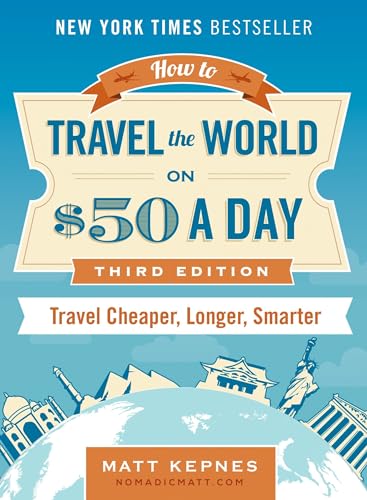
Imagen de portada de Amazon
Imagen de Amazon.com
Imagen de cubierta Syndetics
Portada de Syndetics
Imagen de OpenLibrary

How to travel the world on 50 a day travel cheaper, longer, smarter Matt Kepnes.

Por: Detalles de publicación: New York Penguin ©2015.Edición: Revised Perigee trade paperback editionDescripción: xvii, 316 pages 19 cmTipo de contenido:
Tipo de medio:
Tipo de soporte:
ISBN:
  • 0399173285
  • 9780399173288
Otro título:
  • How to travel the world on fifty dollars a day
  • Travel cheaper, longer, smarter
Tema(s): Clasificación CDD:
  • 910.2/02 23
Clasificación LoC:
  • G155.A1 K44 2015
Contenidos:
Introduction -- Planning your trip: Getting over your fears ; Is travel really too expensive? ; Banking overseas ; Getting the right credit card ; Airline tickets ; Buying a backpack ; Travel insurance ; Get a travel discount card ; What to do with your stuff -- On-the-road expenses: Savings mind-set ; Tips for saving money on accommodations ; Tips for saving money on food and beverages ; Tips for saving money on transportation ; Tips for saving money on activities -- Breaking it down by region: Europe ; Australia ; New Zealand ; Southeast Asia ; Central America ; South America, China, India, Japan -- Putting it all together -- Appendix A: Travel companies -- Appendix B: Suggested packing list -- Appendix C: Vaccinations.
Resumen: For over half a decade, Matt Kepnes (aka Nomadic Matt) has used his massively popular travel blog to teach readers how to travel the world on the cheap. Arguing that traditional travel media lies, Matt cuts through the myth that travel is expensive. In the new edition of How to Travel the World on 50 a Day, Matt reveals the tips, tricks, and secrets to comfortable budget travel that you won't find anywhere else with over 100 new pages of updated content. Traditional media shows you expensive hotels, resorts, cruises, and packages because that's what makes them money. They make you believe you have to spend money on travel. This book will show you why that is a lie and how to use the system against itself to gain free flights, hotel rooms, find alternative accommodation, get into attractions for free, websites to find the best deals, and as well as detailed costs and saving tips for destinations around the world.
Valoración
    Valoración media: 0.0 (0 votos)
Existencias
Imagen de cubierta Tipo de ítem Biblioteca actual Biblioteca de origen Colección Ubicación en estantería Signatura topográfica Materiales especificados Info Vol URL Copia número Estado Notas Fecha de vencimiento Código de barras Reserva de ítems Prioridad de la cola de reserva de ejemplar Reservas para cursos
Referencia Biblioteca Encarnación Valdés Sala de Referencia bev 910.202 K38h (Navegar estantería(Abre debajo)) Disponible 80000002557786
Total de reservas: 0

Descripciones mejoradas de Syndetics:

*UPDATED 2017 EDITION*

New York Times bestseller!

No money? No problem. You can start packing your bags for that trip you've been dreaming a lifetime about.

For more than half a decade, Matt Kepnes (aka Nomadic Matt) has been showing readers of his enormously popular travel blog that traveling isn't expensive and that it's affordable to all. He proves that as long as you think out of the box and travel like locals, your trip doesn't have to break your bank, nor do you need to give up luxury.

How to Travel the World on $50 a Day reveals Nomadic Matt's tips, tricks, and secrets to comfortable budget travel based on his experience traveling the world without giving up the sushi meals and comfortable beds he enjoys. Offering a blend of advice ranging from travel hacking to smart banking, you'll learn how to:

* Avoid paying bank fees anywhere in the world
* Earn thousands of free frequent flyer points
* Find discount travel cards that can save on hostels, tours, and transportation
* Get cheap (or free) plane tickets

Whether it's a two-week, two-month, or two-year trip, Nomadic Matt shows you how to stretch your money further so you can travel cheaper, smarter, and longer.

"A Perigee book."

"Revised, updated & expanded"

Introduction -- Planning your trip: Getting over your fears ; Is travel really too expensive? ; Banking overseas ; Getting the right credit card ; Airline tickets ; Buying a backpack ; Travel insurance ; Get a travel discount card ; What to do with your stuff -- On-the-road expenses: Savings mind-set ; Tips for saving money on accommodations ; Tips for saving money on food and beverages ; Tips for saving money on transportation ; Tips for saving money on activities -- Breaking it down by region: Europe ; Australia ; New Zealand ; Southeast Asia ; Central America ; South America, China, India, Japan -- Putting it all together -- Appendix A: Travel companies -- Appendix B: Suggested packing list -- Appendix C: Vaccinations.

For over half a decade, Matt Kepnes (aka Nomadic Matt) has used his massively popular travel blog to teach readers how to travel the world on the cheap. Arguing that traditional travel media lies, Matt cuts through the myth that travel is expensive. In the new edition of How to Travel the World on 50 a Day, Matt reveals the tips, tricks, and secrets to comfortable budget travel that you won't find anywhere else with over 100 new pages of updated content. Traditional media shows you expensive hotels, resorts, cruises, and packages because that's what makes them money. They make you believe you have to spend money on travel. This book will show you why that is a lie and how to use the system against itself to gain free flights, hotel rooms, find alternative accommodation, get into attractions for free, websites to find the best deals, and as well as detailed costs and saving tips for destinations around the world.

Extracto provisto por Syndetics

INTRODUCTION We are told travel is too expensive to do long term. Fancy tours, hotels, five-star meals, and budget-blowing flights are supposedly what travel is all about. The travel industry keeps this image alive with advertisements in magazines, on TV, and on the Internet. These advertisements always have the uncanny knack of showing a luxurious holiday in some far-off destination where we can go to get away from the stress of our day-to-day life . . . if only we pony up the money. At least, that's what big corporate travel tells us. But they are lying by omission. They are hiding the fact that travel is affordable because you can't run a big magazine or media company by selling hostels, discount transportation, or cheap tours. You need big ad revenue and luxury travel companies have that money. So the media promote a style of travel that is more upscale and thus more lucrative. Even when I read budget travel magazines, they often list "budget" accommodation at $150 USD as if anyone could afford that! That is probably out of the reach of most of us, and seeing those kind of prices keeps most of us at home. Yet everyone I know wants to travel more. Many of the people I encounter in life dream of wasting their days in paradise sitting on a beach as a breeze cools their face and a beer quenches their thirst. But when most people travel, they always seem to head out on a short vacation. Even if they had the time, most think it's too expensive to travel longer. We internalize what those magazines and ads tell us, we never consider the possibility that travel could be affordable. Experience has shown me the opposite is true. It has shown me that travel can be done cheaply without sacrificing comfort. Actually traveling showed me that everything I knew about traveling was wrong. But that realization didn't happen overnight. Back in 2003, I was planning my first trip overseas. I had just graduated from college and was working as a hospital administrator. I was putting in forty-plus-hour weeks and looking forward to my precious two weeks per year vacation. I booked a trip to Costa Rica and spent two weeks falling in love with travel. I loved the sense of adventure. I loved how every day held something new. I loved the feeling of endless possibility each day brought, which was in stark contrast to my well-planned-out days in the office. The next year, I used my limited vacation days in January simply because I couldn't wait to get somewhere else again. Costa Rica had given me the travel bug, and when 2004 rolled around, I left right away. And that's when my life changed. In January 2004, my friend Scott and I ventured to Thailand. While we were in the northern Thai city of Chiang Mai, I left him for a day to visit a temple outside the city. I shared a tuk tuk (the name for inexpensive shared taxis in Asia) with five non-American backpackers. On the ride we began discussing vacation time, and they were amazed that as an American, I only got two weeks of vacation per year. They all received at least a month in their home countries. I was extremely jealous. I wanted that much time off to explore the world. Our whole conversation made me rethink my life. It was heading down a road that I realized I wasn't ready for--marriage, house, kids, 401(k)s, playdates, and college funds. While those things aren't bad, at twenty-three, those weren't the things I wanted right now. I wanted to travel. A few days later, while lying on a beach in southern Thailand, I turned to my friend Scott and said, "I'm going to quit my job and travel the world." I knew the second I told Scott that I was making the right decision. I didn't want to go back to working sixty hours a week at twenty-three. I had my whole life to do that. I came home, quit my job, finished my MBA, and, in July 2006, hugged my parents good-bye and left for the open road. I used the money I had saved and invested from working in my hospital job to fund my initial trip. I had $20,000 to last me for a year. It was supposed to be a one-year trip. It turned into eighteen months, and then eighteen months suddenly became six years. There was a lot I didn't know back then. I made rookie mistakes I look back and laugh at now. But the more I traveled, the more I found ways to save money without sacrificing comfort. I'm here to share that knowledge with you because what I have learned over the years is that the greatest lie ever told is that travel is expensive. I'm writing this book to dispel the myth that travel is expensive. I'll show you how to travel the world for $50 USD a day or less. I'm here to tell you that you don't need to tap a trust fund, have your parents pay for you, or win the lottery to travel. Anyone can travel cheaply and comfortably if that person knows the secrets to saving money on the road. When I returned home in 2008, I started my blog, Nomadic Matt (nomadicmatt.com), and began spreading the word that travel could be affordable. Within months of going home, I was back out on the road (and I'm still on the move!). But blogging has its limits. You can't write a sixty-thousand-word blog post. This book allows me to go deeper into the subject of travel and create a planning guide that can't be done on my blog. Nothing I tell you in this book is a secret to those who have traveled. I didn't need to join a special club to learn these things. I didn't take a course. Experience on the road showed me what most travel companies don't want you to see. I saw behind the machine. I saw that travel is really affordable because a host of budget options exist for tours, accommodations, food, and flights. They just aren't advertised. If you are told a lie frequently enough, you begin to believe it, and we as a whole believe the myth that travel is expensive. I know I did when I started traveling. But actual traveling taught me that everything I learned from those magazines and ads was wrong. There are many ways to travel cheaply; they just weren't advertised. It took the experience of traveling to learn about the tricks and tips, and the goal of this book is to share my knowledge with you, so you know travel is within your reach, even if you don't have a lot of money (I didn't either). This book is about using your money wisely and knowing the tricks to save money. You don't need to be rich to travel--you just need to travel smart. I don't go to Italy to avoid nice meals. I don't go to Bordeaux to avoid a wine tour. I didn't save money at home so I could cook cheap dinners in hostels. I don't go to Australia because I dream about the outback only to turn around and say, "No, that trip is a bit out of my budget. Maybe another time." You should note that it's not possible to travel on $50 a day at every destination in the world. You'll be hard-pressed to live on $50 USD a day in Australia, New Zealand, and Europe. Southeast Asia, China, India, Central America can all be easily done for much less than $50 per day. But between all these destinations, you'll average $50 USD per day on your total trip, which is why this book is titled How to Travel the World on $50 a Day . The more deals and tricks you know, the more you can stretch your budget. And "cheap" doesn't mean traveling like a pauper. It's about traveling (as the cliché goes) like a local because when you are home, you don't spend a lot of money per day and neither do the locals where you are visiting. If you know just a few general tips and some location-specific advice, you can always have a first-class experience without paying a first-class price. This book is structured to take you from the planning stages to the time you get to your destination. Before I left, as much as I was excited about traveling, I had so many questions. I had no clue how to travel. Would I meet people on the road? Is it safe to travel alone? What kind of bag do I bring? Will I find a job when I get back? What if the news is right and everyone does hate Americans? I answer all those questions and more. Part One offers specific, actionable ways to lower your expenses before you even set foot on a plane. From setting up bank accounts that earn you money, to getting tons of free airline miles for free flights, to what gear to get, and what to do with your stuff, you'll learn how to save money from day one. In Part Two, you'll find ways to save money on the road that can be applied to destinations throughout the world. These are general travel tips. In Part Three, I get into specific world destinations. This part is structured by location so you can jump right to the information you need. Each chapter includes typical costs, ways to save money, things to do, and area-specific resources. I've picked the most visited and popular destinations in the world for travelers. I firmly believe you can travel well without paying a lot of money, and this book will help you travel better, cheaper, and longer. Travel has given me so many wonderful opportunities in my life. I've met countless friends who despite distance remain close. I've scuba dived in Fiji, hiked the Grand Canyon, cruised the Galápagos Islands, and lived in foreign countries. As you read through this book, you'll find a lot of advice geared toward people taking multi-month long-term trips. After all, this book is about traveling the world, right? But not everyone is going to jump overseas for months on end. Some people just want to save money on their two-week holiday. Don't worry if you only go away for a week or two--this book is still for you. My tips are not just for those who want to quit their job and travel the world. They can be used for a trip of any length. Whether you are going to Paris for two weeks or two months, you'll still need to know how to get a cheap flight, good insurance, and how to find cheap food in the city. In writing this book, I strove to make the majority of tips applicable to people going on a trip of any length of time. Whether you are looking for a credit card to travel with or trying to figure out how to get a cheap flight, this book will help you. So grab a coffee and a map while you sit back, relax, and learn to save. SINCERELY, "NOMADIC" MATT KEPNES PART ONE Planning Your Trip 1 Getting Over Your Fears THE most difficult part about traveling the world isn't the logistics of a trip--it's finding the motivation to go in the first place. It takes a lot of courage to leave your life and journey into the unknown. It's the step that most people never get past. For me, it took a trip to Thailand to get me to make the leap. For others, it's a lot more difficult. Instead of the nudge I required, some people require a full-on shove. While most of this book will talk about the practical, financial side of travel, the first thing I wanted to tell you is that you don't need to be afraid of traveling the world. It's only natural to second-guess yourself when making a big life change. And this is a big change. One of the most common emails I receive asks me whether or not someone should travel the world. Do they quit their job and go for it? Are they in the right stage of life? Will everything be OK if they leave? Will they get a job when they return? These emails are peppered with nervous excitement over travel's endless possibilities, but there is also always one underlying message in the emails: "Matt, I want to go, but I'm also afraid. I need someone to tell me it will be all right." In my meetings with strangers, they ask me questions about my adventures. People are curious about my travels, experience, and how I got started doing this. They dream of traveling the world. "It must be such the adventure," they tell me. "I wish I could do it." And when I ask them what stops them, they come up with a book full of excuses as to why they can't: I can't afford my trip. I have too many responsibilities at home. I won't be able to make friends on the road. I don't want to be alone. I have too many bills to pay. I'm not sure I could do it. I'm simply too scared. With all that fear and doubt, it's easier for someone to stay home in his or her comfort zone than to break out and travel the world. As the saying goes, "People go with the devil they know over the devil they don't." Home is our safe zone. We know it. We understand it. We may not always like it, but we get it, and that is a powerful force. In the end, held back by their own fears, most people stay home, dreaming of that "one perfect day" when they will finally travel. But you know what? That day never comes. It will never be perfect. Tomorrow, you'll still have bills. Tomorrow, you still won't have just the right amount of money. Tomorrow, there will still be someone's wedding to attend or a birthday party to go to. Tomorrow, you will still second-guess yourself. Tomorrow, you'll find another excuse as to why you can't go. Tomorrow, people you know will still feed the seeds of doubt in your head. Tomorrow will come and you'll say, "Today isn't the right day. Let's go tomorrow." Dropping everything to travel takes a lot of courage, and while many people claim "real-world responsibilities" are the reason for not traveling, I think fear of the unknown is really what holds people back. If you bought this book, you are probably already on the right track. Taking a long-term trip is already on your mind. Maybe you are already committed or still on the fence about it. But no matter what side of the coin you fall on, know that even the most experienced travelers had doubts when they began. I want to reassure you that you are doing the right thing. Right here. Right now. You Aren't the First Person to Travel Abroad One of the things that comforted me when I began traveling was knowing that lots of other people traveled the world before me and ended up just fine. While long-term travel might not be popular in the United States, it is a rite of passage for a lot of people around the world. People as young as high school graduates head overseas in droves for long-term trips. As you read this paragraph right now, millions of people are trekking around the world and discovering foreign lands. And if millions of eighteen-year-olds on a round-the-world trip came home in one piece, I realized there was no reason I wouldn't either. There's nothing I can't do that anyone else can do. And the same goes for you. You won't be the first person to leave home and explore the jungles of Asia. There is a well-worn travel trail around the world where you'll be able to find support and comfort from other travelers. Columbus had reason to be afraid. He had no idea where he was going and he was the first person to go that way. He blazed a trail. You're going on a trail that has already been blazed. That realization helped take away some of my fear because I knew there would be other travelers on the road to comfort me. You Are Just as Capable as Everyone Else I'm smart, I'm capable, and I have common sense. If other people could travel the world, why couldn't I? I realized there was no reason I wouldn't be capable of making my way around the world. I'm just as good as everyone else. And so are you. Early in my travels, I managed to turn up in Bangkok without knowing one person and live and thrive there for close to a year. I made friends, I found a girlfriend, I had an apartment, and I even learned Thai. It was sink or swim, and I swam. I recently navigated my way through Ukraine, a country where few people speak English and even fewer signs are in the Roman alphabet, as they use the Cyrillic script there. Then there are little things like figuring out a local subway, using a map to navigate unknown streets, and making yourself understood without learning the local language. I once went "choo choo" to a taxi driver to make it understood I needed to go to the train station. It worked. Nobody steps out into the world knowing it all. They pick it up along the way. Don't doubt yourself. You get by in your regular life just fine. The same will be true when you travel. The World Isn't as Dangerous as the Media Says CNN, FOX News, and other major media outlets often make the world outside our borders look like a pretty scary place, where you'd be crazy to leave the safety of the United States. They paint a picture of a world filled with violence, anti-Americanism, rampant natural disasters, and lots of crime. But in all my years of traveling, I have never encountered any problem or suffered from any anti-Americanism. One of the main reasons why the world seems so dangerous is because we have instant communication now. Whenever anything happens, we can know about it right away through twenty-four-hour news, Twitter, or Facebook. Earthquakes have always happened, but we could never find out about them instantaneously through online media before. My mother constantly tells me when I go anywhere in the world to "be careful," as if the world is a big scary place. She'll tell me how nervous she is if I end up in a country that she once heard about in the news . . . in 1975. I try to tell her that the world is not that scary and I could get mugged just as easily in New York, Miami, or Houston as I could in London, Beijing, or Brazil and sometimes she'll agree, stating "I guess you have a point." Many of my old coworkers do the same. My friend was going to join me in Thailand, and when she told her coworkers that, they replied, "Why would you want to go there? Hawaii has beaches and do they even have electricity in Thailand?" We believe what we hear on TV so easily because we don't hear otherwise. I remember watching The Tonight Show with Jay Leno , and he often did a sketch called "Jay Walking" in which he would ask Americans questions about foreign leaders or countries, and most people were stumped. According to the Pew Research Center's State of the Media 2010 , only 10.5 percent of news coverage is related to international affairs. That is shockingly low. It's no surprise to me that so many people know so little about the world, when they are exposed to such little information. However, realize that everyone around the world wants the same things that you want. They all have jobs, families, and things to do. They want their kids to be safe, earn money, and be allowed to live life. They want to be left alone. They aren't looking for trouble. Travelers from all corners of the world are crossing paths every day without any problems. In any city in the world, use your street smarts to avoid dodgy situations, and you will be fine. Parts of New York City can be just as unsafe as other parts of the world. As a whole, the world is no more or less safe than any part of the United States. Using common sense, you will not encounter any problems you can't find in an American city. You Will Make Friends People always ask me how to make friends on the road. They tell me they're not very social and that it's hard for them to meet and talk to strangers. After all, not everyone can walk up to a stranger and say hello. You might spend the first few days traveling by yourself, afraid of making the first contact. I was really shy when I hit the road. I could talk my friends' ears off, but when meeting a stranger, I grew silent. Now I have no problems talking to people, and I can thank travel for learning that skill. The good news is that when you travel, you are never alone. There are many solo travelers making their way across the world who are in the same boat as you. They want companionship. They want friends. You'll find people who will come up and talk to you out of the blue. When people see me sitting alone in a hostel, they walk up to me and ask if I'd like to join them. I was recently having a beer in Bangkok, and another guest at my hostel came up to me and we struck up a conversation. Two of my best friends were met because I said hello in a guesthouse in Vietnam. I have attended the weddings of friends I met while asking to join their Frisbee game on the beach. After a while, it becomes normal to strike up a conversation with a complete stranger. Travelers are friendly people who want to make friends. And one of those friends is you. You Are Never Too Old Budget travel, backpacking, round-the-world trips--these trips aren't just for the young. While I was in Poland, I met a sixty-five-year-old American in my hostel. He was traveling around Europe before heading to India. And people were talking to him. He was sharing stories from his youth and drinking a few beers with the younger backpackers. He was never an outcast. My friend once saw a man in his seventies making a big trip around the world because, as he said, he didn't have much time left and wanted to see the world. It was now or never. And he had a number of ailments and carried many prescriptions, but he still went. I've seen families with their children on buses in Southeast Asia and retirees camping in Australia. The point is that you are never too old to go. Some of my favorite encounters on the road have been with older travelers, as they always have the best stories. Like they say, you are only as old as you feel. You Can Always Come Back If you make it three months into your trip and decide that long-term travel isn't for you, it's perfectly OK to return home. I've met a few travelers who, months into their trip, realized that they really liked being at home and missed it terribly. They missed their friends, family, and significant others. So they cut their trip short and went home. There's no shame in doing that. There's no such thing as failure in the world of travel. Your trip is your own. You went away for yourself, not for other people. And, in the end, you only need worry about yourself. Getting up and going is more than most people do, and if traveling isn't for you, at least you tried it. That in itself is a major accomplishment. Whether you are gone for one day, one month, or one year, you still will have learned and grown from your adventure. If there is anything I've learned over the years, it's that these fears, like all fears, are unfounded, because in the end, life works out. Your bills disappear when you cancel your cable, phone, and Internet. Walking away was easy for me, but I understand that not everyone can just cut loose as quickly as I did. Some of us have mortgages, parents to take care of, or children. But that doesn't mean it's impossible to travel. People think that once they have children, they can't travel. But every year, families set off to travel the world. Having children didn't stop the James family. Craig and Dani James of thewidewideworld .com took their two children on a yearlong trip around the world in 2008. As Dani (the mom) puts it, the James children "would soon be on their way to adulthood. We were rapidly approaching our last chance to do something really special together as a family--to do something that would impact the way we thought of ourselves, individually and as a family." The Jameses saw an opportunity to travel as a family. They wanted it and went for it, but it wasn't always easy. Taking your kids out of school can be a real concern too. To which the Jameses said, "You can minimize any disruption to schooling with some careful planning. Conor was missing sixth grade and Caroline, ninth. Conor's middle school was excited about his adventure and confident he could handle seventh grade when we returned. For Caroline, it was slightly more complicated because there are state requirements for high school graduation. We needed, at a minimum, to get Caroline through English 9 while we traveled, to keep her on grade level. To keep Caroline on track we enrolled her in an online homeschool program accredited by Montgomery County. This way, she had a professional teacher available via Internet and we would get a transcript, making reentry into the school system easier. We had no trouble getting either kid enrolled with their peers in the fall. I had worried a lot about the high school credits being easily accepted. It turned out not to be a problem." Having a family doesn't need to be a barrier to world travel. The James family did what thousands of other families had done before them and have done since. Don't believe having a family means ending your travels. Moreover, owning a house doesn't need to be a hindrance to your travels. Sean and Dawn Lynch of wanderingwhy.com had a house before they went away. As Dawn put it, "Being a homeowner is only an excuse if you make it one. Sure, it was something we had to figure out how to handle while we were gone, but it is really not all that difficult. Decide if you are selling or renting, take action, and go--you'll have no regrets." Having a home creates many questions, such as what do you do with your home and your stuff? As Sean said, "Look into a reputable property management company to watch after your home while you're away. For 5 to 10 percent of the rent, they should run a complete background check on any potential tenants and have the means to handle the property maintenance while you are away. The objective was not to turn a profit on our home, but to hit the pause button while we were away." The James family also had to do something with their house. Dani recounts, "A friend of ours needed to rent a house near Washington, DC, for a year, so our house in the Maryland suburbs was a great fit. It was a fortunate circumstance--our friend needed a furnished house, so we didn't have to put any furniture in storage. We had no worries about our house or our belongings--we knew they were in good hands." For every excuse, there is a solution. As people in your life offer both praise and criticism of your trip, you may be nervous and wonder if you are doing the right thing. It's normal to have these fears. Just remember the above tips, calm your nerves, and ease your fears. Your future may hold mouthwatering meals in foreign countries, tropical beaches you only thought existed in a postcard, winding alleyways in European cities that throw you back into the Middle Ages, or jungles so dense and teeming with wildlife you'll feel like you are living in an issue of National Geographic magazine. 2 Is Travel Really Too Expensive? LET'S put the "travel is too expensive" myth to death right now, beginning with a short exercise. Get out a sheet of paper and write down all your set expenses. Write down your rent (or mortgage), your car payments, cable bill, cell phone, and the like. Tally them up. Then write down all your discretionary spending. This is food, movie nights, drinks, shopping, that daily coffee from Starbucks, cigarettes, and the like. If you don't know what you spend money on, track your expenses for a two-week period and see what you spend. Total up all your expenses to get a monthly and then yearly figure. Now, take that number and think about the title of this book--$50 USD per day. That's $1,500 USD per month or $18,250 USD per year. When you add up all your monthly spending and costs, it's more than $1,500 USD, isn't it? If your rent is $900 USD per month, that's $30 per day, which is 60 percent of the daily budget set out in this book. Add in food costs, gas, insurance, and cable and your set expenses are mostly higher than the number you need for a year abroad. And that's before you've done anything else with your life. You might look at the cover of this book and think, "I spend way less than $50 USD per day." That's because we often don't consider our fixed costs, like housing, insurance, and debt payments, when we think of our spending. We may not go to the ATM every day, but we are constantly spending money without even thinking about it. Now, imagine if all your living expenses were less than $50 USD per day. Everything. Your house, food, transportation, travel, nights out at the movies, or drinks at a bar. How wonderful would that be? How wonderful would it be to live on $18,250 or less per year? Pretty wonderful, huh? For that much money, instead of being at home, you could be out traveling the world. And even if you can't save that much money, travel is within your reach. I recently met a girl while in Bangkok. Sarah was an American who lived in New York City working a job that barely paid her enough to live. She had to cut a lot of corners, but after two years of saving, she'd scraped together enough money to travel the world. She didn't have a lot of money, so she went to Southeast Asia, one of the cheapest areas of the world. As Sarah put it, "It's true that I didn't have much in savings, but if I waited until the perfect time to travel, I'd be waiting a long time. Of course I was nervous about leaving a steady job and the life I had created in New York. I worried about going broke in the first two months and having to turn around and live in my mother's basement until I found another job. I'm doing this on a tight budget while still paying student loans, and I'm happy to be doing it now rather than waiting an eternity until retirement. You definitely don't have to be wealthy to pick up and travel." And if the money does run out, there are plenty of ways to work overseas. It doesn't need to all be about savings. Travelers around the world work in hostels, teach English, work on farms, pick fruit, live on kibbutzes, or get service jobs. When I decided to travel longer, I stopped in Thailand and taught English in order to earn more money. And if that doesn't appeal to you, just come home. It's better to have six months traveling the world than no months traveling the world. As the saying goes, "Don't put off to tomorrow what you can do today." How to Save for Your Trip I remember when I began saving for my first trip around the world. I had a rough estimate of how much money I would need ($16,000 USD) and thought, "Whoa. How will I ever save that much?" It seemed like an impossible number to reach. But after writing out all my expenses and seeing where I spent money, I realized that if I made a few changes to my lifestyle, I could save that much. I still had a job, so all I needed to do was cut my expenses and watch my savings grow. The first thing I did was draw up a list of all my expenses--from rent to car payments to the movies I saw on a weekly basis. After all, you can't know what you need to cut if you don't know where you are spending money. You'll be surprised at how many little things drain your money slowly without you ever noticing it. At the start of this chapter, you wrote down all your set expenses and all your discretionary spending. Take another look. You can't cut down expenses without knowing what you spend money on. Here are some proven methods for reducing your expenses and increasing your travel fund: Eat In: Eating out is one of your biggest expenses and the easiest of low-hanging fruit to pick. Instead of having $10 USD lunches and $20 USD dinners, brown-bag it to work and cook dinner at night. When I saved for my trip, I spent $70 USD per week on groceries. I cooked once for dinner and had leftovers the next day. Sure, cooking can be intimidating, as not all of us are Julia Child in the kitchen. However, I found learning cooking was an invaluable skill, not only because it saved me money before my trip, but because it's also one of the easiest ways to cut down your expenses when you travel. Cut the Coffee: Love your Starbucks? Well, Starbucks loves your money. Coffee is the little thing that quietly drains your bank account without you ever noticing. That daily coffee costs you $60 per month ($2 for a coffee). At $720 USD per year, that's a lot of money. What's more important--your daily cup of joe or getting to spend an extra month on the beaches of Thailand or exploring the jungles of Borneo in Malaysia? Give up the coffee or switch from the cappuccino to a standard brew, move to tea, or brew your own cup. Folger's might not taste as delicious as a Venti triple mocha latte with whipped cream from Starbucks, but it's a lot cheaper. Drink Less: It may not be appealing to spend your nights indoors and not out with your friends, but spending money out can be an even bigger drain than coffee. Before I went traveling, I'd go out on the weekends with my friends to places where drinks could cost around $5 USD. I enjoyed going out with my friends, but those drinks really add up. Since I can't nurse one drink, I simply stayed home. It wasn't fun staying in while my friends were out on the weekends, but that year of semi-solitude paid off greatly, as I had more money to enjoy the food in Europe. But if you are stronger than me, go out but cut down on the drinks. Lose the Car: Cars cost a lot of money, between insurance, repairs, and filling your tank with gas. If you can, get rid of yours. Learn to love the bus or subway, or walk. It took me longer to get to work using public transportation, but you'll find that you don't really need a car as much as you think. I understand this tip may not be feasible for everyone, especially those in smaller towns that don't have a good public transportation system. A good alternative is to sell your car and buy a cheap used car. You will only need a car to last you until you go away. Buying a "throwaway car" will allow you to pocket the money from your better car and put it toward your trip. Additionally, consider getting a bike as an alternative to the car altogether. No gas, no insurance, no repairs--it will not only save you money but will keep you in shape! Move Out: Lowering your housing costs will allow you to see huge gains in your savings. Get rid of that apartment or bring in some roommates. If you can, try to move in with Mom and Dad. Six months before I went abroad, I moved in with my parents. It wasn't that fun being twenty-five and living with my parents, but I saved more than $3,000 USD in rent. If this is not an option for you, bring in a roommate. Turn that living room into a spare room and get a housemate. In New York City, people turn living rooms into bedrooms and studio apartments into two bedrooms by adding a folding screen through the middle of the room. It's not the most ideal living situation, but it does save money. If you're spending hundreds of dollars per month on rent, cutting that figure in half or reducing it to zero will give you the biggest whole number jump in your bank account. Get a New Credit Card: While I will go into more depth about credit cards in Chapter 4, a travel credit card can give you free money, free rooms, and free flights. You can accrue miles and reward points on your card and redeem them for free travel on your trip. And that trip doesn't need to be long--you can use those points on a trip that is two weeks or two months. A free flight is a free flight. After all, the best way to save money is to avoid spending it. You'll see the most benefit from this by starting early. As soon as you decide to travel the world, get a travel-related credit card and begin earning free points on your daily purchases. Get Rid of Cable: In the age of Hulu (hulu.com) and free (and legal) streaming TV, there's no reason to be spending $50 USD per month on cable television. Get rid of it and just watch everything online for free. Open a Savings Account: While you are saving money, you can have it grow a little bit more by putting it in a high-yield online savings account so that it can earn interest. This is what I did while preparing to go away, and I netted a few hundred dollars extra. You can refer to Chapter 3 on how to set this up. Earn Extra on the Side: The rise of sharing websites has made it easier to earn extra money on the side. The website TaskRabbit (taskrabbit.com) lets you do tasks (many are online) that people don't have time to do--from cleaning to moving, doing research, or helping with errands. Another similar website is Elance (elance.com), which is geared toward more professional tasks. Finally, the website Zilok (zilok.com) allows you to rent out your unused stuff for money. These sites can provide an easy way to earn money on the side. Be sure to check them out as a way to earn extra money for your upcoming trip. Frugality is the watchword of great travelers. While it sometimes made me feel like an old grandmother, I clipped food coupons to save money on food. I saw matinees if I went to the movies. I did my shopping when there was a sale. If it was nice out, I walked. None of it was "convenient," but when I went abroad with more money than I needed, it was all worth it. Doing a few little things each day can keep you motivated and help you toward your goal. As David Lee of www.gobackpacking .com recounts, "I set an overall goal to pay off my credit cards and save $30,000. This was the figure I felt was necessary to justify quitting my job and uprooting my life. From there, I worked backward to set smaller, monthly goals. I taped these goals to my bathroom mirror, where I was reminded of them every day. I established a habit of saving money from every paycheck. At first it was just $25, but over the years that grew to $500. And as a short-term investment, I participated in my company's stock purchase plan." At the end of the day, the more you save, the longer you can be on the road, the more comfortable you can be, and the more activities you can do. You sacrifice now because of the rewards later. Because when you are on safari in Africa or sailing the Galápagos Islands, you won't even be thinking about those missed nights out or fancy dinners. 3 Banking Overseas YOUR trip will go a lot smoother if you budget and organize your money before you leave. That starts with the right bank account. You'll be accessing your money multiple times a week from locations around the world, so it's important to have a good bank that is easy to work with and has few fees. Excerpted from How to Travel the World on $50 a Day: Travel Cheaper, Longer, Smarter by Matt Kepnes All rights reserved by the original copyright owners. Excerpts are provided for display purposes only and may not be reproduced, reprinted or distributed without the written permission of the publisher.

Notas de autor provistas por Syndetics

Matt Kepnes is a native of Boston but calls the world home now. After a trip to Thailand in 2005 inspired him to travel more, he quit his job and set off around the world. More than six years later, he is still exploring new lands and helping others do the same.
Compartir
logopucpr-y-vive

Contáctanos

¡Queremos saber de ti!

Tel. 787.841.2000 Ext. 1801

bibliotecavaldes@pucpr.edu

⁣Búscanos en las redes

© 2026 Desarrollado por Ignite Online • All Rights Reserved • Powered by Koha.