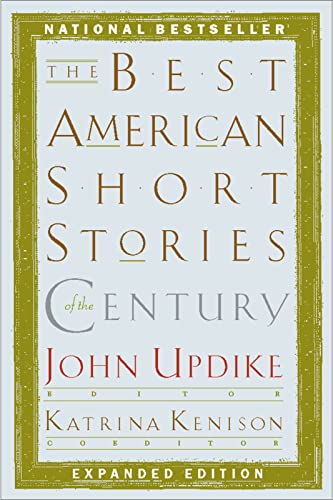

The best American short stories of the century John Updike, editor ; Katrina Kenison, coeditor ; with an introduction by John Updike.
Detalles de publicación: Boston Houghton Mifflin c2000.Edición: Expanded edDescripción: xxiv, 835 p. 23 cmISBN:- 0395843677 (pbk.)
- 0395843685
- PS648.S5 B45 2000
| Imagen de cubierta | Tipo de ítem | Biblioteca actual | Biblioteca de origen | Colección | Ubicación en estantería | Signatura topográfica | Materiales especificados | Info Vol | URL | Copia número | Estado | Notas | Fecha de vencimiento | Código de barras | Reserva de ítems | Prioridad de la cola de reserva de ejemplar | Reservas para cursos | |
|---|---|---|---|---|---|---|---|---|---|---|---|---|---|---|---|---|---|---|
| Libro | Biblioteca Encarnación Valdés Colección General bev | 813 B5611 (Navegar estantería(Abre debajo)) | Disponible | 80000002489501 |
Descripciones mejoradas de Syndetics:
Since the series' inception in 1915, the annual volumes of The Best American Short Stories have launched literary careers, showcased the most compelling stories of each year, and confirmed for all time the significance of the short story in our national literature. Now THE BEST AMERICAN SHORT STORIES OF THE CENTURY brings together the best of the best - fifty-five extraordinary stories that represent a century's worth of unsurpassed accomplishments in this quintessentially American literary genre. Here are the stories that have endured the test of time: masterworks by such writers as Ernest Hemingway, William Faulkner, Willa Cather, F. Scott Fitzgerald, William Saroyan, Flannery O'Connor, John Cheever, Eudora Welty, Philip Roth, Joyce Carol Oates, Raymond Carver, Cynthia Ozick, and scores of others. These are the writers who have shaped and defined the landscape of the American short story, who have unflinchingly explored all aspects of the human condition, and whose works will continue to speak to us as we enter the next century. Their artistry is represented splendidly in these pages. THE BEST AMERICAN SHORT STORIES series has also always been known for making literary discoveries, and discovery proved to be an essential part of selecting the stories for this volume too. Collections from years past yielded a rich harvest of surprises, stories that may have been forgotten but still retain their relevance and luster. The result is a volume that not only gathers some of the most significant stories of our century between two covers but resurrects a handful of lost literary gems as well. Of all the great writers whose work has appeared in the series, only John Updike's contributions have spanned five consecutive decades, from his first appearance, in 1959. Updike worked with coeditor Katrina Kenison to choose stories from each decade that meet his own high standards of literary quality.
Titles selected by John Updike from the 1915 through 1998 editions of The best American short stories series.
Zelig Benjamin Rosenblatt -- Little selves Mary Lerner -- Jury of her peers Susan Glaspell -- Other woman Sherwood Anderson -- Golden honeymoon Ring Lardner -- Blood-burning moon Jean Toomer -- Killers Ernest Hemingway -- Resurrection of a life William Saroyan -- Christmas gift Robert Penn Warren -- Bright and morning star Richard Wright -- Hitch-hikers Eudora Welty -- Peach stone Paul Horgan -- "That in Aleppo once..." Vladimir Nabokov -- Interior castle Jean Stafford -- Miami-New York Martha Gellhorn -- Second tree from the corner E.B. White -- Farmer's children Elizabeth Bishop -- Death of a favorite J.F. Powers -- Resemblance between a violin case and a coffin Tennessee Williams -- Country husband John Cheever -- Greenleaf Flannery O'Connor -- Ledge Lawrence Sargent Hall -- Defender of the faith Philip Roth -- Criers and kibitzers, kibitzers and criers Stanley Elkin -- German refugee Bernard Malamud -- Where are you going, where have you been? Joyce Carol Oates -- Rotifer Mary Ladd Gavell -- Gold Coast James Alan McPherson -- Key Isaac Bashevis Singer -- Cty of churches Donald Barthelme -- How to win Rosellen speaks Harold Brodkey -- Silver dish Saul Bellow -- Gesturing John Updike -- Shawl Cynthia Ozick -- Where I'm calling from Raymond Carver -- Janus Ann Beattie -- Way we live now Susan Sontag -- Things they carried Tim O'Brien -- Meneseteung Alice Munro -- You're ugly, too Lorrie Moore -- I want to live ! Thom Jones -- In the gloaming Alice Elliott Dark -- Proper library Carolyn Ferrell -- Birthmates Gish Jen -- Soon Pam Durban -- Half-skinned steer Annie Proulx.
Tabla de contenidos provista por Syndetics
- Foreword
- Introduction
- Little Selves
- A Jury of Her Peers
- The Other Woman
- The Golden Honeymoon
- Blood-Burning Moon
- The Killers
- Double Birthday
- Coates Theft
- That Evening Sun Go Down
- Here We Are
- Crazy Sunday
- My Dead Brother Comes to America
- Resurrection of a Life
- Christmas Gift
- Warren Bright and Morning Star
- The Hitch-Hikers
- The Peach Stone
- "That in Aleppo Once ..."
- The Interior Castle
- Miami - New York
- The Second Tree from the Corner
- The Farmer's Children
- Death of a Favorite
- The Resemblance Between a Violin Case and a Coffin
- The Country Husband
- Greenleaf
- The Ledge
- Hall Defender of the Faith
- Criers and Kibitzers, Kibitzers and Criers
- The German Refugee
- Where Are You Going, Where Have You Been?
- The Rotifer
- Gold Coast
- The Key
- A City of Churches
- How to Win
- Rhododendron
- Verona: A Young Woman Speaks
- A Silver Dish
- Gesturing
- The Shawl
- Where I'm Calling
- The Way We Live Now
- The Things They Carried
- Meneseteung
- You're Ugly, Too
- I Want to Live!
- In the Gloaming
- Proper Library
- Birthmates
- Soon
- The Half-Skinned Steer
- Biographical
- Notes
Reseñas proporcionadas por Syndetics
Library Journal Review
The only author to be included in Best American Short Stories in every decade since the 1950s, John Updike was chosen to select those stories best representing the American century since the series inception in 1915. Being limited to those originally chosen for the annual volumes, Updike admits that past editors may have overlooked some gems. But he makes a valiant effort to include all the masters of the form, from Faulkner, Hemingway, and Fitzgerald, through Cheever, OConnor, and Malamud, to Carver and Munro. Though one might question whether an individual choice is really one of the best of the century, as a whole the collection presents a microcosm of 20th-century American life: the immigrant experience (many of the early stories), the Roaring Twenties (Fitzgerald), World War II (Roth) and the Holocaust (Malamud and Ozick), 1950s suburban values (Cheever) and their rejection by 1960s youth culture (Oates), Vietnam (OBrien), and AIDS (Sontag and Dark). Many of the stories are famous and easily found elsewhere, but there are some rare surprises like a semi-autobiographical piece by Tennessee Williams. Recommended for most public libraries, and for those academic libraries that no longer hold all the annual volumes. [Previewed in Prepub Alert, LJ 12/98.]Christine DeZelar-Tiedman, Univ. of Idaho Lib., Moscow (c) Copyright 2010. Library Journals LLC, a wholly owned subsidiary of Media Source, Inc. No redistribution permitted.Publishers Weekly Review
Updike narrowed down his collection of short stories from 55 to 21 to present this rich, warm voicing of some of the best writing of the 20th century. Whenever possible, it seems, Updike has enlisted living writers to read their own works. It's a pleasure to hear Updike soothe his way through his own "Gesturing" and Gish Jen whir her "Birthmates." Others contributor/readers include Thom Jones, Cynthia Ozick, Lorrie Moore and Tim O'Brien. For writers such as Dorothy Parker, Robert Penn Warren and Raymond Carver, Updike has cleverly paired appropriate readers. He lends his own voice to Sherwood Anderson's "The Other Woman," George Plimpton deftly breathes F. Scott Fitzgerald's "Crazy Sunday" and Jill McCorckle's sharp twang lends a wry rhythm to Eudora Welty's "The Hitchhikers." Each story, sometimes snug with a second, fits neatly on one side of a cassette. Brief interludes of music, when the readers introduce themselves, the stories and the places of original publication, thankfully fade away, leaving the listener with crisp, fresh recordings of these excellent tales. Based on the Houghton Mifflin paperback. (Apr.) (c) Copyright PWxyz, LLC. All rights reservedBooklist Review
"Best" is, of course, a subjective labeling, but this anthology certainly brims with significance. The estimable Best American Short Stories series has been going on nearly as long the century, and from each year of its existence series editor Kenison and guest editor Updike have culled a monumental assemblage of superior short story writing. And what would a century's end gathering be without Sherwood Anderson, Ernest Hemingway, Katherine Anne Porter, Eudora Welty, John Cheever, Flannery O'Connor, and Raymond Carver? But wonderful writers too much forgotten by today's reader will ignite interest in their work, or so it is hoped; those writers include William Saroyan, Jean Stafford, J. F. Powers, and Martha Gellhorn. An anthology all fiction collections should be blessed with. --Brad HooperNotas de autor provistas por Syndetics
American novelist, poet, and critic John Updike was born in Reading, Pennsylvania on March 18, 1932. He received an A.B. degree from Harvard University, which he attended on a scholarship, in 1954. After graduation, he accepted a one-year fellowship to study painting at the Ruskin School of Drawing and Fine Art in Oxford, England. After returning from England in 1955, he worked for two years on the staff of The New Yorker. This marked the beginning of a long relationship with the magazine, during which he has contributed numerous short stories, poems, and book reviews.Although Updike's first published book was a collection of verse, The Carpentered Hen and Other Tame Creatures (1958), his renown as a writer is based on his fiction, beginning with The Poorhouse Fair (1959). During his lifetime, he wrote more than 50 books and primarily focused on middle-class America and their major concerns---marriage, divorce, religion, materialism, and sex. Among his best-known works are the Rabbit tetrology---Rabbit, Run (1960), Rabbit Redux (1971), Rabbit Is Rich (1981), and Rabbit at Rest (1988). Rabbit, Run introduces Harry "Rabbit" Angstrom as a 26-year-old salesman of dime-store gadgets trapped in an unhappy marriage in a dismal Pennsylvania town, looking back wistfully on his days as a high school basketball star. Rabbit Redux takes up the story 10 years later, and Rabbit's relationship with representative figures of the 1960s enables Updike to provide social commentary in a story marked by mellow wisdom and compassion in spite of some shocking jolts. In Rabbit Is Rich, Harry is comfortably middle-aged and complacent, and much of the book seems to satirize the country-club set and the swinging sexual/social life of Rabbit and his friends. Finally, in Rabbit at Rest, Harry arrives at the age where he must confront his mortality. Updike won the Pulitzer Prize for both Rabbit Is Rich and Rabbit at Rest.
Updike's other novels range widely in subject and locale, from The Poorhouse Fair, about a home for the aged that seems to be a microcosm for society as a whole, through The Court (1978), about a revolution in Africa, to The Witches of Eastwick (1984), in which Updike tries to write from inside the sensibilities of three witches in contemporary New England. The Centaur (1963) is a subtle, complicated allegorical novel that won Updike the National Book Award in 1964. In addition to his novels, Updike also has written short stories, poems, critical essays, and reviews. Self-Consciousness (1989) is a memoir of his early life, his thoughts on issues such as the Vietnam War, and his attitude toward religion. He was elected to the American Academy of Arts and Letters in 1977. He died of lung cancer on January 27, 2009 at the age of 76.
(Bowker Author Biography)